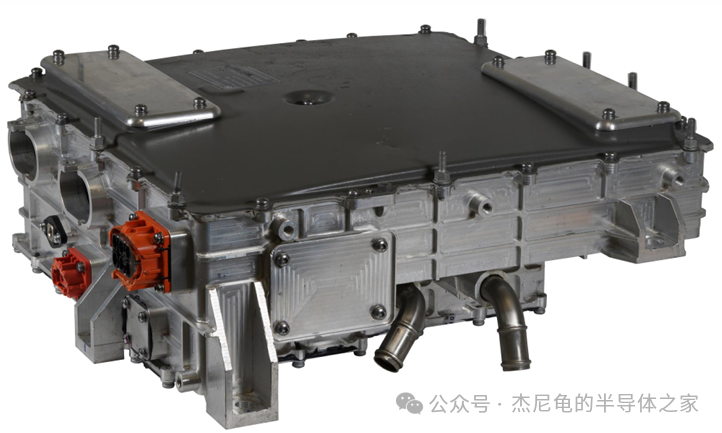
What is the most expensive and core component of an electric vehicle? It is not the battery pack or the intelligent driving domain, but the electric drive controller that converts battery energy into wheel torque. BYD’s 2023 mass-produced ‘eight-in-one’ power domain controller (P/N: KTZ55X55S-A) integrates eight major functions: inversion, power distribution, charging, DC-DC, current sampling, high-voltage power distribution, EMC filtering, and thermal management into a single aluminum shell, measuring only 460×390×151 mm and weighing 24 kg, with a peak power of 235 kW and a peak current of 550 A. We used X-ray, slicing, SEM, and BOM full-scale disassembly to reveal all its technical secrets under the microscope for the first time—after reading this article, you will understand how BYD integrates SiC, magnetic components, bus capacitors, and sampling chips into a ‘Lego-style’ solution, and why this approach can save over 30% of the electric drive costs for vehicle manufacturers.
1. System Architecture: Understanding How the ‘Eight-in-One’ is Assembled in One Diagram
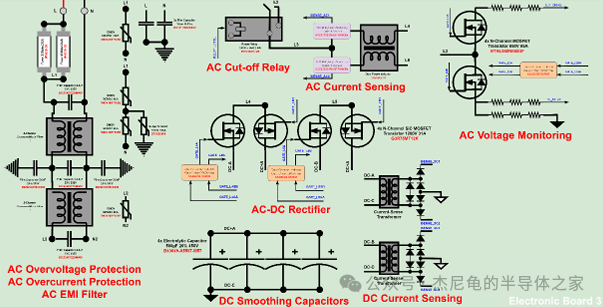
1. Power Flow
Battery 750 Vdc → DC-Link film capacitor (480 µF + 100 µF / 700 V) → 1200 V / 500 A SiC power module (BM840F12B34U2) → Three-phase inverter → Motor
(1)Synchronous rectification + bidirectional OBC: AC 220 V ↔ HVDC ↔ Battery
(2)Two-stage DC-DC: HVDC ↔ 14 V / 48 V low-voltage bus
2. Signal Flow
Main control: TI TMS320F28379D 200 MHz dual-core MCU (1 MB Flash, 337-BGA)
Auxiliary control: 3 TI C2000 + 1 Lattice CPLD for timing management
Current sampling: Allegro 400 kHz Hall SoC + Melexis 250 kHz Hall chip
Communication: NXP high-speed CAN ×3 + LIN ×1, isolation chip TI ISO7742 (5 kVrms)
In summary: Power, sampling, control, and communication are all closed-loop within the shell, with only four external interfaces remaining: high-voltage DC, three-phase AC, low-voltage 12 V / 48 V, and CAN / LIN.
2. The Most Expensive Board: Electronic Board 3
(1)6-layer FR4, 275×210 mm, 2 mm thick, 70 µm inner copper, ENIG, $10.96 / piece
(2)12 Genesic 1200 V / 31 A SiC MOSFETs (G3R75MT12K, TO-247, $3.79 / piece) + 6 ON 650 V / 65 A Si MOSFETs, forming a ‘SiC + IGBT’ hybrid full bridge, balancing cost and high-speed performance
(3)4 TDK 450 V / 580 µF aluminum electrolytic capacitors (30×52 mm, $2.28 / piece) + 3 FARATRONIC 1100 V / 2 µF film capacitors, supporting 800 V fast charging surges
(4)Magnetic integration: 2 Sumida 2.2 µH flat wire inductors + 3 planar transformers, peak efficiency > 98.5 %
(5)Sampling link: Allegro ACS37002 (400 kHz, 0.5 % accuracy) + TI INA240 (80 V common mode, bidirectional), for ‘zero-drift’ sampling of battery, motor, and OBC in three channels
Conclusion: Board 3 = power semiconductors + bus capacitors + magnetic components ‘trinity’, accounting for 13.4 % of the total material cost of the system, but bearing > 95 % of the power loss, with a heat dissipation base directly cooled by water, junction-water thermal resistance < 0.15 K/W.
3. Disassembly of the SiC Power Module: BM840F12B34U2
(1)Package: 155×125×17 mm, 680 g, aluminum substrate directly water-cooled
(2)Chip: 24 1200 V SiC MOSFETs (6 in parallel × 4 bridge arms) + 12 SiC SBDs, each chip 9.3×9.3 mm, silver sintering + aluminum wire bonding
(3)Thermal design: Ceramic substrate (Al₂O₃) + 0.3 mm copper layer, Rth(j-c) = 0.08 K/W
(4)Electrical: DC bus copper busbar thickness 4 mm, loop inductance < 5 nH, turn-off overvoltage < 100 V (@500 A)
Module conduction losses reduced by 40 %, switching losses reduced by 65 %, achieving 1.8 % higher efficiency than silicon solutions of the same power, directly increasing NEDC range by +12 km.
4. Mechanical ‘Skeleton’: How to Compress 24 kg into 24 L
(1)Shell: AlSi9Cu3 (ADC12) die-casting → CNC precision machining → friction stir welding, total cost $138.6 (1 M batch)
(2)Die-cast blank 9.15 kg, machined to 7.4 kg, wall thickness 3-11 mm, meeting IP67 + 10 g vibration
(3)Cooling: Two parallel water channels, fin thickness 1.2 mm, water-side heat transfer coefficient > 8000 W/(m²·K), power module temperature difference < 8 ℃
(4)Busbar: 8 pieces of 2-6 mm thick tinned copper busbars, integrally bent + laser welded, loop inductance < 15 nH, capable of withstanding 350 kHz switching spikes
(5)Electromagnetic: Dual-stage common-mode filtering (99×49×51 mm, 158 g, 51 µH), OBC frequency band 150 kHz-30 MHz, EMC margin > 6 dB
5. The Truth About Costs: Where Every Dollar of $1265 is Spent
|
Item |
Amount/$ |
Percentage |
Remarks |
|
Power Semiconductors |
361.2 |
37 % |
SiC MOSFET + Si MOSFET + SBD |
|
Magnetic / Capacitors |
197.1 |
20 % |
Film DC-Link + electrolytic + planar transformers |
|
Mechanical Parts |
271.1 |
28 % |
Aluminum shell + copper busbars + connectors + heat dissipation |
|
PCB + SMT |
26.0 |
2.7 % |
11 boards, $26 / set |
|
Others |
113.0 |
11.6 % |
Relays, wiring harnesses, sensors, adhesives |
|
Manufacturing Costs |
23.9 |
2.4 % |
SMT + testing + assembly, $23.87 / set |
|
Profit + Expenses |
273.2 |
21.6 % |
According to BYD’s 2022 financial report: R&D 2.4 %, G&A 5.4 %, net profit 9.2 % |
Conclusion: At a 1 M batch size, the factory price of the entire controller is $1265, reducing costs by over 30% compared to traditional ‘three-in-one’ + OBC + DC-DC split solutions, with a weight reduction of 15 kg and a volume reduction of 40%.
6. Final Thoughts
BYD has created a pluggable ‘power brick’ by integrating power semiconductors, magnetic components, bus capacitors, and mechanical heat dissipation using SiC modules, single-sided water cooling, stacked busbars, and magnetic integration, effectively addressing the three major challenges of high voltage, high frequency, and high power density. This eight-in-one solution is not just a simple integration; it encapsulates electric drive, power supply, distribution, sampling, communication, and thermal management into a ‘black box’, allowing vehicle manufacturers to simply connect high-voltage DC, three-phase lines, and CAN to get the motor running—truly ‘plug and play’.
Next time you see a Seal, Han EV, or Tengshi N7 glide silently past you, remember that beneath it lies this 24 kg ‘little black box’, which holds the secrets to extending range by +12 km and accelerating from 0-100 km/h 0.5 seconds faster.
Related reports are available on my knowledge platform, where we update semiconductor industry information, relevant supply chain data, technical disassembly reports, and market analysis reports daily. Everyone is welcome to join!