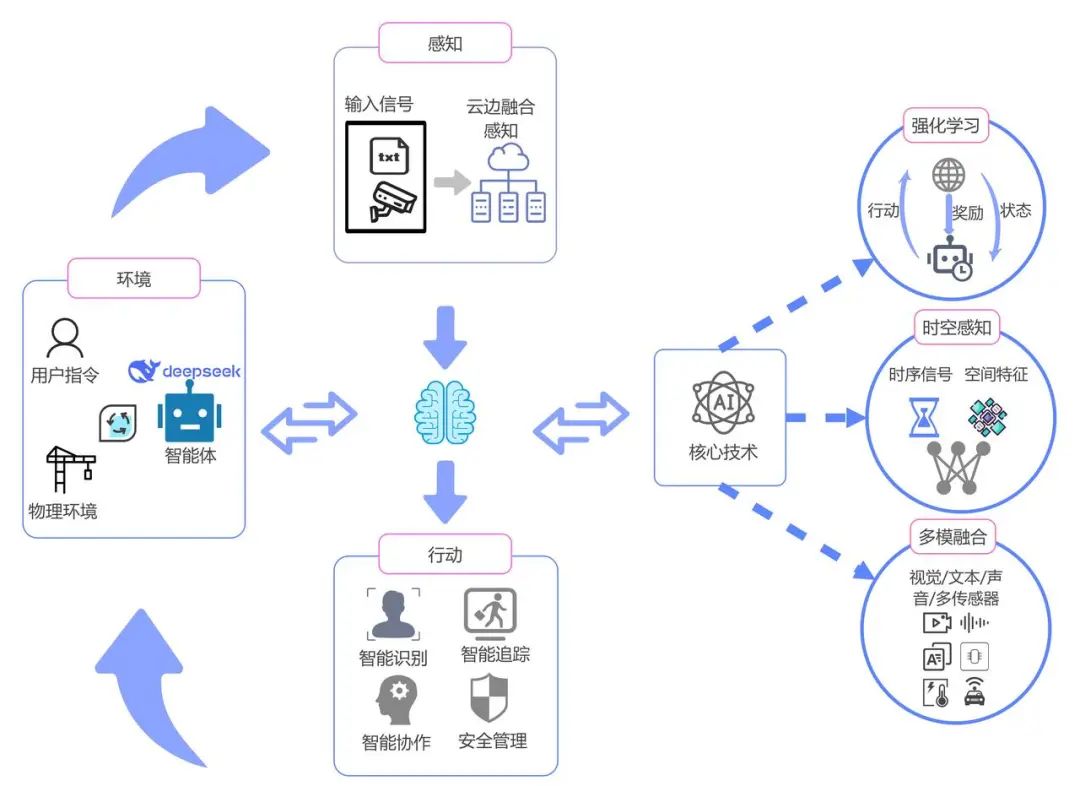
In the wave of digital transformation in the construction industry, cognitive technology plays a core role. Traditional computer vision technologies can identify various equipment and physical environments on construction sites, but their limitation lies in the lack of proactive perception and decision-making capabilities. To address this, Xianyuan Technology has proposed the Agentic Multi-modal Cognition (AMC) technology based on a fusion of the Deep Thinking Model (DeepSeek R1) and multi-modal models. The emergence of AMC technology is expected to fundamentally change this situation. By combining advanced reinforcement learning frameworks, spatial-temporal perception networks, and edge computing technologies, AMC empowers agents on construction sites with the ability to actively perceive their environment, make decisions, and collaborate. This not only enhances the efficiency and safety of construction operations but also lays the foundation for the full intelligence of the construction industry.
01
Technical Principles:
Empowering Agents with Cognitive Abilities
“
Reinforcement Learning Framework:
Enabling Proactive Decision-Making Capabilities for Agents
In AMC technology, reinforcement learning (RL) serves as the core algorithmic framework. Agents integrated into construction scenarios continuously learn and optimize decision-making strategies through interaction with their environment. For instance, a construction machine equipped with an agent can automatically adjust its working path and speed based on real-time data from the surrounding environment (such as construction progress, weather conditions, and safety hazards), thus achieving efficient and safe operations.
The key to reinforcement learning lies in its dynamic decision-making mechanism. Through reward and penalty mechanisms, agents gradually optimize their behavior strategies. For example:
If a machine avoids potential collision risks with workers, it will receive a positive reward.
✦
If it causes construction delays during movement, it will be penalized.
This autonomous learning mechanism enables each agent on the construction site to adapt to complex construction environments and make proactive decisions.
“
Spatial-Temporal Perception Network:
Understanding Dynamic Changes in the Environment
Another key aspect of AMC technology is the Spatial-Temporal Perception Network (STPN). Unlike traditional object detection technologies that focus only on single-frame images, STPN models the relationships of objects across time and space, allowing for a deeper understanding of the dynamic changes in construction site environments.
Spatial Perception: Through multi-target tracking algorithms, the system can real-time locate people, machines, and construction materials on the construction site and predict their movement trajectories.
✦
Temporal Perception: Through sequential learning models, the system can analyze time series data during the construction process to predict potential safety hazards or construction delays.
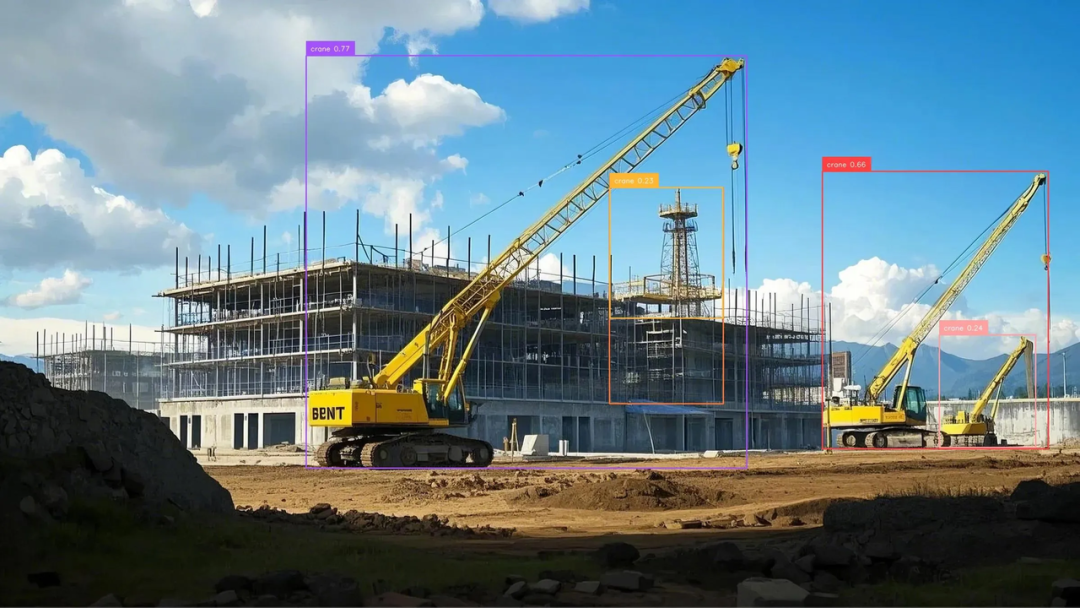
For example, when a collision risk between cranes is detected, the system will automatically trigger an alarm and stop crane operations; when it detects that certain work areas are idle, it will proactively remind production managers and relevant personnel to enhance resource utilization efficiency.
“
Edge Computing and Multi-Modal Data Fusion
The implementation of AMC technology relies on support from edge computing and multi-modal data fusion.
Edge Computing: By deploying edge computing nodes on construction sites, the system can real-time process data from various devices such as cameras, sensors, and RFID, ensuring real-time perception and low latency.
✦
Multi-Modal Data Fusion: The system integrates various perception data such as visual, infrared, and distance data, enhancing the robustness of environmental perception. For instance, during foggy or nighttime operations, the system can still accurately identify objects on the construction site.
These technologies have immense potential for on-site safety hazard detection and progress status perception.
02
Technology Implementation:
Driving Intelligent Collaboration in Construction
“
Intelligent Object Recognition and Tracking
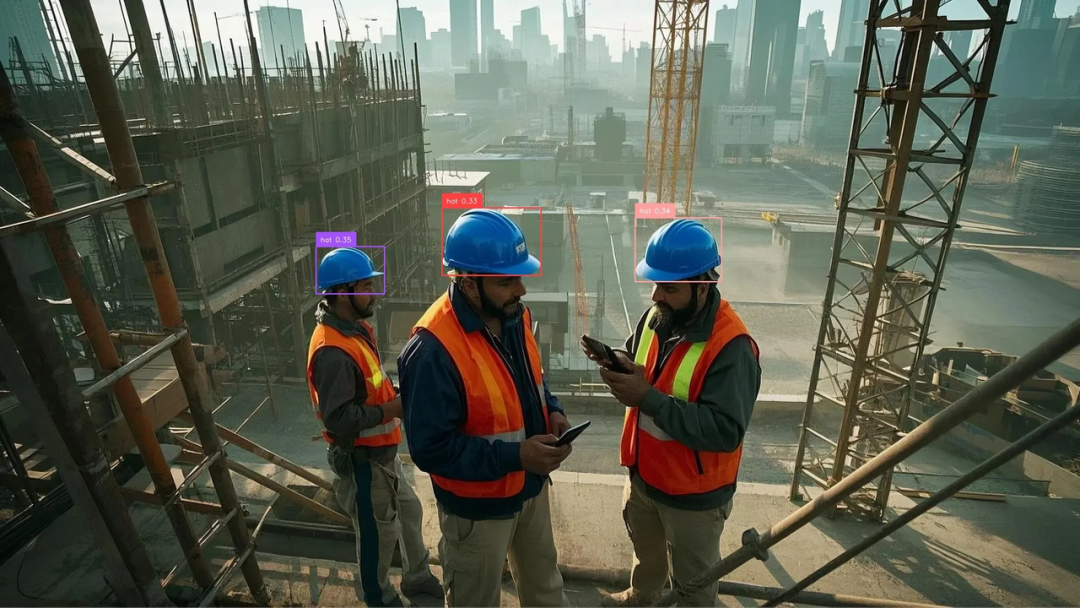
In traditional construction management, the identification and tracking of construction materials and equipment often rely on manual recording or QR code scanning, which is not only inefficient but also prone to errors. Through AMC technology, the system can automatically recognize and track various elements on the construction site, including:
Construction Materials: Such as rebar, concrete, pipes, etc., the system can automatically recognize and count their quantities.
✦
Construction Equipment: Such as cranes, excavators, forklifts, etc., the system can real-time track their locations and operational status.
✦
Construction Personnel: The system can identify the locations of construction personnel, ensuring they work within safe zones.
This intelligent management method not only enhances construction efficiency but also significantly reduces human error, equivalent to deploying a sentinel that supervises all elements at the project site, making on-site management more organized.
“
Dynamic Safety Management
Construction sites are high-risk areas, and traditional safety management often relies on manual inspections, making it difficult to achieve all-weather, all-around monitoring. AMC technology can automatically identify potential safety hazards through real-time environmental perception:
Collision Risk Warning: When the distance between two machines or between a person and a machine falls below a safety threshold, the system will automatically issue a warning.
✦
Personnel Safety Monitoring: When construction personnel enter hazardous areas (such as heights or machinery operation zones), the system will immediately trigger an alarm.
✦
Environmental Anomaly Detection: If loose soil or abnormal vibrations are detected in the construction area, the system will issue an early warning.
Through dynamic safety management, AMC technology can reduce the accident rate by over 50%, providing comprehensive safety assurance for contractors and construction companies.
“
Intelligent Collaboration and Automation
The ultimate goal of AMC technology is to achieve fully intelligent collaboration on construction sites. Through proactive perception and decision-making capabilities, the system can automatically optimize construction processes:
Equipment Collaboration: Construction equipment can automatically adjust their working pace based on construction progress and environmental changes.
✦
Resource Scheduling: The system can real-time schedule construction equipment and human resources based on construction needs, reducing resource waste.
✦
Anomaly Handling: When construction delays are predicted, the system will automatically propose adjustment plans.
With efficient collaboration, the construction period can be shortened by 15%-20%, resource utilization can be improved by 30%, and labor costs can be reduced by over 30%.
03
Future Prospects:
Accelerating the Intelligent Revolution in the Construction Industry
The future application of AMC technology is not limited to perception and collaboration on construction sites; it also provides a technological foundation for the comprehensive intelligent transformation of the construction industry:
Deep Integration with BIM (Building Information Modeling): By combining AMC technology with BIM systems, construction parties can achieve intelligent management throughout the entire process from design to construction to operation and maintenance.
✦
Intelligent Building Lifecycle Management: AMC technology can track the usage status of building materials throughout their entire lifecycle, providing data support for building maintenance and renovation.
✦
Realization of Green Construction: By optimizing construction resources and reducing waste, AMC technology can help construction enterprises achieve green construction and carbon neutrality goals.
Conclusion
Driven by Technology, a Promising Future
AMC technology is an important milestone for the construction industry towards intelligence. Through the proactive perception and decision-making capabilities of agents, AMC technology not only enhances construction efficiency and safety but also lays the foundation for the comprehensive digital transformation of the construction industry. At the same time, AMC technology also has broader application prospects, such as supply chain management, smart agriculture, and smart transportation, which involve complex perception and decision-making scenarios.
In this intelligent revolution, Xianyuan Technology is driving the landing of more innovative technologies, injecting infinite possibilities for the transformation and upgrading of various industries.
AMC OpenAPI service is being updated, welcome to follow and inquire.
Recommended Reading