

Click the blue text above to follow us

📋📋📋 The content of this article is as follows: 🎁🎁🎁
Table of Contents
💥1 Overview
📚2 Results
🎉3 References
🌈4 Matlab Code, Data, Documentation



1 Overview

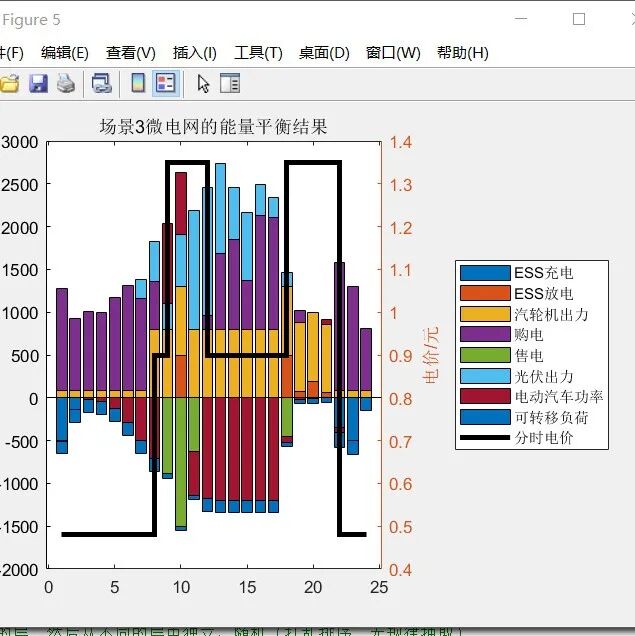
This code proposes a novel method for the two-stage robust optimization scheduling problem of microgrids. Uniquely, it does not adopt the commonly used CC&G algorithm but instead employs an innovative technique—key scenario identification. This technique can accurately pinpoint the most adverse scenarios through several iterations. In addressing the uncertainties and intermittencies of photovoltaic (PV) generation, this code effectively utilizes dynamic robust optimization techniques. We constructed a two-stage robust optimization scheduling model for microgrids that considers electricity price fluctuations and uncertainties in PV generation. By employing adverse scenario identification techniques, we decompose the challenges into a main problem and subproblems, using an iterative strategy for resolution. The subproblem is responsible for accurately locating extremely adverse PV generation scenarios, while the main problem focuses on solving a single-layer optimization model for this specific scenario, significantly reducing the total number of scenarios to consider and effectively improving the computational efficiency of the model. This research not only demonstrates the importance of innovative thinking but also brings new solutions to the field of microgrid optimization scheduling.
The two-stage robust optimization method based on key scenario identification effectively balances the economy and robustness of microgrid operation through precise screening of high-risk scenarios and a phased decision-making mechanism. Its advantages in reducing computational complexity and improving scheduling efficiency provide a reliable solution for microgrid optimization under high proportions of renewable energy integration. Future research should further explore the construction of dynamic scenario libraries and multi-objective collaborative optimization to promote the application of this method in complex energy systems.
The two-stage robust optimization method based on key scenario identification effectively balances the economy and robustness of microgrid operation through precise screening of high-risk scenarios and a phased decision-making mechanism. Its advantages in reducing computational complexity and improving scheduling efficiency provide a reliable solution for microgrid optimization under high proportions of renewable energy integration. Future research should further explore the construction of dynamic scenario libraries and multi-objective collaborative optimization to promote the application of this method in complex energy systems.
 References:

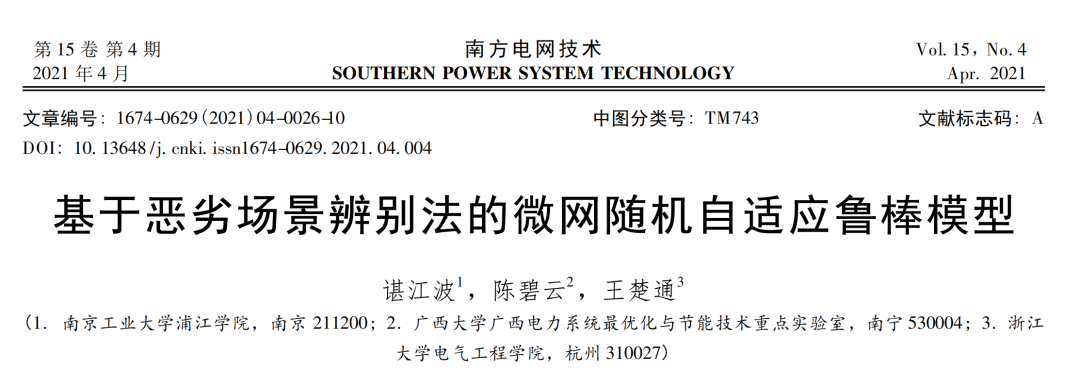
Research on Two-Stage Robust Microgrid Optimization Scheduling Based on Key Scenario Identification Algorithm
This code proposes a novel method for the two-stage robust optimization scheduling problem of microgrids. Uniquely, it does not adopt the commonly used CC&G algorithm but instead employs an innovative technique—key scenario identification. This technique can accurately pinpoint the most adverse scenarios through several iterations. In addressing the uncertainties and intermittencies of photovoltaic (PV) generation, this code effectively utilizes dynamic robust optimization techniques. We constructed a two-stage robust optimization scheduling model for microgrids that considers electricity price fluctuations and uncertainties in PV generation. By employing adverse scenario identification techniques, we decompose the challenges into a main problem and subproblems, using an iterative strategy for resolution. The subproblem is responsible for accurately locating extremely adverse PV generation scenarios, while the main problem focuses on solving a single-layer optimization model for this specific scenario, significantly reducing the total number of scenarios to consider and effectively improving the computational efficiency of the model. This research not only demonstrates the importance of innovative thinking but also brings new solutions to the field of microgrid optimization scheduling.
1. Research Background and Significance
As the global energy transition accelerates, microgrids play a crucial role in enhancing energy efficiency and promoting the consumption of renewable energy. However, the intermittency and volatility of wind and solar power generation, along with the uncertainty of load demand, make traditional deterministic optimization scheduling methods difficult to adapt to complex operating environments. Stochastic optimization relies on probability distribution information, leading to high computational complexity; while robust optimization can handle uncertainty, considering all scenarios can lead to excessive conservatism. The introduction of the key scenario identification algorithm, which precisely screens key scenarios that significantly impact microgrid operation, combined with a two-stage robust optimization model, provides a new direction for resolving the conflict between economy and robustness.
2. Two-Stage Robust Microgrid Optimization Scheduling Model
-
First Stage (Deterministic Decision) The goal is to minimize the basic operating costs (generation costs, energy storage charging and discharging costs, etc.), determining the generation plan for distributed energy sources, energy storage charging and discharging plans, and other basic scheduling schemes, while satisfying power balance and equipment capacity constraints. This stage does not consider the specific implementation of uncertainty, forming an initial scheduling framework.
-
Second Stage (Robustness Adjustment) Dynamic adjustments are made for key scenarios, with decision variables including adjustments to distributed energy source power, additional energy storage charging and discharging amounts, etc. The goal is to minimize adjustment costs and penalty costs (such as outage losses), while satisfying voltage, line capacity, and other constraints under key scenarios. Through two-stage collaboration, a balance of “basic economy + extreme robustness” is achieved.
3. Sources of Microgrid Uncertainty and Modeling Methods
-
Sources of Uncertainty
- Renewable Energy: Wind and solar output are significantly affected by weather.
- Load Demand: User electricity consumption behavior fluctuates.
- Equipment Status and Market Factors: Energy storage efficiency degradation, electricity price fluctuations, etc.
Modeling Methods
- Robust Uncertainty Set: Describes the uncertainty boundary using intervals or nonlinear sets, suitable for conservative control.
- Key Scenario Screening: Evaluates scenario impacts through changes in the objective function, screening scenarios with differences exceeding a threshold.
- Dynamic Adjustment Parameters: Introduces a conservatism adjustment coefficient to flexibly balance economy and robustness.
4. Principles and Implementation of Key Scenario Identification Algorithm
-
Algorithm Definition Screens scenarios based on their impact on operational objectives (such as cost, reliability), identifying the most adverse “worst-case scenarios” (e.g., minimum solar output, peak load overlap, etc.).
-
Implementation Process
- Step 1: Generate an initial scenario set (e.g., through historical data clustering or Monte Carlo simulation).
- Step 2: Calculate the objective function differences between each scenario and the baseline scenario (e.g., cost deviation rate).
- Step 3: Set a threshold (e.g., 20%) to screen key scenarios with significant differences.
- Step 4: Iteratively solve the main problem (basic scheduling) and subproblem (scenario identification), dynamically updating the key scenario set.
Technical Advantages
- Computational Efficiency: Traditional CCG algorithms require multiple iterations over all scenarios, while the key scenario method only requires a few iterations (e.g., 3-5), reducing computational load by over 50%.
- Robustness Assurance: Focuses on extreme scenarios, avoiding scheduling failures due to neglecting high-risk scenarios.
5. Two-Stage Model Construction Method
-
Model Decomposition: Uses column and constraint generation (C&CG) algorithms to decompose the original problem into a main problem (determine basic scheduling) and subproblem (identify worst-case scenarios), solving alternately. For example:

Conservative Control: Introduces uncertainty adjustment parameters (e.g., Γ) to limit the deviation range of wind and solar output, avoiding excessive conservatism. For example:

-
Solution Tools: Commonly used MATLAB+CPLEX or Gurobi to implement model solving, combining strong duality theory to convert bi-level optimization into a single-level problem.
6. Comparison of Actual Application Effects
-
Case Study: A photovoltaic microgrid adopting this method reduced operating costs by 12%-18%, and power supply reliability improved to 99.2%. Compared to traditional robust optimization, computation time was reduced from 120 minutes to 45 minutes.
-
Performance Indicators
- Economy: Unit electricity cost reduced by 0.05 yuan/kWh.
- Robustness: Power shortfall under extreme scenarios reduced by 60%.
- Computational Efficiency: Iteration count reduced from 15 to 4.
7. Future Research Directions
- Multi-Uncertainty Coupling Modeling: Simultaneously consider multiple sources of uncertainty such as wind, solar, and electricity prices.
- Dynamic Threshold Adjustment: Adaptively optimize scenario screening thresholds based on real-time data.
- Integration of Artificial Intelligence: Combine deep learning to predict key scenarios and enhance predictive capabilities.
8. Conclusion
The two-stage robust optimization method based on key scenario identification effectively balances the economy and robustness of microgrid operation through precise screening of high-risk scenarios and a phased decision-making mechanism. Its advantages in reducing computational complexity and improving scheduling efficiency provide a reliable solution for microgrid optimization under high proportions of renewable energy integration. Future research should further explore the construction of dynamic scenario libraries and multi-objective collaborative optimization to promote the application of this method in complex energy systems.


2 Results
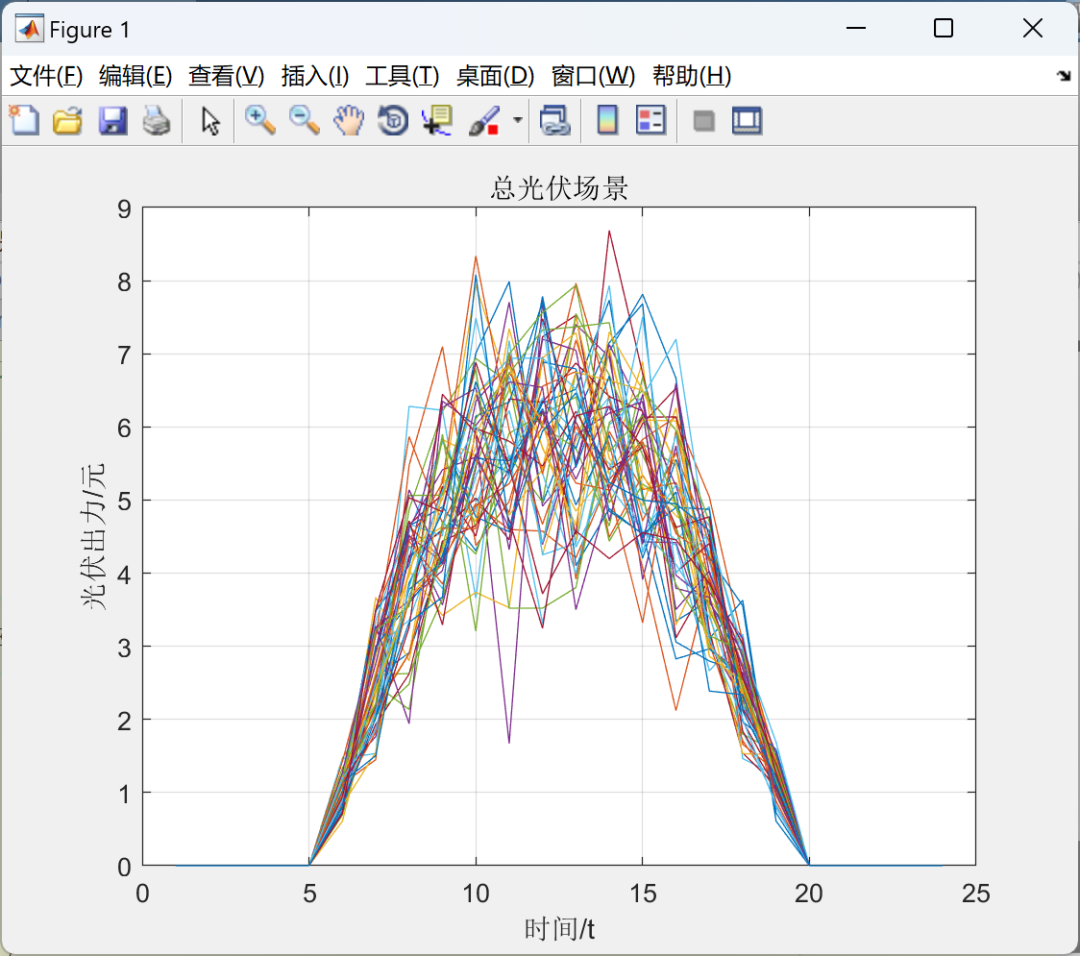
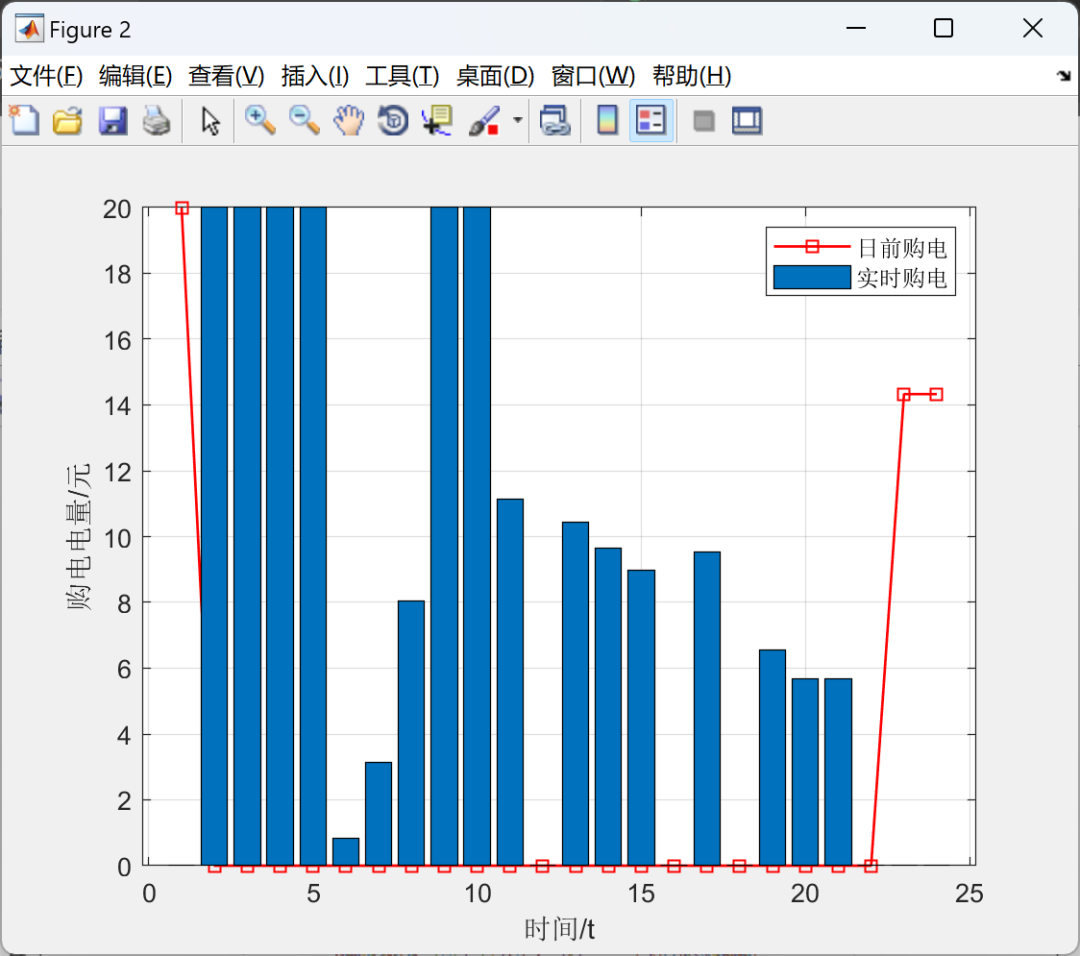
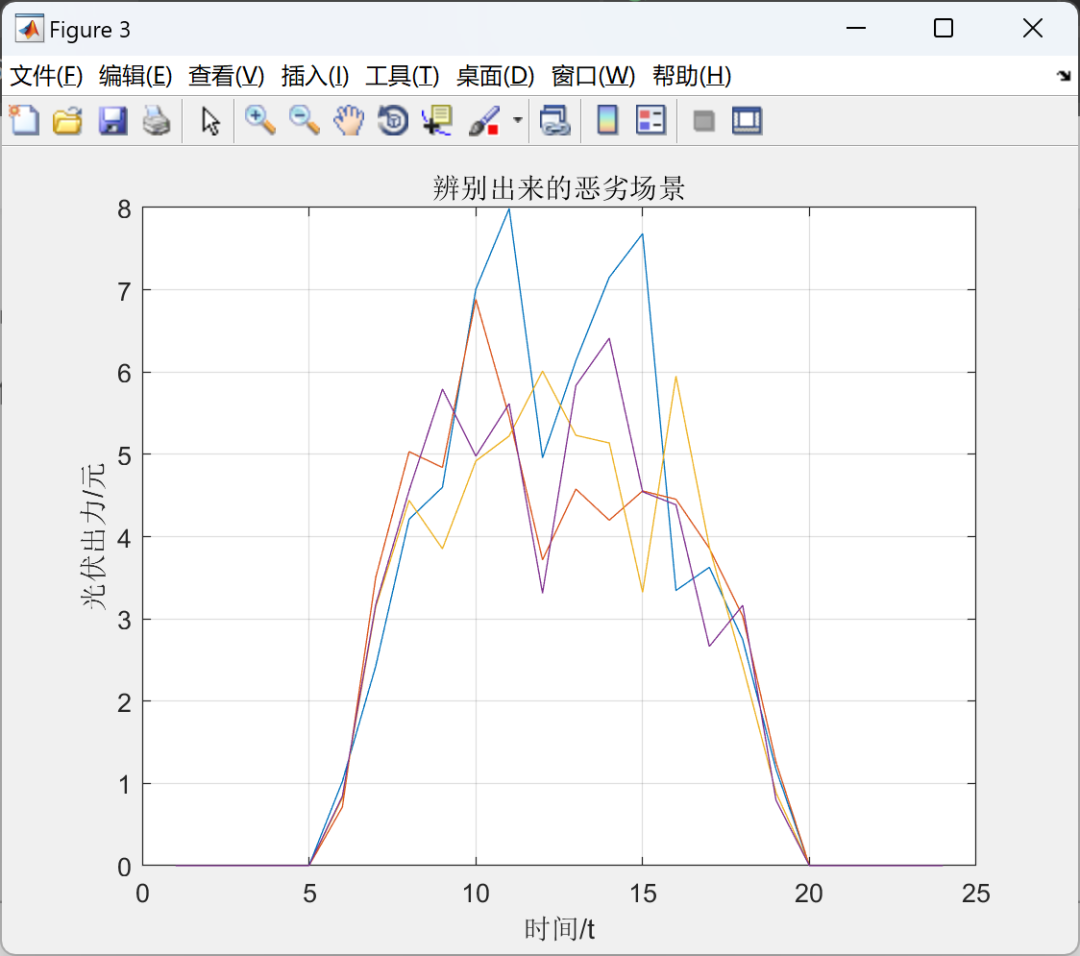
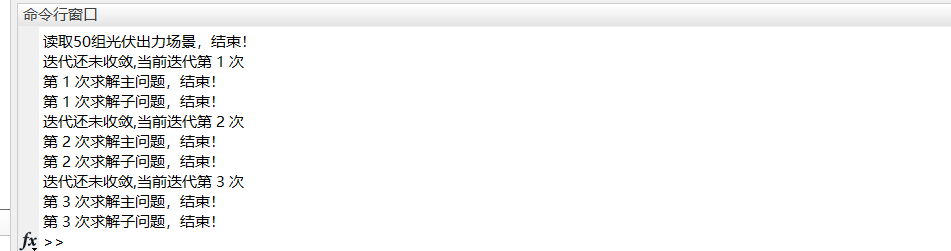
% Import 50 photovoltaic scenario data
Spv=xlsread('光伏数据','测试50场景4迭代','A1:AX24');
disp('Read 50 sets of photovoltaic output scenarios, finished!');
figure
plot(Spv)
grid
xlabel('Time/t');
ylabel('Photovoltaic Output/Yuan');
title('Total Photovoltaic Scenarios')
%% Define key scenario set
j=[1];
P_MP=1;% Define initial value
P_SP=0;% Define initial value
k=0;% Define iteration count
% Set program main loop
while(P_MP>P_SP)
display(['Iteration has not converged, current iteration number ', num2str(k+1),' times']);
P_RES=Spv(:,j)';
kk=length(j);
Obj_MP=zeros(kk,24);
P_MP=zeros(1,1);
P_DA=zeros(kk,24);
S_DA=zeros(kk,24);
u_GT=zeros(kk,24);
u_GTon=zeros(kk,24);
u_GToff=zeros(kk,24);
[Obj_MP,P_MP,P_DA,S_DA,u_GT,u_GTon,u_GToff]=Fun_MP(j,P_RES);
display(['Iteration ', num2str(k+1),' finished solving the main problem!']);
P_MP=value(P_MP);
P_DA_SP=value(P_DA);
S_DA_SP=value(S_DA);
u_GT_SP=value(u_GT);
u_GTon_SP =value(u_GTon);
u_GToff_SP =value(u_GToff);
P_SP_b=[];% Define temporary matrix
%%%%%%%%%% Solve subproblem for each photovoltaic scenario's P_SP%%%%%%%%%%
% Filter out photovoltaic scenarios from the main problem
j_SP=[];
for i=1:50 % Modify according to the number of scenarios, change to 1000 for 1000 scenarios
if ismember(i,j)~=1
j_SP=[j_SP,i];
end
end
% Define subproblem photovoltaic index
P_RES_SP=Spv(:,j_SP)';
[Obj_SP,Obj_SP_scene]=Fun_SP(j_SP,P_RES_SP,P_DA_SP,S_DA_SP,u_GT_SP,u_GTon_SP,u_GToff_SP);
display(['Iteration ', num2str(k+1),' finished solving the subproblem!']);
Obj_SP=value(Obj_SP);
Obj_SP_scene=value(Obj_SP_scene);
P_SP_b=Obj_SP_scene(1,:);
P_SP=min(P_SP_b);% Find the maximum value in P_SP_b matrix
% Find the scenario corresponding to the maximum value P_SP
j_b=find(P_SP_b==P_SP);
j1=sort(j);% Sort the scenarios in the main problem
for ii=1:length(j1)
j1(ii)=j1(ii)-ii;
end
m=0;
for ii=1:length(j1)
if j_b>j1(ii)
m=m+1;
end
end
j=[j,j_b+m];% Add the scenario corresponding to the maximum value P_SP
k=k+1;
end

3References
Some content in this article is sourced from the internet, and references will be noted or cited. If there are any inaccuracies, please feel free to contact us for removal.



4 Matlab Code, Data, Documentation
Lychee Research Society



MATLAB|Global Sensitivity Analysis|Variance-Based Sensitivity Index|Uncertainty Analysis|A Simple and Efficient Method for Global Sensitivity Analysis Based on Cumulative Distribution Function
2024-03-30
MATLAB|Unscented Kalman Filter|Uncertainty and Indirect Measurement Nonlinear Dynamic System Identification Research
2024-03-28
MATLAB|Multimodal Transport|Solving Uncertain Multimodal Transport Path Optimization Problem Based on AFO Algorithm, GA, and PSO Algorithm
2024-03-28
Python|A Hierarchical Framework for Electric Vehicle Charging Network Infrastructure Demand Forecasting and Iterative Optimization Under Consideration of Cost and Service QualityUncertainty
2024-03-17
MATLAB|Synchronous Squeeze Transformation and Redistribution Method|Time-Frequency Analysis (TFA)|Providing New Methods to Solve Heisenberg’s Uncertainty Principle (HUP)
2024-03-06
MATLAB|[Kalman Filtering] Application Research of Rough Models and Filtering Techniques Under UncertaintyUncertainty
2024-03-04
MATLAB|Considering Uncertainty in the Operation of Clustered Electric Vehicle Grid-Connected Microgrid Random Optimization Scheduling Research
2024-01-27
MATLAB|Uncertainty-Sensitive Trajectory Planning: Application Research of Uncertainty Quantification and Propagation in Mobile Robot Traversability Prediction
2024-02-07
MATLAB|[Risk-Sensitive Control, Stochastic Optimal Control] Considering Uncertainty in Optimizing Robot Control Through Higher-Order Cost Statistics Research
2023-12-29
MATLAB|Research on the Dual Optimization Model of Power Distribution Network Considering Uncertainty Based on Benders and TSO-DSO Coordination
2023-12-09
Python|Using Fuzzy Clustering to Solve the Uncertainty and Inaccuracy Existing in Time Series Deterministic Components
2023-12-02
MATLAB|Considering Source-Load Uncertainty in the Optimization of Combined Heat and Power Microgrid
2023-10-07
MATLAB|[Wind and Solar Uncertainty] Research on Active Distribution Networks Based on Multi-Time Scale Rolling Optimization Algorithm【IEEE 33 Nodes】
2023-09-07
MATLAB|Research on the Time Coupling Robustness and Unpredictability of Microgrids with Renewable Energy and Energy Storage Systems
2023-08-07
MATLAB|[Robust Optimization, Chance-Constrained] Coordinated Economic Dispatch of Power-Gas Interconnected Systems Under Wind Power Uncertainty
2023-08-02

MATLAB|Distribution Robust Optimization Unit Combination Considering Wind Power Generation Uncertainty
2023-07-09
MATLAB|[Robust Optimization] Optimal Operation of Regional Microgrids with Renewable Energy and Energy Storage: Robust and Non-Predictive Solutions for Uncertainty
2023-06-27
MATLAB|[Uncertainty Research] Comprehensive Energy System Optimization Scheduling Research Based on Information Gap Decision Theory (Matlab Code Implementation)
2023-05-30
Considering Multi-Energy Load Uncertainty in Regional Comprehensive Energy System Robust Planning (Python Code Implementation)
2023-05-12
Research on the Operation Scheduling and Capacity Configuration Optimization of Comprehensive Energy Production Units Considering Source-Load Uncertainty (Matlab Code Implementation)
2023-04-23
[Robust Optimization, Big M Method, C&CG Algorithm] Considering Wind, Solar, and Load Uncertainty Two-Stage Robust Optimization (Matlab Code Implementation)
2023-04-22
Wind and Solar Output Scenario Generation Method Based on Bivariate Frank-Copula Function [Considering Wind and Solar Output Uncertainty and Correlation] (Matlab Code Implementation)
2023-03-17
[Wind Power Forecasting] Research on Wind Power Forecasting Considering Forecasting Error Uncertainty (Matlab Code Implementation)
2023-03-13
Considering New Energy Output Uncertainty in the Collaborative Optimization of Electrical Equipment Comprehensive Energy Systems (Matlab Code Implementation)
2023-03-12
Research on the Random Optimization Scheduling of Virtual Power Plants Considering Wind and Solar Scenario Reduction and Source-Load Uncertainty (Matlab Code Implementation)
2023-03-02
[Power System Optimization Scheduling] Considering Source-Load Uncertainty in Wind Power Systems Low-Carbon Dispatch (Matlab Code Implementation)
2023-02-15
State Estimation|Analysis Estimator Based on MMSE for Uncertain Power System Analysis (Matlab Code Implementation)
2022-12-31
Wind and Solar Scenario Uncertainty Reduction Based on Probability Distance Reduction Method and Monte Carlo Reduction Method (Matlab Code Implementation)
2022-11-18