✅ Author Profile: A research enthusiast and Matlab simulation developer, skilled in data processing, modeling simulation, program design, complete code acquisition, paper reproduction, and scientific simulation.
🍎 Previous reviews can be found on the personal homepage:Matlab Research Studio
🍊 Personal motto: Seek knowledge through investigation; complete Matlab code and simulation consultation available via private message.
🔥 Content Introduction
In the digital age, the explosive growth of image data poses significant challenges for storage, transmission, and processing. From everyday photos taken on mobile phones to high-definition videos in security monitoring, from precise diagnostics in medical imaging to massive data from satellite remote sensing, compression technology is required to reduce data volume while ensuring visual quality. Traditional quantization methods (such as uniform quantization and non-uniform quantization in the JPEG standard) often face the dilemma of balancing “compression rate and image quality.”IGS (Iterative Gain-Shaping) quantization technology, with its core advantage of “dynamically adapting to image features,” provides a better solution for image compression. This article will comprehensively analyze this efficient compression scheme from four aspects: the principles of IGS quantization, the complete process of image compression, experimental validation, and application scenarios.
1. Image Compression and IGS Quantization: Core Needs and Technical Positioning
(1) The Core Contradiction of Image Compression: Balancing Compression Rate and Visual Quality
The essence of image compression is to remove redundant information from the data, mainly including three types of redundancy:
- Spatial Redundancy: Adjacent pixels in an image have highly similar gray or color values (e.g., blue sky areas, white walls);
- Visual Redundancy: The human eye is less sensitive to high-frequency details (such as fine textures) compared to low-frequency information (such as overall contours), allowing for the discarding of some high-frequency data;
- Coding Redundancy: The occurrence probabilities of different gray values vary, and efficient coding (such as Huffman coding, arithmetic coding) can reduce the number of storage bits.
Among these, quantization is the key step to remove visual redundancy—by mapping continuous pixel values to a limited set of discrete values, directly reducing data volume. However, traditional quantization methods have significant limitations: uniform quantization applies a “one-size-fits-all” approach to global image features, which can lead to excessive compression in low-frequency areas or loss of detail in high-frequency areas; JPEG non-uniform quantization, while considering human visual characteristics, is based on a fixed template and cannot adapt to the personalized features of different images (e.g., the high-frequency distribution differences between night and day images are significant).
(2) Technical Positioning of IGS Quantization: A Dynamic Adaptive Iterative Optimization Scheme
IGS quantization (Iterative Gain-Shaping quantization) is an adaptive quantization technology based on “iterative gain adjustment.” Its core idea is: to dynamically adjust the quantization step size based on local image features (such as texture complexity, gray distribution) and optimize gain parameters through multiple iterations to find the optimal balance between compression rate and image quality.
Compared to traditional quantization methods, the core advantages of IGS quantization are:
- Strong Local Adaptability: Setting differentiated quantization step sizes for different areas of the image (e.g., smooth areas, texture-dense areas) avoids the “one-size-fits-all” compression distortion;
- Iterative Optimization Mechanism: Through multiple rounds of gain adjustment, it gradually approaches the “maximum compression rate with minimum distortion,” resulting in better image quality than single fixed quantization;
- High Compatibility: Can be combined with existing coding standards (such as JPEG, JPEG 2000) without the need to reconstruct the entire compression framework, lowering the application threshold.
2. Core Principles of IGS Quantization: Mathematical Logic of Iterative Gain Adjustment
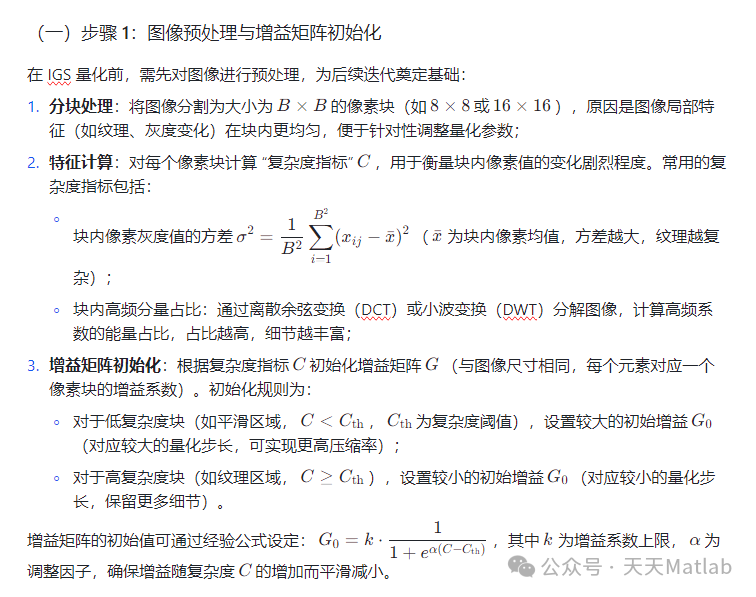
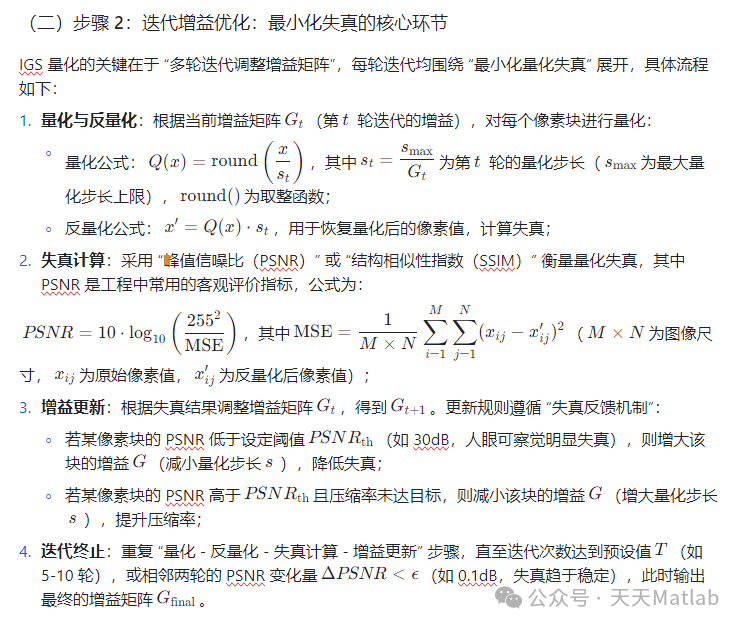
The core of IGS quantization is “dynamically adjusting the quantization step size for each pixel or pixel block through iterative optimization of the gain matrix,” which can be divided into three main stages: “initialization – iterative optimization – quantization mapping.” The mathematical logic and implementation details are as follows:
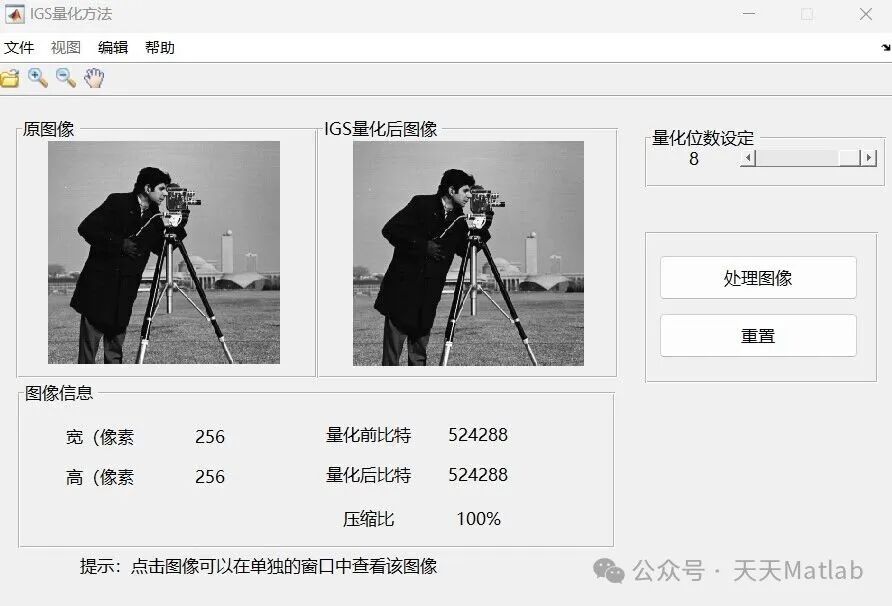
⛳️ Results
📣 Sample Code
% H = IMGCOMPRESSING_IGS returns the handle to a new IMGCOMPRESSING_IGS or the handle to
% the existing singleton*.
%
% IMGCOMPRESSING_IGS(‘CALLBACK’,hObject,eventData,handles,…) calls the local
% function named CALLBACK in IMGCOMPRESSING_IGS.M with the given input arguments.
%
% IMGCOMPRESSING_IGS(‘Property’,’Value’,…) creates a new IMGCOMPRESSING_IGS or raises the
% existing singleton*. Starting from the left, property value pairs are
% applied to the GUI before imgCompressing_igs_OpeningFcn gets called. An
% unrecognized property name or invalid value makes property application
% stop. All inputs are passed to imgCompressing_igs_OpeningFcn via varargin.
%
% *See GUI Options on GUIDE’s Tools menu. Choose “GUI allows only one
% instance to run (singleton)”.
%
% See also: GUIDE, GUIDATA, GUIHANDLES
% Edit the above text to modify the response to help imgCompressing_igs
% Last Modified by GUIDE v2.5 23-Apr-2017 11:23:50
% Begin initialization code – DO NOT EDIT
gui_Singleton = 1;
gui_State = struct(‘gui_Name’, mfilename, …
‘gui_Singleton’, gui_Singleton, …
‘gui_OpeningFcn’, @imgCompressing_igs_OpeningFcn, …
‘gui_OutputFcn’, @imgCompressing_igs_OutputFcn, …
‘gui_LayoutFcn’, [] , …
‘gui_Callback’, []);
if nargin && ischar(varargin{1})
gui_State.gui_Callback = str2func(varargin{1});
end
if nargout
[varargout{1:nargout}] = gui_mainfcn(gui_State, varargin{:});
else
gui_mainfcn(gui_State, varargin{:});
end
% End initialization code – DO NOT EDIT
% — Executes just before imgCompressing_igs is made visible.
function imgCompressing_igs_OpeningFcn(hObject, eventdata, handles, varargin)
% This function has no output args, see OutputFcn.
% hObject handle to figure
% eventdata reserved – to be defined in a future version of MATLAB
% handles structure with handles and user data (see GUIDATA)
% varargin command line arguments to imgCompressing_igs (see VARARGIN)
% Move the user interface to the center of the screen
movegui(hObject, ‘center’);
🔗 References
[1] Jin R, Jin S, Feng G. M_DCB: Matlab code for estimating GNSS satellite and receiver differential code biases[J]. Gps Solutions, 2012, 16(4):541-548. DOI:10.1007/s10291-012-0279-3.
🎈 Some theoretical references are from online literature; please contact the author for removal if there is any infringement.
👇 Follow me to receive a wealth of Matlab e-books and mathematical modeling materials
🏆 Our team specializes in custom MATLAB simulations across various research fields, helping to realize research dreams:
🌟 Improvements and applications of various intelligent optimization algorithms
Production scheduling, economic scheduling, assembly line scheduling, charging optimization, workshop scheduling, departure optimization, reservoir scheduling, three-dimensional packing, logistics site selection, cargo position optimization, bus scheduling optimization, charging pile layout optimization, workshop layout optimization, container ship loading optimization, pump combination optimization, medical resource allocation optimization, facility layout optimization, visual domain base station and drone site selection optimization, knapsack problem, wind farm layout, time slot allocation optimization, optimal distribution of distributed generation units, multi-stage pipeline maintenance, factory-center-demand point three-level site selection problem, emergency supply material distribution center site selection, base station site selection, road lamp post arrangement, hub node deployment, transmission line typhoon monitoring devices, container scheduling, unit optimization, investment portfolio optimization, cloud server combination optimization, antenna linear array distribution optimization, CVRP problem, VRPPD problem, multi-center VRP problem, multi-layer network VRP problem, multi-center multi-vehicle VRP problem, dynamic VRP problem, two-layer vehicle routing planning (2E-VRP), charging vehicle routing planning (EVRP), oil-electric hybrid vehicle routing planning, hybrid flow shop problem, order splitting scheduling problem, bus scheduling optimization problem, flight shuttle vehicle scheduling problem, site selection routing planning problem, port scheduling, port bridge scheduling, parking space allocation, airport flight scheduling, leak source location, cold chain, time windows, multi-vehicle fields, site selection optimization, port bridge scheduling optimization, traffic impedance, redistribution, parking space allocation, airport flight scheduling, communication upload and download allocation optimization
🌟 Time series, regression, classification, clustering, and dimensionality reduction in machine learning and deep learning
2.1 BP time series, regression prediction, and classification
2.2 ENS voice neural network time series, regression prediction, and classification
2.3 SVM/CNN-SVM/LSSVM/RVM support vector machine series time series, regression prediction, and classification
2.4 CNN|TCN|GCN convolutional neural network series time series, regression prediction, and classification
2.5 ELM/KELM/RELM/DELM extreme learning machine series time series, regression prediction, and classification
2.6 GRU/Bi-GRU/CNN-GRU/CNN-BiGRU gated neural network time series, regression prediction, and classification
2.7 Elman recurrent neural network time series, regression prediction, and classification
2.8 LSTM/BiLSTM/CNN-LSTM/CNN-BiLSTM long short-term memory neural network series time series, regression prediction, and classification
2.9 RBF radial basis function neural network time series, regression prediction, and classification
2.10 DBN deep belief network time series, regression prediction, and classification
2.11 FNN fuzzy neural network time series, regression prediction
2.12 RF random forest time series, regression prediction, and classification
2.13 BLS broad learning system time series, regression prediction, and classification
2.14 PNN pulse neural network classification
2.15 Fuzzy wavelet neural network prediction and classification
2.16 Time series, regression prediction, and classification
2.17 Time series, regression prediction, and classification
2.18 XGBOOST ensemble learning time series, regression prediction, and classification
2.19 Transform various combinations of time series, regression prediction, and classification
Directions cover wind power prediction, photovoltaic prediction, battery life prediction, radiation source identification, traffic flow prediction, load prediction, stock price prediction, PM2.5 concentration prediction, battery health status prediction, electricity consumption prediction, water body optical parameter inversion, NLOS signal identification, precise prediction of subway stops, transformer fault diagnosis
🌟 In the field of image processing
Image recognition, image segmentation, image detection, image hiding, image registration, image stitching, image fusion, image enhancement, image compressed sensing
🌟 In the field of path planning
Traveling salesman problem (TSP), vehicle routing problem (VRP, MVRP, CVRP, VRPTW, etc.), three-dimensional path planning for drones, drone collaboration, drone formation, robot path planning, grid map path planning, multimodal transport problems, charging vehicle routing planning (EVRP), two-layer vehicle routing planning (2E-VRP), oil-electric hybrid vehicle routing planning, ship trajectory planning, full path planning, warehouse patrol, bus time scheduling, reservoir scheduling optimization, multimodal optimization
🌟 In the field of drone applications
Drone path planning, drone control, drone formation, drone collaboration, drone task allocation, online optimization of safe communication trajectories for drones, vehicle collaborative drone path planning,
🌟 In the field of communication
Sensor deployment optimization, communication protocol optimization, routing optimization, target location optimization, Dv-Hop location optimization, Leach protocol optimization, WSN coverage optimization, multicast optimization, RSSI location optimization, underwater communication, communication upload and download allocation
🌟 In the field of signal processing
Signal recognition, signal encryption, signal denoising, signal enhancement, radar signal processing, signal watermark embedding and extraction, electromyography signals, electroencephalography signals, signal timing optimization, electrocardiogram signals, DOA estimation, encoding and decoding, variational mode decomposition, pipeline leakage, filters, digital signal processing + transmission + analysis + denoising, digital signal modulation, bit error rate, signal estimation, DTMF, signal detection
🌟 In the field of power systems
Microgrid optimization, reactive power optimization, distribution network reconstruction, energy storage configuration, orderly charging, MPPT optimization, household electricity, electric/cold/heat load forecasting, power equipment fault diagnosis, battery management system (BMS) SOC/SOH estimation (particle filter/Kalman filter), multi-objective optimization in power system scheduling, photovoltaic MPPT control algorithm improvement (perturbation observation method/conductance increment method), electric vehicle charging and discharging optimization, microgrid day-ahead optimization, energy storage optimization, household electricity optimization, supply chain optimization
🌟 In the field of cellular automata
Traffic flow, crowd evacuation, virus spread, crystal growth, metal corrosion
🌟 In the field of radar
Kalman filter tracking, trajectory association, trajectory fusion, SOC estimation, array optimization, NLOS identification
🌟 In the field of workshop scheduling
Zero-wait flow shop scheduling problem (NWFSP), permutation flow shop scheduling problem (PFSP), hybrid flow shop scheduling problem (HFSP), zero idle flow shop scheduling problem (NIFSP), distributed permutation flow shop scheduling problem (DPFSP), blocking flow shop scheduling problem (BFSP)
👇