Connecting ThingsBoard Cloud Platform with ARMxy Gateway and Node-RED: A Complete Edge Intelligence and Cloud Management Solution
1.Solution Description The ARMxy series of industrial-grade gateways (such as BL450, BL335, BL410, etc.) serve as the core hardware platform for industrial IoT edge applications, thanks to their rich hardware interfaces (Ethernet, RS485, BLE, LoRa, etc.), stable Linux system, and powerful edge computing capabilities. Node-RED, as a lightweight visual programming tool, enables rapid implementation of multi-protocol data collection, edge data processing, and device interaction. ThingsBoard provides mature IoT cloud management capabilities, covering device access, data storage, visualization monitoring, and remote control. The deep integration of these three components constructs an integrated IoT solution for “edge collection – local processing – cloud control,” suitable for various fields such as smart manufacturing, smart water management, and intelligent warehousing. Below are the detailed implementation processes and advantages of the solution.
2.Core Value of the SolutionLow-code Rapid Deployment:Node-RED’s visual drag-and-drop programming allows for sensor data collection, protocol conversion, and cloud integration without complex code development, significantly shortening project deployment cycles (traditional development takes weeks, while this solution only requires 1-3 days). Edge-Cloud Collaboration:The ARMxy gateway runs Node-RED locally to perform data preprocessing (filtering, aggregation, cleaning), reducing invalid data uploads and lowering network bandwidth usage; ThingsBoard centrally manages devices, stores data, and issues commands, balancing real-time performance and control efficiency. Multi-Scenario Adaptability:ARMxy supports multiple interfaces and protocol compatibility, allowing integration with various industrial devices such as Modbus sensors, PLCs, AGVs, and smart meters; Node-RED’s rich community nodes (2000+) can quickly expand protocol support to meet different industry needs. High Reliability and Security:The industrial-grade hardware design of ARMxy (wide temperature range, electromagnetic interference resistance) ensures stable operation in harsh environments; ThingsBoard supports MQTT over TLS encrypted transmission and device identity authentication, while Node-RED can integrate edge-side security checks to build end-to-end security protection.
3.Preparation Steps1. Hardware EnvironmentARMxy Gateway:Recommended BL450 (RK3588 chip, 6TOPS NPU, supports complex edge AI inference), BL335 (entry-level industrial gateway, suitable for lightweight data collection scenarios), ensure the gateway is connected to the network (wired / 4G/WiFi). Peripheral Devices: Connect sensors (temperature and humidity, vibration, flow, etc.), controllers (PLC, relays), actuators, etc., according to scenario requirements, supporting devices with protocols such as Modbus, CAN, BLE, LoRa, etc. Network Environment:Ensure the gateway and ThingsBoard cloud platform are interconnected (public network/intranet penetration) to ensure smooth data transmission. 2. Software EnvironmentARMxy Gateway:Pre-installed with Ubuntu 20.04/Linux system, Node.js (recommended version 16.x LTS), and npm package manager installed. ThingsBoard Platform:Registered account (community version/professional version/private deployment) and created target device (obtained device Access Token). Node-RED:Globally installed via npm, along with node-red-contrib-thingsboard (ThingsBoard communication node), node-red-contrib-modbus (Modbus protocol node), and other extension nodes.
4.Detailed Implementation Steps
1.Create a Project on ThingsBoard Cloud Platform
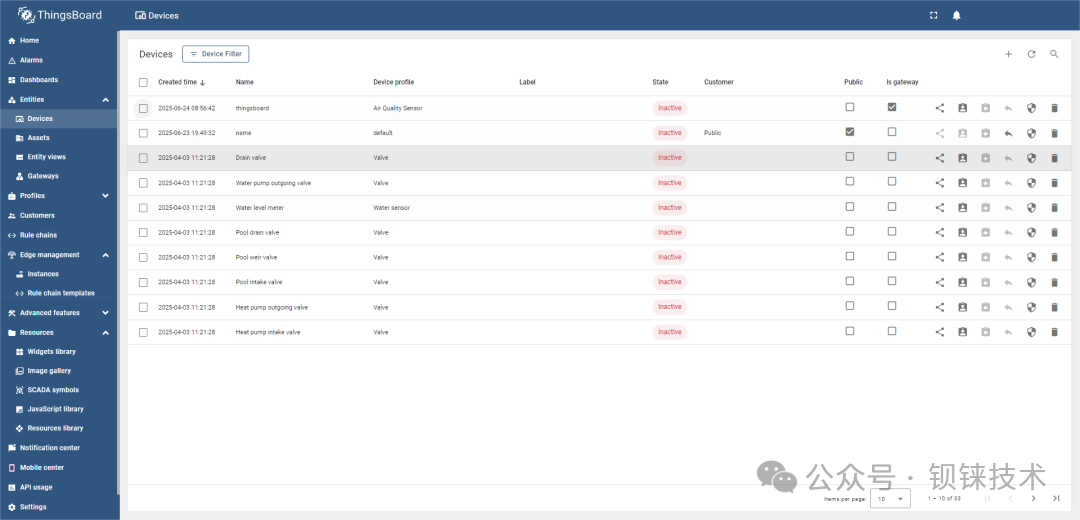
(1) Create Device
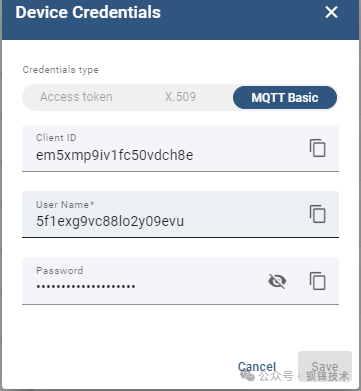
(2) Record MQTT Basic
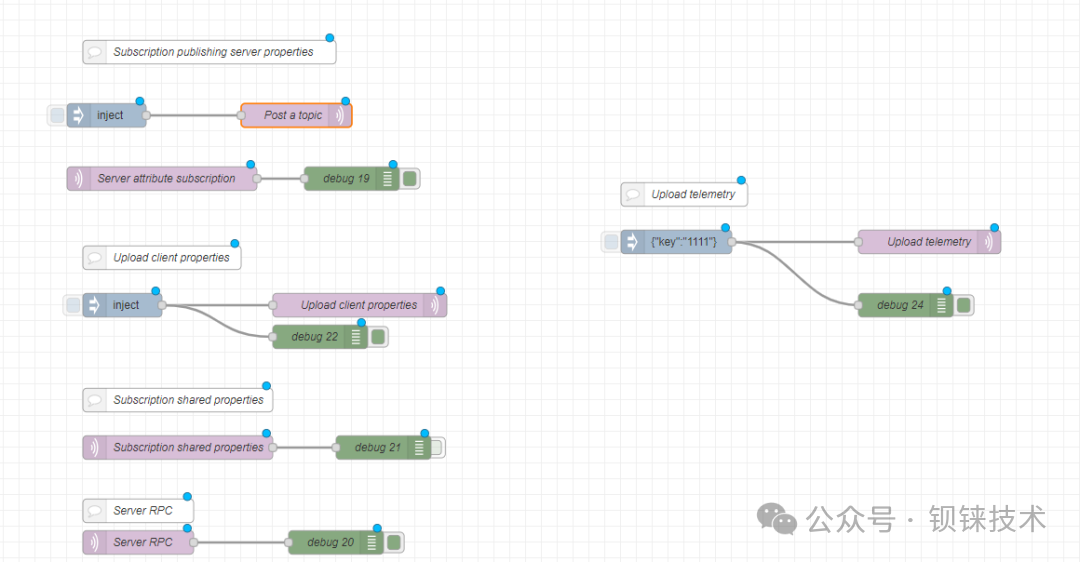
2.Create Node-RED Flow
(1) Create Node-RED Flow
3. Upload Telemetry
(1) Publish Topic
v1/devices/me/telemetry
(2) Configure MQTT
First, select the mqtt out node, double-click to edit it, and set its topic and server
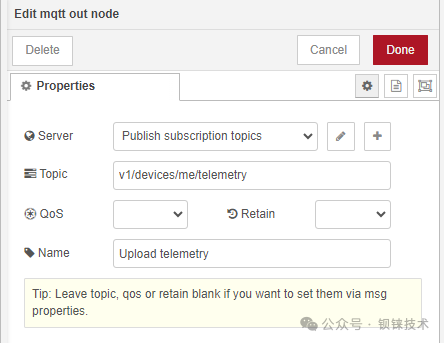
Set the server’s IP: demo.thingsboard.io and Client ID in the connection parameters
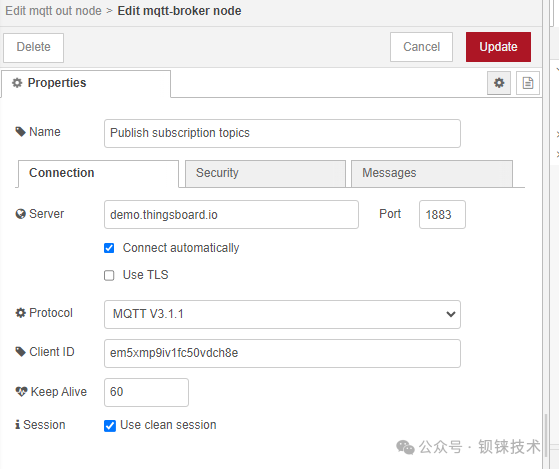
Input username and password, click Update to save (2) Configure Flow
(3) View Data on ThingsBoard
4. Upload Attribute Settings
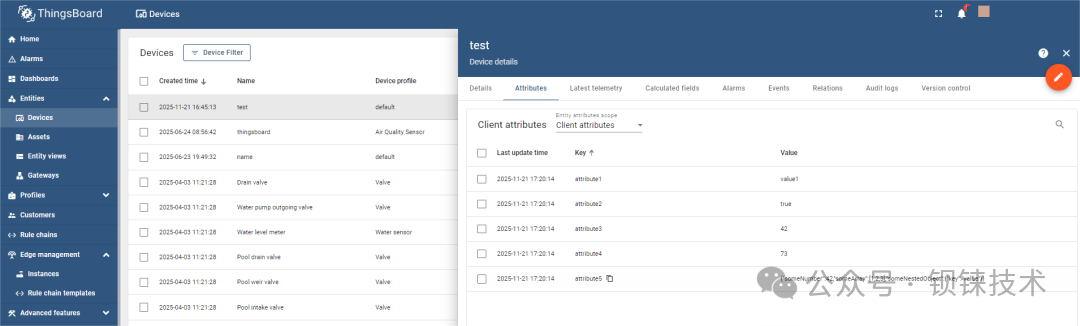
Set upload attributes on the inject node
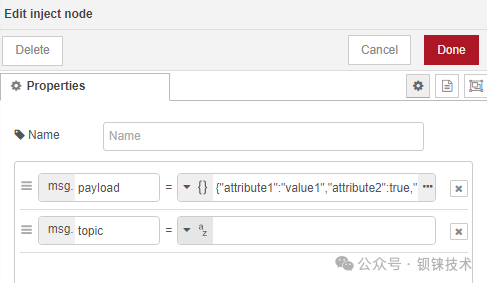
Inject:
{
“attribute1”: “value1”,
“attribute2”: true,
“attribute3”: 42.0,
“attribute4”: 73,
“attribute5”: {
“someNumber”: 42,
“someArray”: [1, 2, 3],
“someNestedObject”: {
“key”: “value”
}
}
}
(2) Edit mqtt out node, fill in the topic: v1/devices/me/attributes
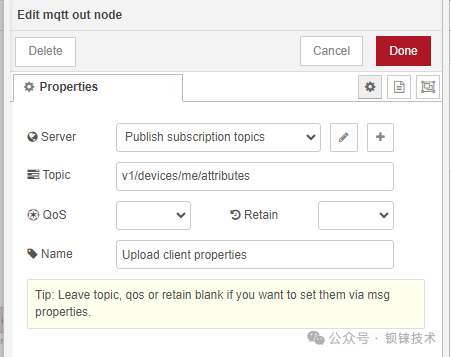
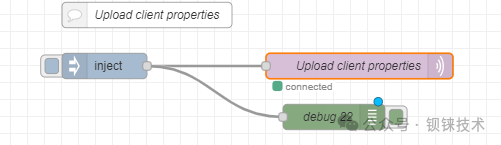
(3) Final Flow
Latest attribute data on ThingsBoard:
5. Subscribe and Publish Server Attributes
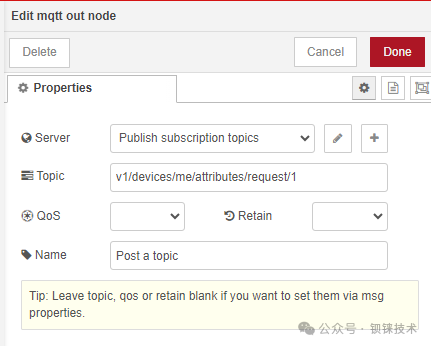
(1) Create Publish Topic v1/devices/me/attributes/request/1
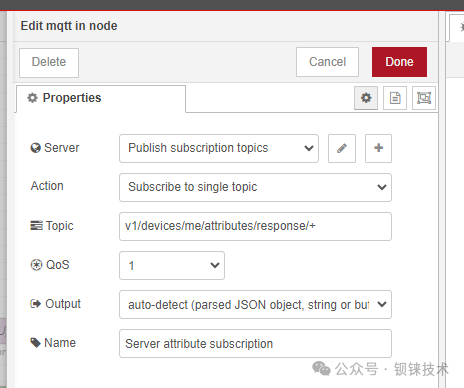
(2) Subscribe Topic: v1/devices/me/attributes/response/+
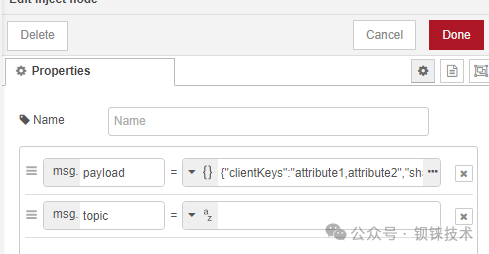
(3) Publish Message Request Attributes
{
“clientKeys”: “attribute1,attribute2”,
“sharedKeys”: “shared1,shared2”
}
Build Flow
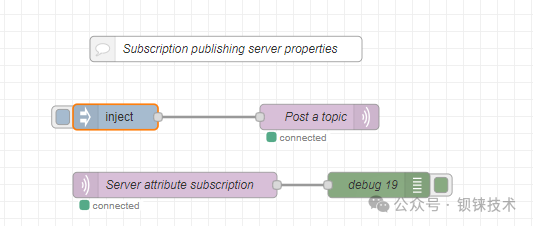
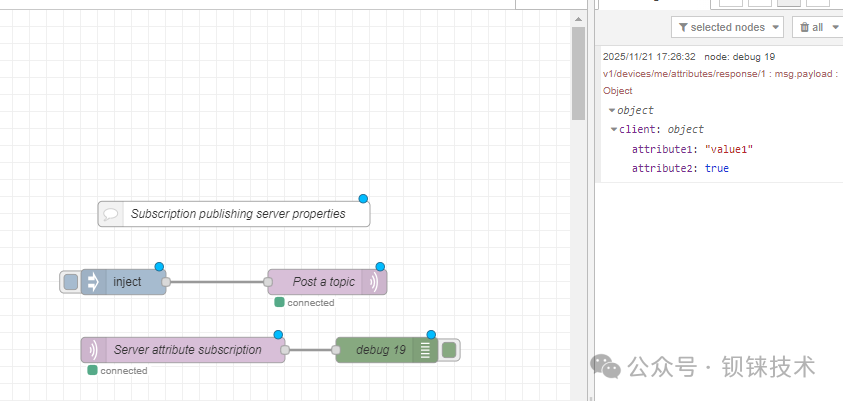
Debug Window to View Results
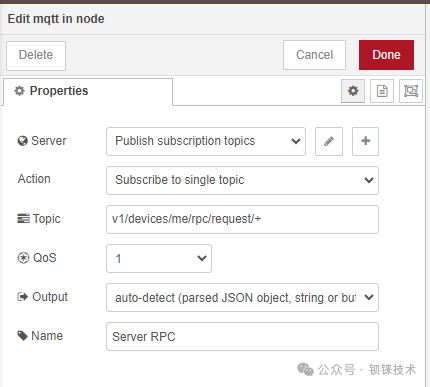
6. Server RPC
(1) Configure Flow

(2) Edit mqtt in node
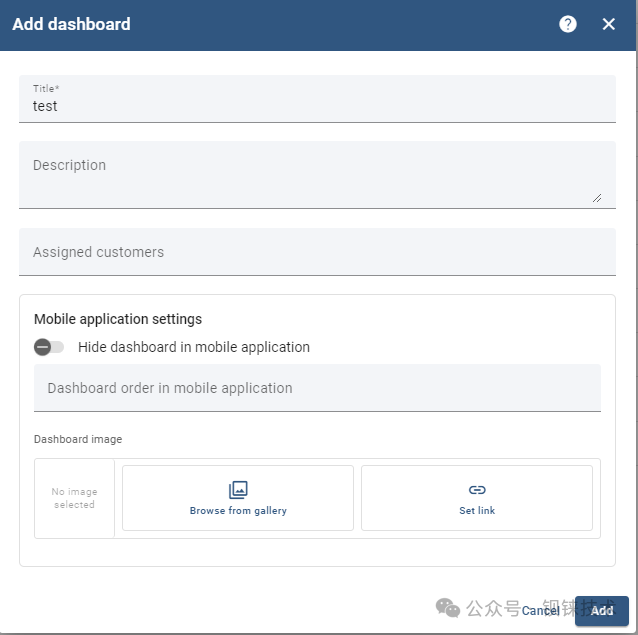
Create Dashboard on ThingsBoard
Select a Switch on the Canvas
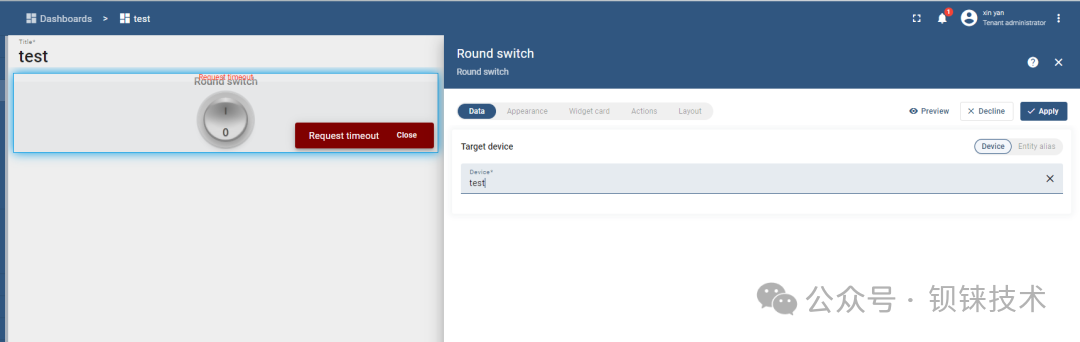
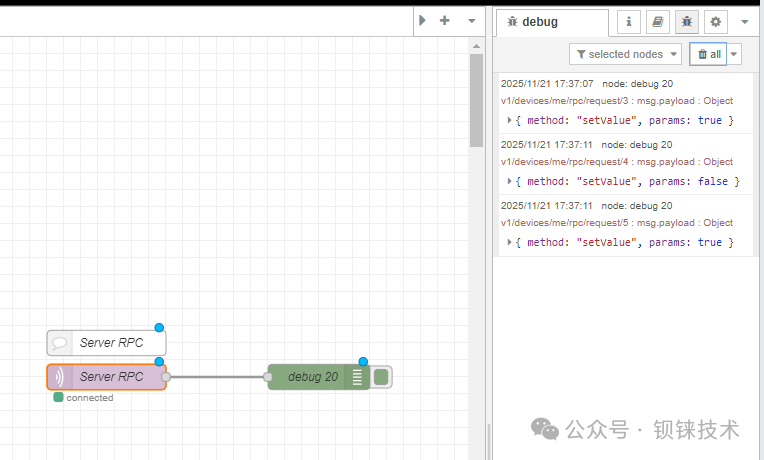
Trigger the Switch to View the Node-RED Debug Window, where you can see the commands issued by ThingsBoard
5.Typical Application Scenarios
1. Intelligent Operation and Maintenance Management of New Energy Charging Piles (New Energy Sector)Pain Points:Urban charging piles are widely distributed, and traditional manual inspections are inefficient, leading to equipment failures (such as charging module damage, network interruptions) that prevent users from charging, and cumbersome charging data statistics and electricity bill settlements. Hardware Deployment:Deploy 1 ARMxy BL450 gateway for every 10 charging piles, connecting to the charging pile controller and smart meter via Modbus TCP, and connecting the charging pile camera and fault alarm light via Ethernet; the gateway connects to the public network via a 4G module, and all device data is aggregated to the ThingsBoard cloud. Software Configuration:Node-RED installs node-red-contrib-modbus (to collect charging pile data) and node-red-contrib-thingsboard nodes; configure the data collection interval for charging pile voltage, current, and charging power to 1 second, and the data collection interval for the smart meter to 5 seconds; create a charging pile device group on ThingsBoard and set fault alarm thresholds (e.g., voltage below 220V). Core Process:The ARMxy gateway collects charging pile operating parameters via Modbus, Node-RED filters out invalid data (such as transient fluctuations), and uploads charging amount, duration, and fault codes to ThingsBoard; when a charging module fault is detected, Node-RED triggers the alarm light to flash, while ThingsBoard pushes a work order to maintenance personnel (including fault location and device number); the cloud automatically compiles charging statistics for each charging pile, generating electricity bill settlement reports that support usage analysis by time period/region.
2. Smart Power Distribution Network Monitoring (Power Sector)Pain Points:Urban distribution network lines are dispersed, and traditional manual inspections cannot cover all nodes, making it easy for faults such as line overload and leakage to cause power outages, and the statistics on distribution network loss data are not timely, leading to serious energy waste. Hardware Deployment:Deploy ARMxy BL450 gateways at key nodes of the distribution network (transformers, branch boxes), collecting line current and voltage data through CT sensors and voltage sensors, and connecting to the ThingsBoard cloud and power dispatch system via 4G Cat M1 network (suitable for remote areas with weak signals); install infrared cameras in transformer areas to monitor equipment temperature. Software Configuration:Node-RED installs node-red-contrib-modbus (to collect power data) and node-red-contrib-signalK (for data parsing) nodes; current and voltage data collection interval is set to 1 second, and fault data is uploaded in real-time; ThingsBoard configures a distribution network loss calculation model and pre-sets line overload thresholds (e.g., 10kV line current ≤ 400A). Core Process:The gateway collects distribution network current and voltage data in real-time, Node-RED calculates power, loss, and other parameters and uploads them to the cloud; when line current exceeds the threshold, ThingsBoard pushes overload alarms to the dispatch center, while linking fault indicators to mark the fault location; when the infrared camera detects transformer temperature exceeding 80℃, it triggers an overheating alarm; the cloud generates distribution network loss reports, analyzes high-loss areas, and provides optimization suggestions.
3.MBR Membrane Process Control for Industrial Wastewater Treatment (Environmental Protection Industry)Pain Points:Industrial park wastewater treatment plants using MBR membrane processes face issues such as membrane fouling leading to reduced water production rates, high aeration energy consumption, and unstable effluent quality, with high costs for membrane component replacement (over 100,000 yuan per set) and difficulty in predicting failures in advance. Hardware Deployment:Deploy 1 ARMxy BL450 gateway in the MBR pool area, collecting data through turbidity sensors and DO (dissolved oxygen) sensors (RS485), and connecting to aeration fans and membrane cleaning pump controllers via Modbus TCP; monitor water production volume through flow sensors; the gateway connects to the ThingsBoard cloud and environmental supervision system. Software Configuration:Node-RED installs node-red-contrib-modbus (to connect fans/pumps) and node-red-contrib-json (for water quality data parsing) nodes; DO and turbidity data collection intervals are set to 1 second, and water production data collection intervals are set to 5 seconds; ThingsBoard pre-sets effluent water quality standards (turbidity ≤ 1NTU) and configures a membrane fouling early warning model. Core Process:When the DO sensor detects values below 2mg/L, Node-RED increases the power of the aeration fan; when turbidity exceeds the threshold, it assesses the degree of membrane fouling and starts the online cleaning pump for chemical cleaning; when water production volume continues to decline, it pushes a warning for membrane component replacement; when effluent water quality does not meet standards, it automatically returns to the adjustment pool for reprocessing to avoid exceeding discharge standards; the cloud records the entire treatment process data and generates environmental compliance reports.
4.Collaborative Control of Industrial Robot Production Lines (Smart Manufacturing Sector)Pain Points:In automotive parts production lines, 10 industrial robots (ABB, FANUC) have incompatible protocols, making it easy to have action conflicts during collaborative operations, and fault troubleshooting relies on manual intervention (averaging 2 hours), with serious energy waste from robots (high standby power). Hardware Deployment:Deploy 1 ARMxy BL450 gateway for each production line, connecting to robot controllers and end-effector force sensors via Modbus TCP, and connecting production line vision cameras and smart meters via Ethernet; the gateway connects to the ThingsBoard cloud and MES system via industrial Ethernet. Software Configuration:Node-RED installs node-red-contrib-ethercat (for robot communication) and node-red-contrib-thingsboard nodes; robot operating parameters (joint angles, load current) collection interval is set to 500ms, and energy consumption data collection interval is set to 1 second; ThingsBoard builds a digital twin model for collaborative robot operations, pre-setting action conflict warning thresholds. Core Process:After the MES system issues a production order, Node-RED plans the robot action sequence through the digital twin model to avoid collaborative conflicts; when the force sensor detects abnormal end load, it immediately pauses operation and pushes a fault alarm, while ThingsBoard synchronously displays the faulty joint and historical data; if a robot is idle for more than 5 minutes, it automatically switches to low-power mode; the cloud generates robot operation reports, analyzing utilization rates and energy optimization potential.
5. Intelligent Operation and Maintenance of Industrial Dock Belt Conveyors (Port Industry)Pain Points:Coal docks with 12 belt conveyors (total length over 5 kilometers) are prone to misalignment, tearing, and motor overheating, with traditional manual inspections being inefficient (covering once takes 4 hours), leading to cargo accumulation and transport interruptions, resulting in significant losses. Hardware Deployment:Deploy 2 ARMxy BL450 gateways (one at the head and one at the tail) for each conveyor, collecting device status through misalignment sensors, tearing sensors, and temperature sensors, and connecting to conveyor frequency converters and alignment control devices via Modbus TCP; deploy AI cameras (to identify belt misalignment and foreign objects); the gateway connects to the ThingsBoard cloud and dock dispatch system via a 4G module. Software Configuration:Node-RED installs node-red-contrib-modbus (to connect frequency converters) and node-red-contrib-image-processing (for AI image recognition) nodes; sensor data collection interval is set to 500ms, and camera frames are sampled every 1 second; ThingsBoard pre-sets fault alarm thresholds and configures alignment linkage logic. Core Process:When the misalignment sensor detects belt deviation, Node-RED immediately activates the alignment device while reducing conveyor speed; when the tearing sensor detects belt damage, it immediately stops operation and pushes an alarm to the dispatch center, marking the fault location; when motor temperature exceeds 80℃, it pushes an overheating alarm and suggests load reduction; when the AI camera identifies large foreign objects on the belt, it triggers a sorting device to remove them; the cloud generates conveyor operation maintenance reports, predicting maintenance cycles for bearings, motors, and other components.