The Fibonacci sequence is a classic mathematical sequence characterized by the fact that the first two numbers are 1 and 1, and from the third number onward, each number is the sum of the two preceding ones. The sequence is as follows: 1, 1, 2, 3, 5, 8, 13, 21, …
Method 1: Using Loops (Iterative Method)
This is the most efficient method, with a time complexity of O(n) and a space complexity of O(1).
#include <stdio.h>
// Output the first n terms of the Fibonacci sequence
void fibonacci(int n) {
    int first = 1, second = 1;
    int next;
    // Handle special cases
    if (n <= 0) {
        printf("Please enter a positive integer\n");
        return;
    } else if (n == 1) {
        printf("The first term of the Fibonacci sequence: %d\n", first);
        return;
    }
    // Output the first two terms
    printf("The first %d terms of the Fibonacci sequence: %d, %d", n, first, second);
    // Loop to calculate and output subsequent terms
    for (int i = 3; i <= n; i++) {
        // The next term is the sum of the previous two terms
        next = first + second;
        printf(", %d", next);
        // Update the values of the previous two terms
        first = second;
        second = next;
    }
    printf("\n");
}
int main() {
    int num;
    printf("Please enter the number of Fibonacci sequence terms to output: ");
    scanf_s("%d", &num);
    fibonacci(num);
    return 0;
}
Code Analysis:
- Define
<span>first</span>and<span>second</span>to represent the first two terms of the sequence (initial values are both 1) - Handle special cases: when n=1, only output the first term
- Loop to calculate each term starting from the 3rd term:
- The next term
<span>next</span>= the sum of the previous two terms (<span>first + second</span>) - Update the values of
<span>first</span>and<span>second</span>for the next calculation
Method 2: Using Recursion
The recursive method has concise code but lower efficiency, with a time complexity of O(2^n), making it unsuitable for calculating larger n values.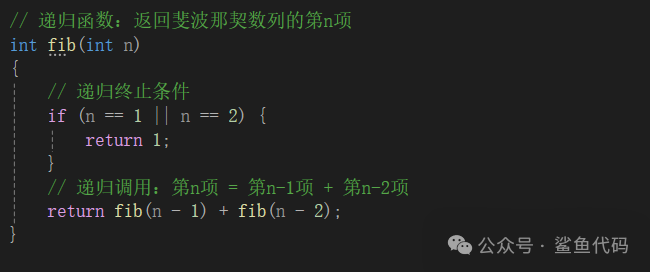 Disadvantage: There is a lot of repeated calculations (for example, calculating
 <span>fib(5)</span> requires calculating <span>fib(4)</span> and <span>fib(3)</span>, and calculating <span>fib(4)</span> again requires calculating <span>fib(3)</span>)
Method 3: Using Arrays for Storage (Memoization)
#include <stdlib.h>
#include <stdio.h>
// Use an array to calculate and output the first n terms of the Fibonacci sequence
void fibonacci(int n) {
    int* fib = (int*)malloc(n * sizeof(int));
    if (fib == NULL) {
        printf("Memory allocation failed\n");
        return;
    }
    // Initialize the first two terms
    if (n >= 1) fib[0] = 1;
    if (n >= 2) fib[1] = 1;
    // Calculate subsequent terms
    for (int i = 2; i < n; i++) {
        fib[i] = fib[i - 1] + fib[i - 2];
    }
    // Output results
    printf("The first %d terms of the Fibonacci sequence: ", n);
    for (int i = 0; i < n; i++) {
        printf("%d", fib[i]);
        if (i < n - 1) {
            printf(", ");
        }
    }
    printf("\n");
    // Free memory
    free(fib);
}
Comparison of the Three Methods
| Method | Time Complexity | Space Complexity | Advantages | Disadvantages |
|---|---|---|---|---|
| Iterative Loop | O(n) | O(1) | Highest efficiency, low memory usage | Cannot directly access any term |
| Recursion | O(2^n) | O(n) | Concise code, aligns with mathematical definition | Low efficiency, unsuitable for large n |
| Array Storage | O(n) | O(n) | Can directly access any term | Uses additional memory |
Conclusion
- For general applications, it is recommended to use the iterative method, which combines efficiency and low memory usage
- The recursive method is mainly used to understand the concept of recursion and is rarely used in practical applications
- The array storage method is suitable for scenarios where multiple different terms in the sequence need to be accessed
.