Like a battle-scarred professional boxer, PCM refuses to yield or give up the fight. Despite being battered by the unfortunate encounters of PCM with Micron’s 3D XPoint and Intel’s Optane, it has found its way in the microcontroller arena thanks to the collaboration between STMicroelectronics ( ST) and Samsung. As early as 2018, STMicroelectronics announced that it was providing embedded PCM (ePCM) microcontrollers manufactured using 28nm FD-SOI technology for the automotive market. Now, STMicroelectronics has announced the next generation of automotive microcontrollers with ePCM, manufactured using a jointly developed 18nm FD-SOI process by Samsung combined with STMicroelectronics’ ePCM technology.
ST specifically targets the automotive industry with its ePCM microcontrollers, as the automotive industry has stricter environmental temperature requirements than most other microcontroller applications. High temperatures are PCM‘s fatal weakness. PCM utilizes the resistance change of materials when transitioning between amorphous and crystalline states: the resistance of the amorphous state is high, while the resistance of the crystalline state is low. These two states create a storage cell. A sharp, short temperature spike from a heater at the same location causes the PCM storage medium to present an amorphous state, while a longer, lower thermal pulse transforms the material into a crystalline state, as shown in the figure below.
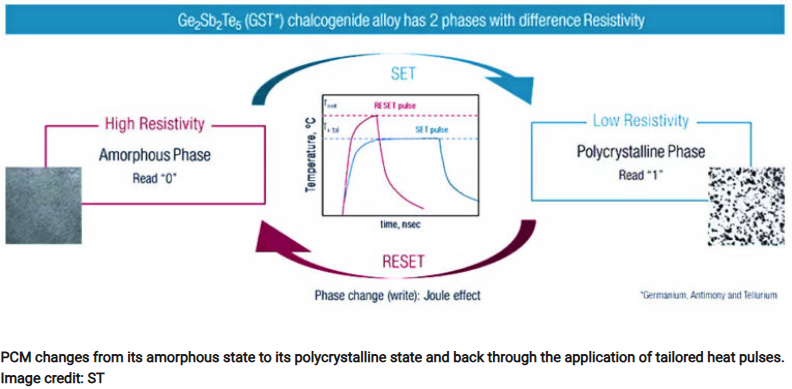
According to STMicroelectronics’ PCM webpage, the company’s PCM material has a maximum operating temperature of 165 °C, making it suitable for the company’s 18nm automotive microcontroller.
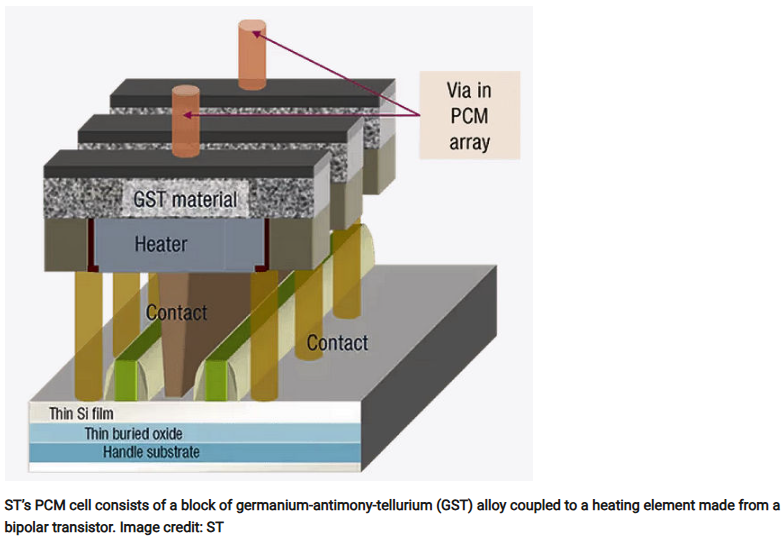
The figure below illustrates the design of the PCM battery. The heaters driving these PCM batteries’ phase changes are embedded bipolar transistors.
Building a new microcontroller family on a memory technology with a long and rough history seems risky, but ST has a way. Since the emergence of microcontrollers in the 1970s, they have primarily been based on some form of erasable PROM ( EPROM) cell, aside from hard ROM versions. The earliest microcontrollers used ultraviolet-erasable EPROM ( UV-EPROM) cells. IC suppliers packaged these first erasable microcontrollers in packages with quartz windows to allow for erasing and reuse. To reduce device costs, they would omit the package window, creating one-time programmable devices from the same microcontroller chip. Later, as the semiconductor industry mastered electrically erasable EEPROM and flash EEPROM, the quartz window packaging completely disappeared.
As the industry slid down the curve of Moore’s Law, the expansion of flash EEPROM cells was not good, prompting STMicroelectronics to seek an alternative non-volatile storage technology suitable for microcontrollers manufactured using more advanced semiconductor nodes. Some microcontroller manufacturers have shifted their microcontrollers to FeRAM or eMRAM. ST chose ePCM.
ST is no stranger to PCM. In 2008, ST partnered with Intel to establish a new non-volatile semiconductor storage company called Numonyx. Numonyx storage chips used flash EEPROM or PCM storage cells. This new company produced various non-volatile memories, specializing in NOR flash memory. Numonyx launched 90nm PCM devices in 2010. That same year, Micron acquired Numonyx for 1.27 billion dollars in stock and entered the PCM field. Micron quickly discontinued Numonyx PCM devices and later launched a different series of PCM storage chips developed in collaboration with Intel. The company named these new PCM devices “3D XPoint“. Intel launched its own version of 3D XPoint PCM, called Optane, packaging it into memory DIMM and SSD products.
Intel’s Optane and Micron’s 3D XPoint were positioned as direct competitors to NAND flash EEPROM, but the economics of PCM and the rapid development of NAND flash devices never allowed 3D XPoint and Optane products to be cost-competitive in large non-volatile memory. Micron exited the PCM field in 2021, and Intel shut down Optane PCM in 2022.
ST is also no stranger to FD-SOI. The company opened pre-production orders for its 28nm FD-SOI process at the end of 2012. Around the same time, ST and GlobalFoundries announced that GlobalFoundries would produce integrated circuits based on ST 28 nanometer and 20 nanometer FD-SOI process technologies. Samsung obtained a license for ST‘s FD-SOI process technology in 2015, and in 2022, they announced that they would establish a new joint operation supporting FD-SOI at a 300-millimeter semiconductor manufacturing plant near ST’s existing 300 millimeter semiconductor plant in Crolles, France. Returning to this brief history, ST recently released its 18nm FD-SOI microcontroller for automotive applications. Samsung is the initial foundry for this device, but the ST/GlobalFoundries joint plant in Crolles will serve as an alternative manufacturing source. Recently, an additional supply source looks very attractive as automotive customers have been severely impacted by the semiconductor supply chain collapse.
ST has remained cautious about the specifications of its new 18nm automotive microcontroller. The press release simply states:
The first microcontroller based on this technology will integrate a state-of-the-art ARM Cortex-M core, providing enhanced performance for machine learning and digital signal processing applications. It will offer fast and flexible external storage interfaces, advanced graphics capabilities, and will integrate numerous analog and digital peripherals. It will also feature advanced, certified security functions that have already been launched on ST‘s latest MCU.
When asked about the name of the processor core, a spokesperson for ST provided an indirect answer, stating that Arm‘s most advanced Cortex-M processor core is Cortex-M85. This Arm processor core integrates Arm‘s Helium vector processing extension, which can accelerate graphics, DSP, and machine learning algorithms. Compared to Arm‘s Neon SIMD vector extension, Helium is a lightweight vector processing approach. Helium is a lighter inert gas than neon, thus it is named for the extension of the Arm Cortex-M architecture.
How fast is Arm’s “most advanced Cortex-M” processor running on ST’s new 18nm microcontroller? Similarly, ST did not specify. However, microcontroller vendor and competitor Renesas recently launched a series of microcontrollers based on the Cortex-M85 processor core, the RA8D1, with a clock frequency of 480MHz. Renesas uses 22nm process technology to manufacture the RA microcontroller, so the ST 18nm FD-SOI microcontroller’s Cortex-M85 core may run even faster.
Similarly, ST did not mention the amount of PCM or RAM included in the new automotive microcontroller. To look for clues, we can examine the previous generation of automotive microcontrollers based on FD-SOI and PCM. These devices utilized ST’s 28 nanometer Stellar microcontroller series. The largest member of this family is the Stellar SR6 P6, which includes six Arm Cortex-R52+ processor cores, up to 2.3 megabytes of SRAM, and up to 16 megabytes of PCM, with 15.5 megabytes of PCM dedicated to storing code and data, and 0.5 megabytes of PCM allocated for the microcontroller’s hardware security module. The Stellar SR6 P6 microcontroller also features 15.5 MB of shadow PCM to accommodate OTA updates.
In the leap from 28 nanometer to 18 nanometer FD-SOI process technology, it is expected that ST should be able to easily double or quadruple the available RAM and PCM on its new microcontroller. Ultimately, ST will provide additional information in the data sheet for these new 18nm FD-SOI microcontrollers. The next generation of FD-SOI technology is expected to offer the industry (manufactured by Samsung, ST, and GlobalFoundries) a new interesting application, while PCM will enter the next round of the semiconductor memory price war.
Original link:
https://www.eejournal.com/article/st-rolls-a-new-fd-soi-microcontroller-with-phase-change-memory-pcm-for-automotive-applications/
|
High-End WeChat Group Introduction |
|
|
Venture Capital Group |
AI, IOT, chip founders, investors, analysts, brokers |
|
Flash Memory Group |
Covering over 5000 global Chinese flash memory and storage chip elites |
|
Cloud Computing Group |
Public and private cloud discussions on all-flash, software-defined storage SDS, hyper-converged, etc. |
|
AI Chip Group |
Discussion on AI chips and heterogeneous computing of GPU, FPGA, CPU |
|
5G Group |
IOT, 5G chip discussions |
|
Third Generation Semiconductor Group |
Discussion on compound semiconductors such as GaN, SiC |
|
Storage Chip Group |
Discussion on various storage media and controllers such as DRAM, NAND, 3D XPoint |
|
Automotive Electronics Group |
Discussion on MCU, power supply, sensors, and other automotive electronics |
|
Optoelectronic Devices Group |
Discussion on optoelectronic devices such as optical communication, lasers, ToF, AR, VCSEL |
|
Channel Group |
Quotations, market trends, channels, and supply chains for storage and chip products |

< Long press to identify the QR code to add friends >
Join the above group chat

Leading you into the new era of information revolution of storage, intelligence, and interconnectivity
of all things

WeChat ID: SSDFans