
Barry Olney
Executive Director of In-Circuit Design Pty Ltd (iCD) in Australia. The company specializes in PCB design services and focuses on circuit board-level simulation technology. Their developed iCD Design Integrity software integrates iCD Stackup, PDN, and CPW Planner.
This software can be downloaded from www.icd.com.au.

The traditional PCB design process is often both time-consuming and labor-intensive. Complex PCB layouts can consume up to 30% of a designer’s time, and solving this issue is not straightforward. We have all encountered situations where, after spending hours setting constraints, we hit the “start” button only to be surprised by visually unappealing designs with obvious flaws.
History shows that PCB designers are generally skeptical, with many preferring interactive routing—where the setup process often takes longer than manual routing design. However, modern auto routers have achieved a combination of automation and interactive control, allowing users to interact with the system while choosing, thus balancing independence and user intervention. Yet, many designers do not fully utilize the capabilities of their routers.
Over the past 30 years, PCB routers have made significant advancements, evolving from basic point-to-point connectors to complex routing systems. However, there is still considerable room for improvement. This article will delve into the latest advancements in artificial intelligence technology, focusing on its impact on routing technology.
Modern auto routers employ Boolean algorithms, which largely depend on configuration and settings, meaning their effectiveness is directly related to the skills of the person configuring them. Fortunately, these configurations can be saved and applied to future designs, saving some time. Over the years, PCB routers have undergone many different development stages, from third-party applications that are difficult to learn, use, and interact with, to cohesive, cloud-based layout/routing environments. IC and PCB routing applications use many of the same algorithms, with shape-based, push-and-shove, and auto-undo and retry features being the most effective.
However, with the emergence of reinforced machine learning, AI can be trained on a wide range of professional PCB layout libraries, bypassing the traditional setup process. This enables AI to leverage its training to produce high-quality products, effectively reusing constraints and topologies from previous designs.
PCB designers often spend considerable time on manual tasks such as component placement and signal routing. However, with the advent of generative AI, these processes can be automated, allowing for faster iterations and greater design exploration in the early stages. For example, Allegro X AI claims to adhere to constraints related to wire length, signal integrity, and power distribution. However, considering that propagation delay is a more critical issue than length itself, one might question the necessity of analyzing wire length.
The system can automate the placement and routing of components for critical nets, ensuring reduced routing time while maintaining signal integrity. The copper pouring process is also automated, facilitating the creation of ground and power planes, which was previously a time-consuming task. For decades, Cadence has been developing Place-and-Route (P&R) tools for IC synthesis, and this technology has now been applied to PCB P&R. Shorter interconnects and reduced crossings are crucial for both chip and PCB layouts, but critical routing, including signal integrity and flight time requirements, is even more important for PCBs.
Zuken has also introduced an AI technology known as Autonomous Intelligent Place and Route (AIPR), which enhances the CR-8000 platform through a three-phase rollout. The initial phase, called Basic Brain, significantly improves user experience by using an intelligent auto router based on learning methods and strategy optimization for design routing. The second phase, Zuken’s Dynamic Brain, will incorporate insights from newly developed PCB designs, integrating historical design cases into its AI algorithms. This fusion of customer best practices and AI-driven insights is expected to accelerate design iterations and significantly enhance overall productivity within the CR-8000 framework. The final phase, Autonomous Brain, will possess the ability to self-improve in each project, ushering in a new era of AI-driven innovation.
Siemens has made significant progress in introducing Process Prediction, a key component of its modern user experience solution. This innovative feature has been integrated into Xpedition PCB, Constraints Manager, and HyperLynx Analysis tools. As users design their products, the predictive model is continuously trained in real-time, enabling it to make instant predictions. For each new command, the model learns the specific sequence of the user to adapt to their unique behavior. It can accommodate multiple learning subprocesses and seamlessly switch between these paths (Figure 1).
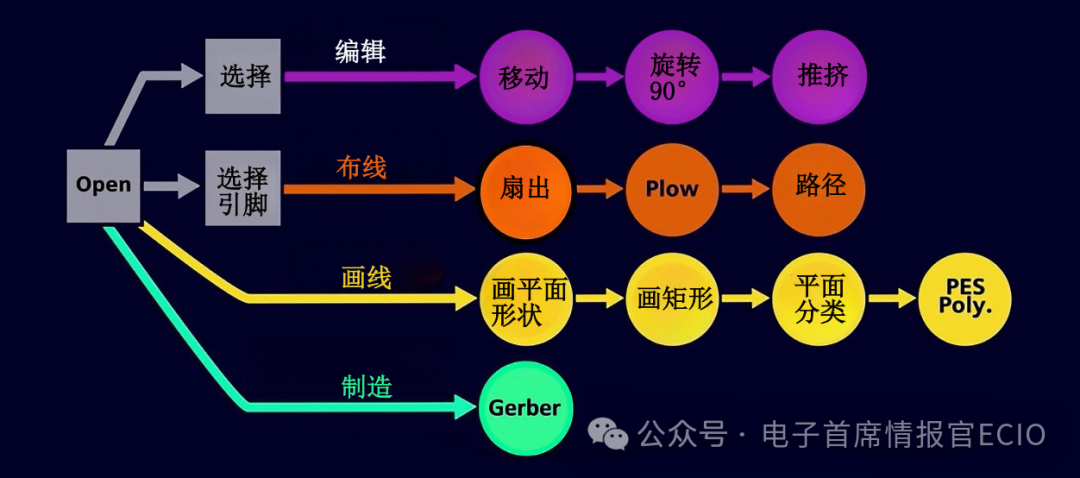
Figure 1: Switching paths between processes (Source: Siemens EDA)
The process begins with Xpedition PCB, where layouts are created, followed by establishing constraints, including stackup definitions and design rules. It then returns to the layout for editing. During the routing layout, key constraints are input into HyperLynx for signal integrity analysis to ensure quality. This process employs a DDR batch wizard for timing simulation. If a failure occurs, the layout is reviewed for fine-tuning. This loop continues until all requirements are met, completing the entire design process from start to finish (Figure 2).
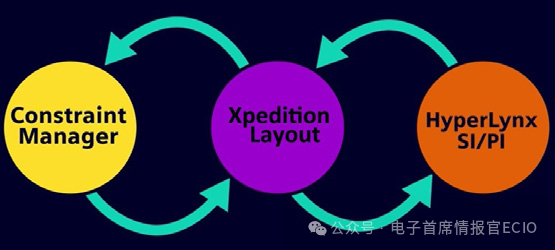
Figure 2
The target audience includes inexperienced designers who can leverage pre-trained seed models. Intermediate designers can choose to train their own models or utilize models created by experienced designers to enhance process efficiency. Additionally, expert designers can impart their knowledge of complex workflows and standardized design processes through these seed models.
In the low-end market, emerging platforms like DeepPCB and Flux Copilot have been identified. DeepPCB is an end-to-end, fully automated pay-per-use PCB AI tool. DeepPCB supports all Specctra-compatible PCB EDA tools, including OrCAD, Allegro, PADS, Zuken CR-3000/CR-5000, Altium, EAGLE, KiCAD, EasyEDA, and more. To achieve the best results with DeepPCB, sensitive components and unsupported nets need to be manually routed, allowing DeepPCB to handle the rest while protecting existing routing. The standard version of DeepPCB enables users to design layouts with up to 8 layers and 1200 connections, completing a design in just a few hours. This may be suitable for KICAD and Eagle users, but it seems to represent a regression in technology, as the ability to auto-route non-critical nets has existed for decades and can be completed in seconds.
Flux Copilot is another entry-level tool in the AI PCB design space, suitable for hobbyists designing simple microcontroller projects. It assists in component selection, debugging when difficulties arise, and provides suggestions and creates schematic connections for users. Flux Copilot is a direct competitor to KiCAD and EasyEDA. Additionally, KiCAD Guider offers AI-driven support for KiCAD, providing design suggestions and detecting errors to enhance the designer’s experience.
PCB design has evolved from manual routing to highly advanced AI-driven auto-routing solutions, significantly reducing the time and labor required in the design process. While past routers largely relied on setups and user expertise, modern AI-based tools utilize machine learning to simplify and optimize routing while still maintaining signal integrity.
As AI integration continues to develop, PCB designers will have more opportunities to enhance workflows, reduce repetitive tasks, focus on innovation, and ultimately transform PCB design into a more intuitive, intelligent, and seamless experience.
Key Points
• History shows that PCB designers are generally skeptical, with many preferring interactive routing.
• Modern auto routers employ Boolean algorithms, which largely depend on configuration and settings. This means their effectiveness is directly related to the skills of the person configuring them.
• With the emergence of reinforced machine learning, AI can be trained on a wide range of professional PCB layout libraries, thus bypassing the traditional setup process.
• Allegro X AI adheres to constraints related to wire length, signal integrity, and power distribution.
• Zuken has also introduced AI technology known as Autonomous Intelligent Place and Route (AIPR).
• Siemens has made significant progress in introducing Process Prediction, a key component of its modern user experience solution.
END


Above are the electronic chief intelligence officer partners (partial)
Order does not indicate priority