According to a report by Reference News on November 18, the Spanish newspaper El Mundo published an article titled “The Capital of Artificial Intelligence and Robotics in China – Marco Polo Once Called It ‘The Most Beautiful and Luxurious City in the World'” on November 15, reported by journalist Lucas de la Calle from Hangzhou. The report is translated as follows:
In the late 13th century, Marco Polo first arrived in an eastern city of China, where canals crisscrossed, bridges were numerous, gardens were abundant, and markets were bustling. Years later, while imprisoned in Genoa, this Venetian explorer described to a scribe that it was “the most beautiful and luxurious city in the world.” This city is Hangzhou.
This city, once the capital of silk and poetry, has now become the cradle of robotics and artificial intelligence in China. On this land, which once attracted merchants from all over Asia to pilgrimage, young engineers obsessed with algorithms and chatbots now flock in droves. Hangzhou, a megacity with a population of over 12 million, has become China’s most ambitious testing ground, eager to ascend to the throne of a technological superpower. It is the center of startups nationwide, an incubator for internet celebrities, and home to globally advanced manufacturing facilities for bipedal and quadrupedal robots.
The bridges that once dazzled Marco Polo now connect neighborhoods filled with servers, and the workshops that once printed ancient texts have been replaced by buildings writing complex code sequences. Numerous teahouses have transformed into co-working spaces, where discussions about tokens, datasets, and graphics processing unit (GPU) clusters echo in the air.

Local developers proudly claim that Silicon Valley was born in the memory-less deserts of California, while Hangzhou’s tech boom is built upon the deep foundations of a glorious civilization. “This is a paradise for aspiring young engineers and programmers. More and more foreigners are coming here. The quality of life is high,” said Nathan Yu, in his twenties, who works at e-commerce giant Alibaba.
Alibaba has long been the darling of this city, until earlier this year when the AI startup DeepSeek emerged, causing a seismic shift in the tech market. The R1 inference model was released by DeepSeek in open source, triggering a panic among major investors, as China threatens the dominance of American tech giants.
The AI boom has created such waves in Hangzhou that the local government recently announced that in the new semester, artificial intelligence general education courses will be fully implemented at all stages of primary and secondary schools in Hangzhou.
Hangzhou has always placed artificial intelligence at the center of its development strategy, and the city is gaining attention due to the rapid rise of the “Six Little Dragons,” referring to innovative companies making waves in the tech industry. Besides DeepSeek, Yushu Technology stands out as a leader in the fields of humanoid and quadrupedal robots.
Other tech companies, such as Yundong Technology, Qiangnao Technology, and Qunkong Technology, are also making significant breakthroughs. Among the “Six Little Dragons” is a game developer – Game Science, whose game “Black Myth: Wukong” became a global sensation last year.
A report from the British magazine The Economist points out that Hangzhou has now become one of the most dynamic local economies in China. The report’s author wrote: “Driven by key players like DeepSeek, Hangzhou has solidified its leading position in the AI race while fully leveraging its advanced manufacturing advantages.”
Walking through this city, especially at dusk, one is struck by the sight of young people everywhere holding smartphones, tripods, or selfie sticks, live-streaming for social media. Before the AI boom, Hangzhou was known as a center for the e-commerce industry, with thousands of businesses throughout the city training internet celebrity hosts to sell various products to hundreds of millions of viewers.
Between stone bridges, canals, and skyscrapers, in the place Marco Polo called “the most beautiful and luxurious city in the world,” now stands a metropolis that has not severed its historical ties while looking forward to a hopeful present and future dominated by artificial intelligence. (Translated by Su Jiawei)
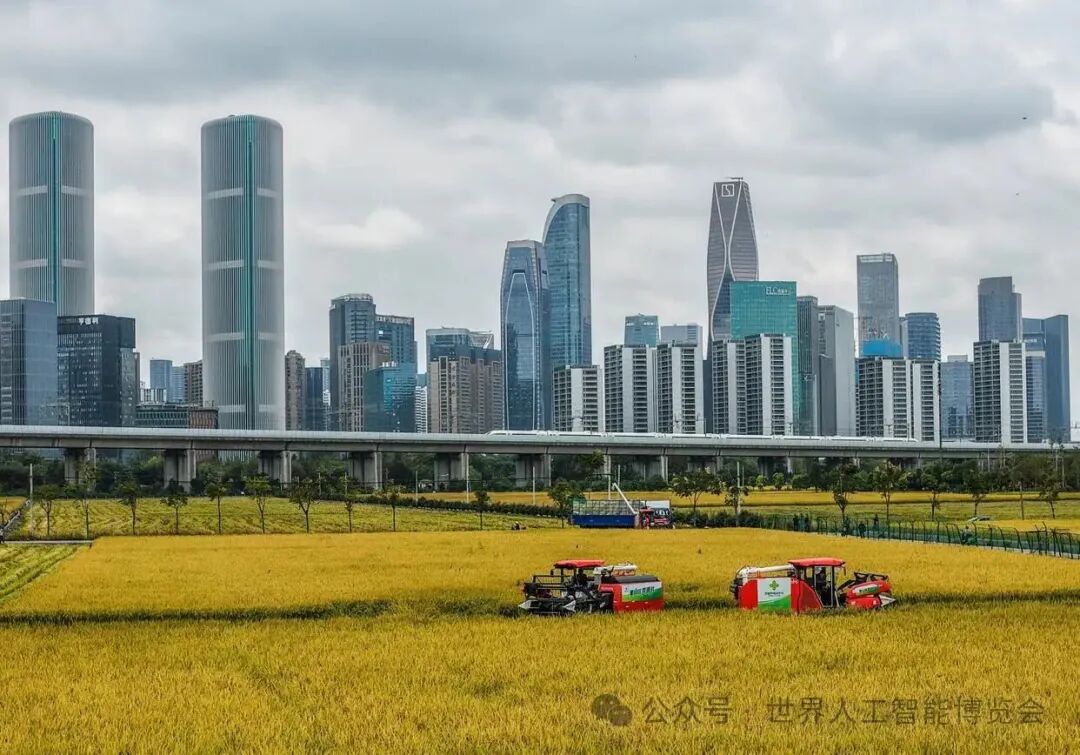
More than 3,000 acres of rice in the Century Agricultural Functional Zone in Xiaoshan District, Hangzhou, Zhejiang Province, have welcomed a bountiful harvest. The picture shows a harvester harvesting rice in the fields on October 21, with a high-speed train speeding by in the distance (drone photo). (Xinhua News Agency)