At Chengdu Polar Ocean Park, a boy named Xiao Chen leans against the huge glass wall, pointing at the slowly swimming beluga whale and asking, “Does it spray water? Like in the cartoons?”
Before his father can think of how to explain, the robot beside them jumps in: “Yes! That’s the beluga ‘exhaling.’ Its blowhole is on top of its head, and when it surfaces, it expels the air from its lungs, spraying it several meters high!”
This is not a scene from a heartwarming movie, but a real moment that unfolds daily at Chengdu Polar Ocean Park.

“Does the beluga spray water?” “Why is this fish’s mouth blue?” “Where do penguins spend the winter?”
Children’s questions often come out of nowhere, and most of these inquiries fall on the parents, who temporarily pull out their phones to search for answers. However, by the time they do, the child’s attention has already shifted elsewhere.
For the ocean park, some questions are indeed common, but providing one-on-one answers is challenging. There are limited numbers of guides, and while the information screens and displays are detailed, children may not necessarily pay attention to them.

Children’s questions may not have standard answers, but they crave someone to listen and respond. The curiosity of children and the anxiety of parents are giving rise to a new demand—an active, companion-based, knowledge-driven tour experience.
Chengdu Polar Ocean Park decided to entrust this task to a “new friend.”
Chengdu Polar Ocean Park chose to collaborate with Orion Star to introduce two voice-interactive robots, deployed in the Whale and Dolphin Pavilion and the Sichuan Stream Ecological Pavilion.
Unlike robots that rely on manual configuration, Orion Star’s robots can learn proprietary knowledge with a single click based on AI large models, ensuring response rates and accuracy. Additionally, both teams have localized the robots based on user expression habits, allowing them to not only understand children’s questions but also respond in a language that children can comprehend.
With the integration of Agent capabilities, the robots can not only answer questions but also proactively greet children and provide guided explanations based on their interests.
Thus, the robots have transformed from mere “tools” into companions that explore and respond alongside the children.

Children are willing to say more, walk a little slower, and return repeatedly just to chat with the robots.
During the peak summer season, the two robots worked 12 hours a day, with an average of 1,311 interactions, 319 guiding directions, and 318 guided explanations each day.
The head of the operations department at Chengdu Polar Ocean Park stated: “This summer, the number of annual pass customers has increased significantly. In terms of the number of passes sold, we have actually sold over 2,000 more than the same period last year; in terms of visit frequency, it has also improved, with annual pass customers visiting about 6 times now.“
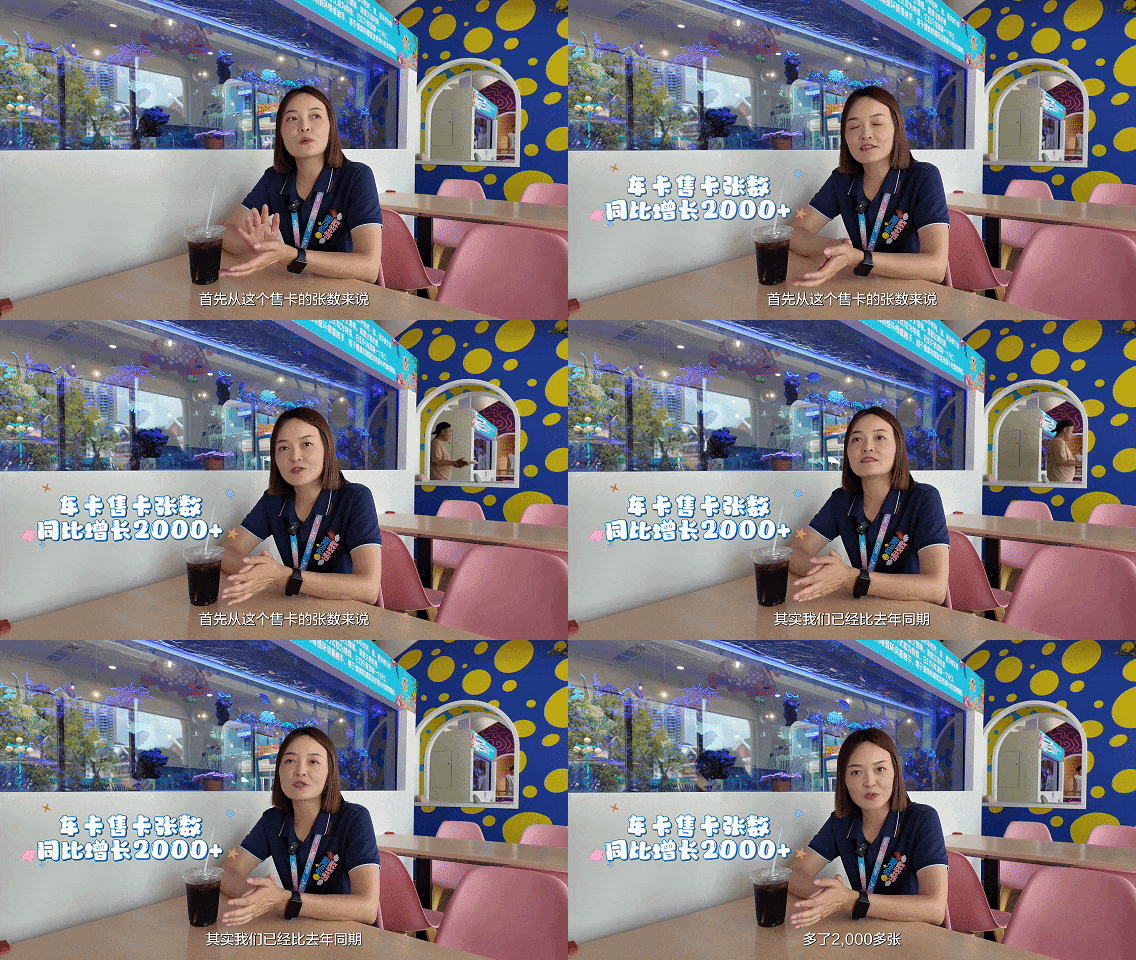
The visits from annual pass customers have given Chengdu Polar Ocean Park new insights: every year, the investment in new products and technologies allows visitors to feel the park’s vitality. “With the robots, parents and children want to greet them as soon as they enter the park.”
Thus, at Chengdu Polar Ocean Park, more and more children’s questions are receiving serious responses from the robots.
They think they are just playing, but in reality, they are gradually understanding the world and acquiring knowledge.
And this time, helping them grow is a tireless and always patient “intelligent friend.”
“For questions I can’t answer, the robot explains it to them.”
This is probably the most reassuring sentence for parents.
