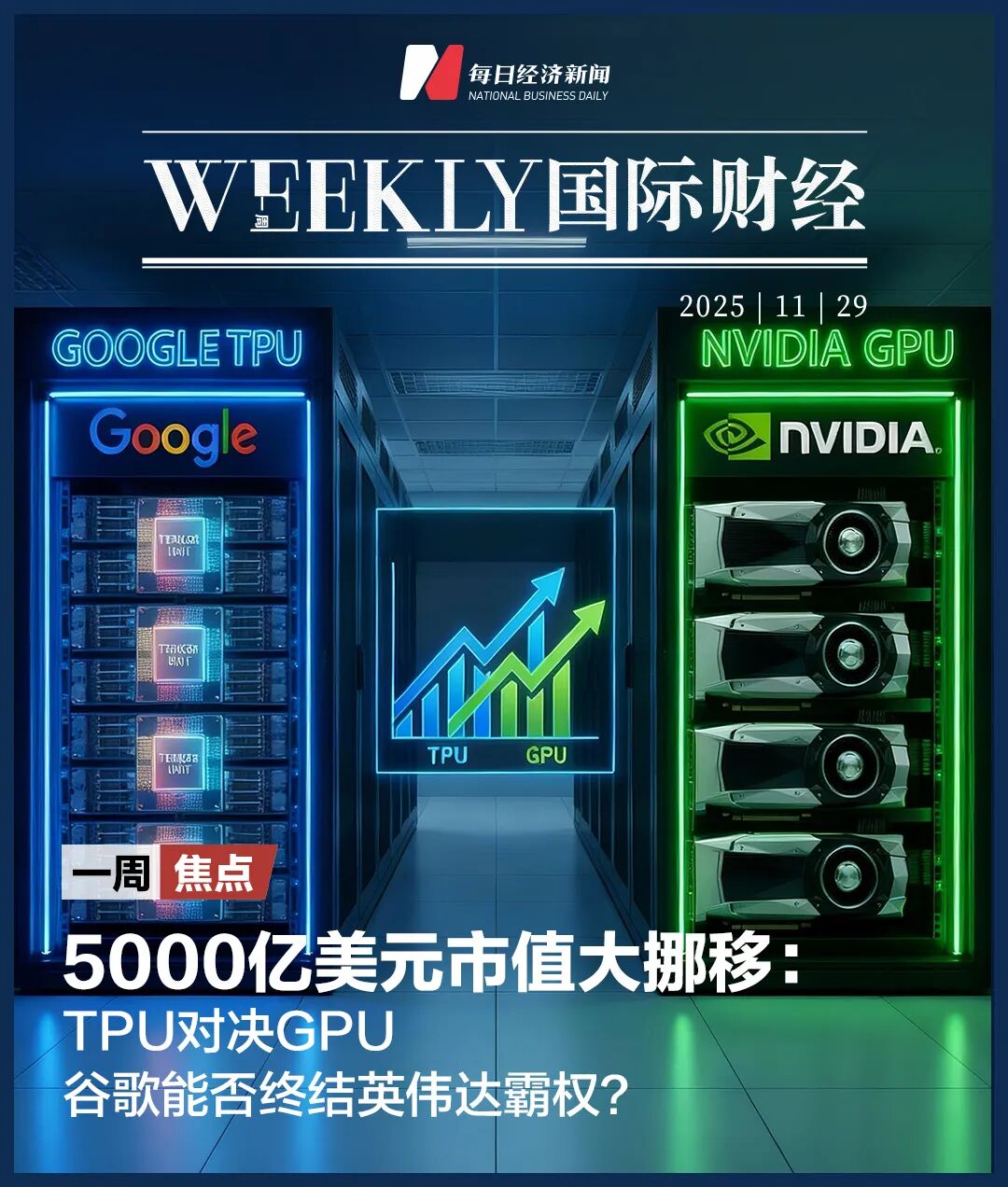
In November 2025, Google’s market value increased by approximately $530 billion, while Nvidia lost $620 billion. Behind this increase and decrease is the possibility that Meta may “switch sides” to purchase Google’s TPU chips, challenging Nvidia’s dominance in the GPU market.
The TPU and GPU have different technical routes, sparking debates on Wall Street regarding Nvidia’s position. The “win-win faction” believes the market is large enough, while the “threat faction” worries about the risks posed by Google’s ecosystem.
In November 2025, a significant market shift of over $500 billion occurred between Nvidia and Google: Google’s parent company Alphabet saw its market value grow by approximately $530 billion, aiming for $4 trillion; meanwhile, the AI chip “dominant player” lost $620 billion (approximately 4.39 trillion yuan).
Behind this increase and decrease is a rumor that could reshape the industry landscape: Meta is in talks with Google, planning to spend billions of dollars to purchase Google’s TPU (Tensor Processing Unit) chips by 2027. As a core customer of Nvidia, Meta’s computing power needs have heavily relied on its GPU chips, and switching sides would directly impact Nvidia’s nearly 85% market share.
This is not just a simple loss of customers, but a game of technical routes. Google’s TPU chip, honed over a decade, has opened a gap with an energy efficiency ratio 2-3 times that of GPUs, and the performance of the seventh-generation product, Ironwood, has surged fourfold compared to its predecessor. Is Nvidia’s CUDA ecosystem truly unassailable? What changes will the trillion-dollar AI chip race bring?

Image Source: Reporter Zheng Yuhang

TPU Surprise Attack: Google’s Market Value Increases by Approximately $530 Billion
Nvidia Loses $620 Billion
In November 2025, the stock prices of the two giants in the global AI chip field, Google and Nvidia, showed significant divergence. Alphabet, Google’s parent company, saw its stock price rise by 13.87% this month, with a year-to-date increase of 69%; while Nvidia’s stock price fell nearly 12.59% during the same period, with a year-to-date increase narrowing to 27.96%.This month, Google’s market value increased by approximately $530 billion, approaching $4 trillion; while Nvidia’s market value evaporated by $620 billion.
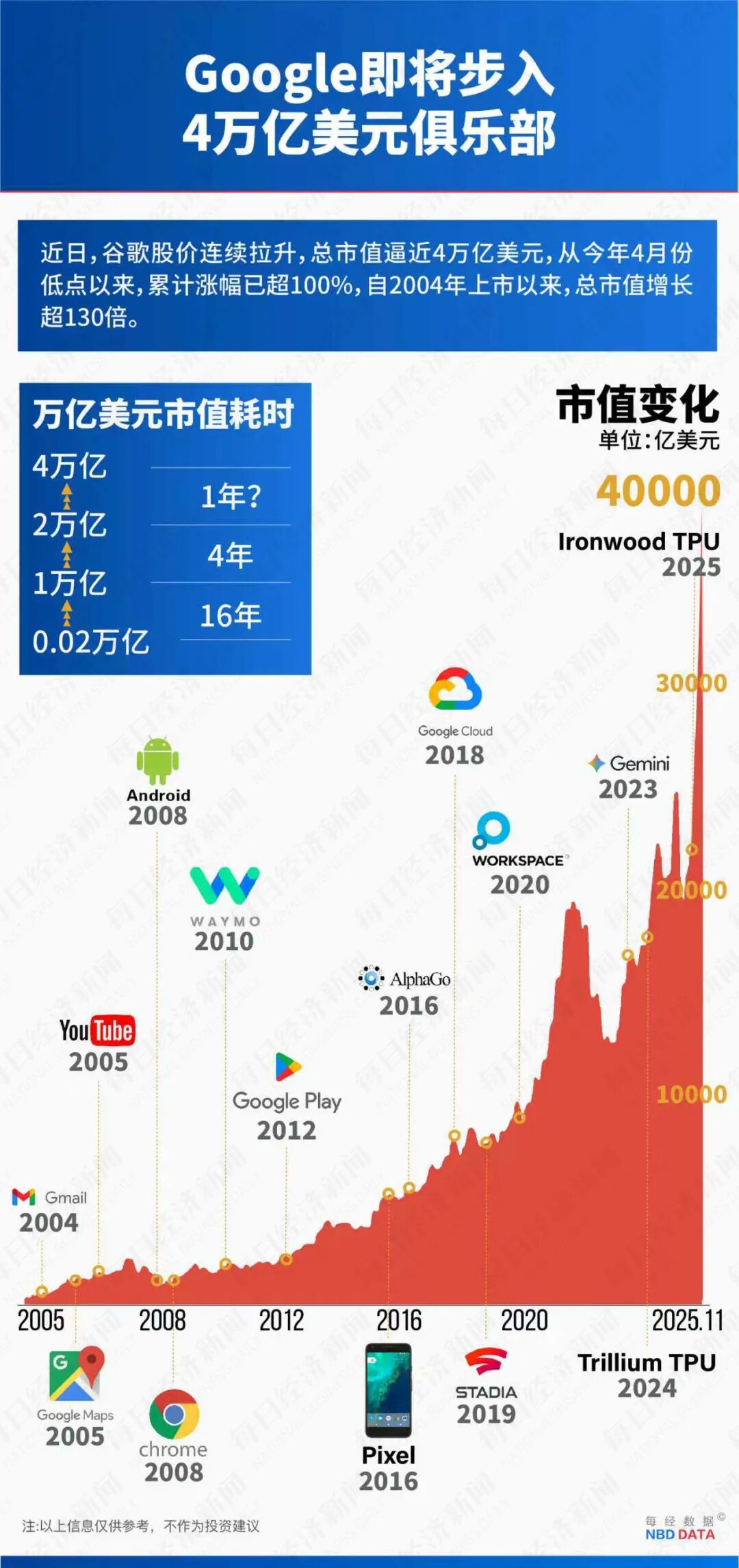
The core of this difference is the market’s sensitive reaction to the changing competitive landscape of AI chips.
The trigger for the stock price divergence originated from market rumors on November 24: Meta is in deep discussions with Google, planning to spend billions of dollars by 2027 to purchase Google TPU chips for deployment in its own data centers, and may rent Google Cloud TPU computing power starting in 2026.As a core customer of Nvidia, if Meta “switches sides” to Google, it will directly impact Nvidia’s market dominance.
The news quickly triggered a chain reaction in the industry chain: Google’s TPU joint manufacturer Broadcom (responsible for chip design and supply chain management, with TSMC handling manufacturing) saw its stock price rise over 16% this week, while other companies in Google’s supply chain also strengthened; Nvidia, on the other hand, faced significant pressure—despite its latest financial report exceeding Wall Street expectations, its stock price still fell the day after the report, with a cumulative decline of over 2% this week. Coupled with discussions around the “AI bubble” and controversies surrounding the “circular financing” of star companies like OpenAI, Nvidia’s stock price faced additional challenges.
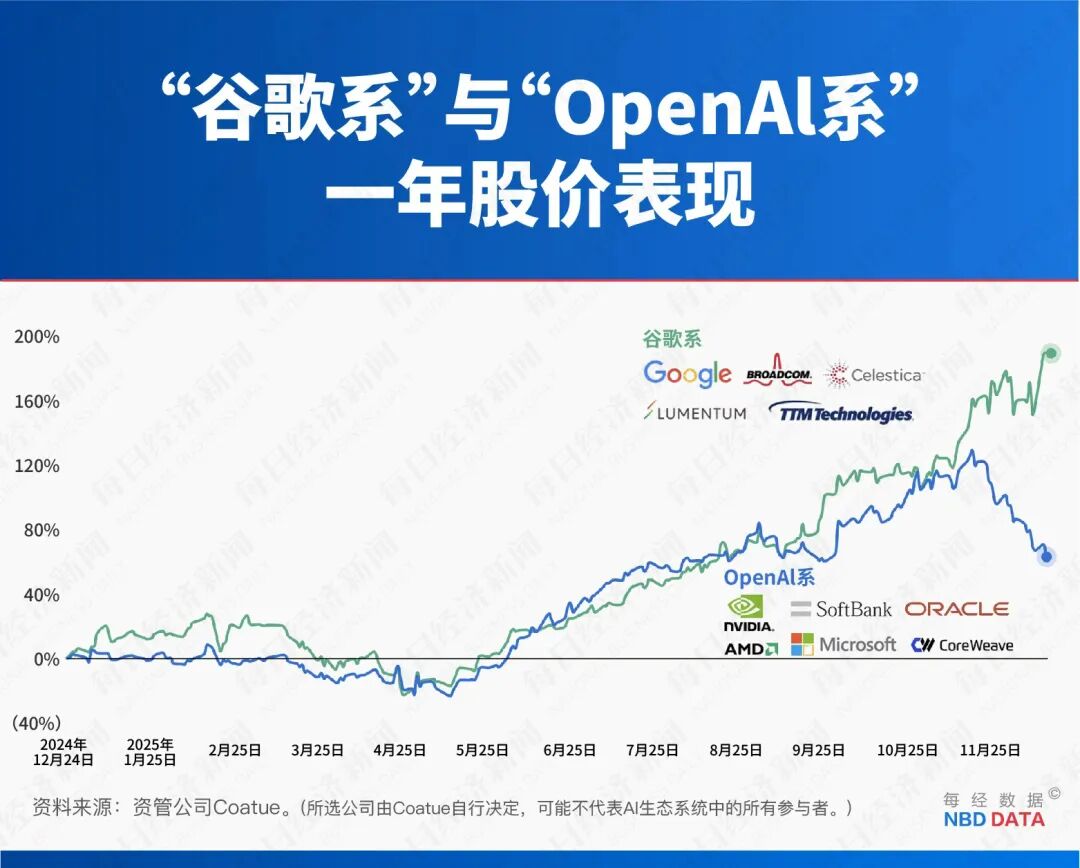
Research firm Melius Research analyst Ben Reitzes pointed out that Google is the “most vertically integrated hyperscale vendor,” possessing self-developed TPU chips and customized network devices, which may reduce its reliance on external suppliers like Nvidia, AMD, and Arista Networks in the long run.
In Ben Reitz’s view,Google has made a strong return in the AI field, with its latest upgraded GeminiAI model and self-developed TPU leading some investors to believe that Google will win this AI war ahead of schedule.
Technical Divide Between TPU and GPU:
“Specialist” vs. “Generalist” Showdown
The differences in technical routes between AI-specific chips (TPU, Tensor Processing Unit) and general processors (GPU, Graphics Processing Unit) determine their respective market positioning and competitiveness.
The evolution of Google’s TPU is a nearly ten-year history of technological iteration through seven generations.Each generation of TPU has continuously improved in computing acceleration, energy efficiency, and scalability, solidifying its leading position as a dedicated chip for AI workloads, especially in large-scale model training and inference scenarios within the Google Cloud ecosystem.
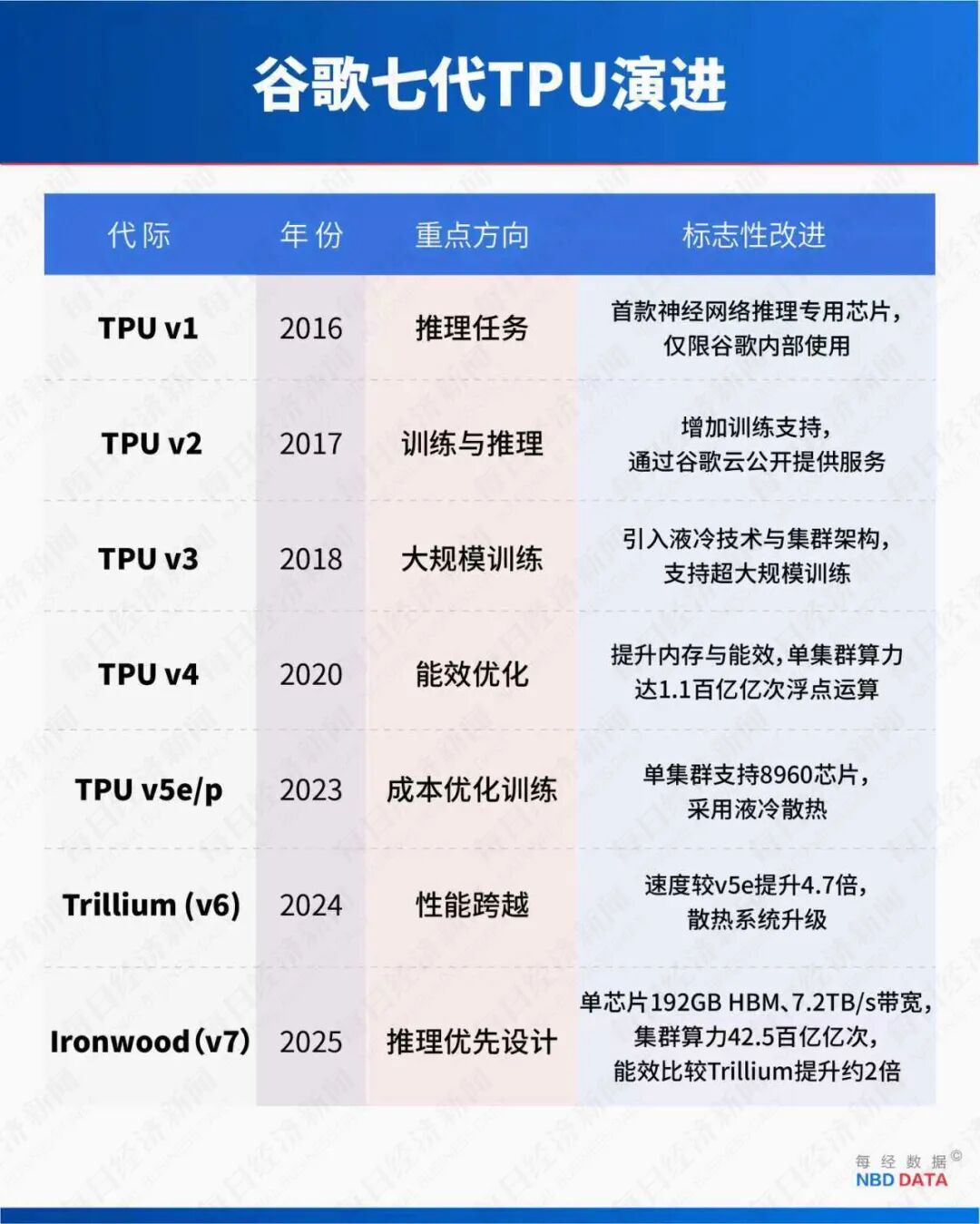
The seventh-generation product is also the first TPU product sold externally; previously, Google only provided rental computing power services. Morgan Stanley’s Brian Nowa team noted in a recent report thatby 2027, Google may ship 500,000 to 1 million TPUs externally, officially entering the global computing power market.
As an application-specific integrated circuit (ASIC), the TPU is based on a “pulsed array” core structure, specifically designed to accelerate tensor operations for neural networks, achieving energy efficiency 2-3 times higher than that of GPUs under AI workloads,making it particularly suitable for complex deep learning tasks that require long-term training, such as Google Gemini and AlphaFold.
In contrast, GPUs are based on “general flexibility,” with thousands of parallel micro-cores originally designed for graphics processing.Since the launch of Nvidia’s CUDA platform in 2006, it has achieved breakthroughs in general computing, penetrating various fields such as AI research, graphics rendering, and scientific simulation due to its programmability and mature ecosystems like PyTorch and TensorFlow. For developers needing custom operations or cross-framework switching, the flexibility of GPUs remains a necessity.
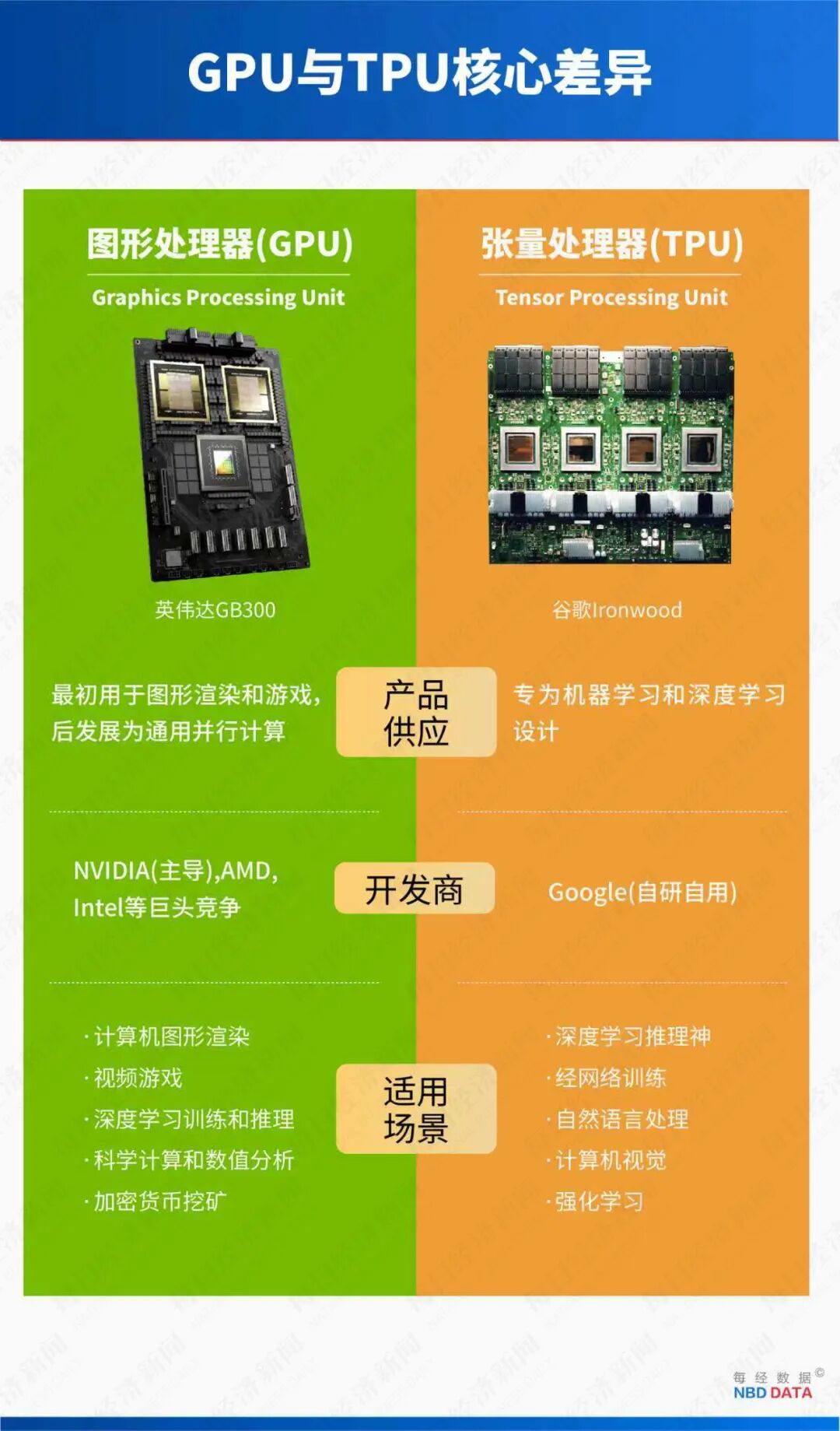
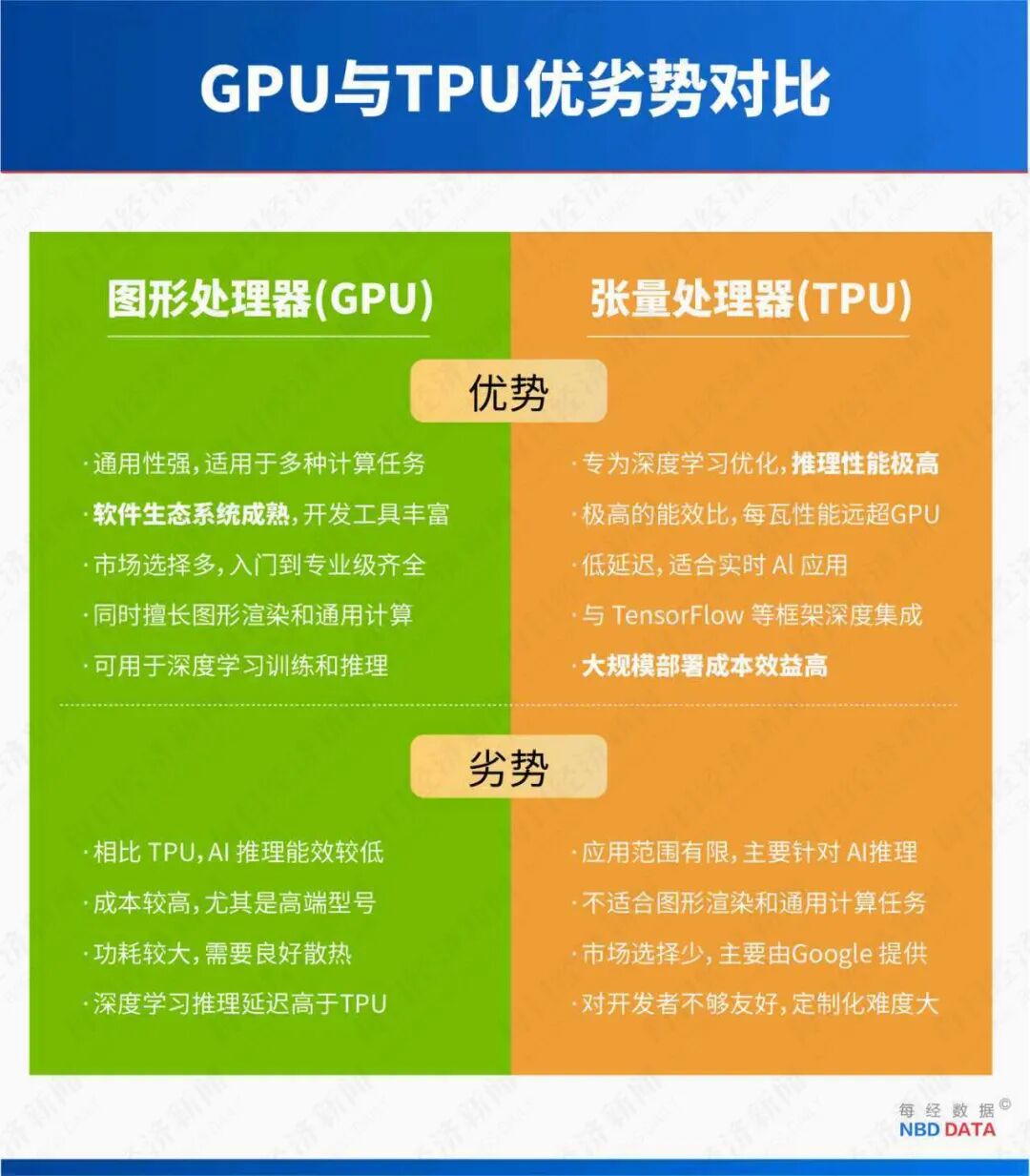
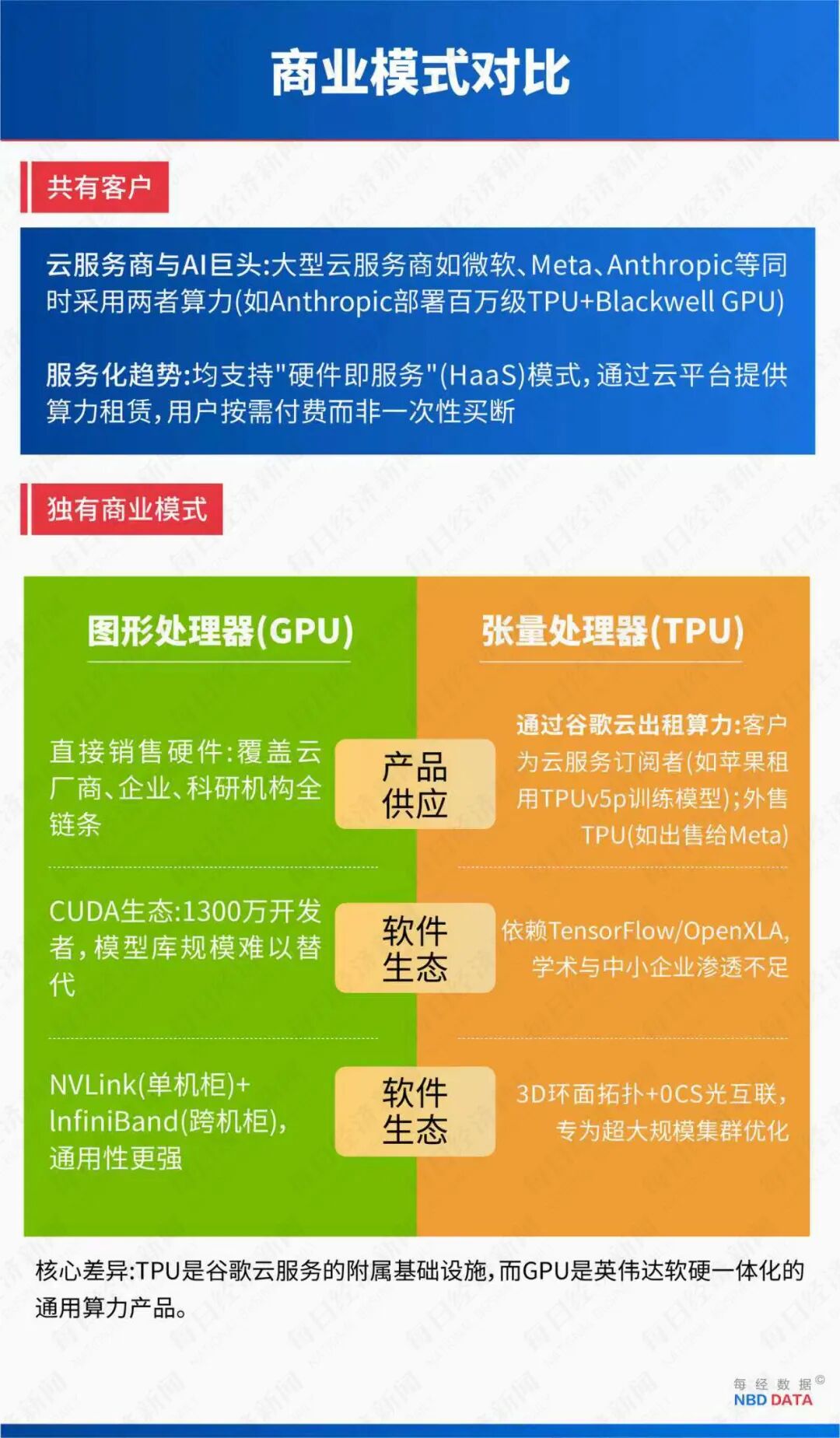
In summary, GPUs are the “general all-rounders,” dominating the market with their ecosystem advantages; while TPUs are the “AI specialists,” carving out niches with extreme efficiency.

Wall Street Debate: Is Nvidia’s “Moat” Secure?
The strong breakout of Google’s TPU has sparked intense debate on Wall Street regarding Nvidia’s market position, forming two camps: the “win-win faction” and the “threat faction.”
The “win-win faction” generally believes that the market’s reaction to Google’s TPU is excessive, falling into the “zero-sum game fallacy.”
Analyst Daniel Newman from research firm Futurum Group believes that AI infrastructure is a massive market that will reach trillions of dollars in the future, capable of accommodating multiple giants like Google, Nvidia, and AMD to coexist and thrive. Bank of America analyst Vivek Arya predicts that by the end of this decade, the total market size of AI data centers will grow from $242 billion this year to $1.2 trillion.At that time, although Nvidia’s market share may drop from the current approximately 85% to 75%, it will still be the market leader.
Wedbush analyst Dan Ives compared Nvidia to “the undisputed Rocky Balboa of the AI revolution” (the protagonist of the movie “Rocky”, implying champion). He believes that the starting and ending points of the AI revolution are both centered on Nvidia, and this situation will not change in the coming years.
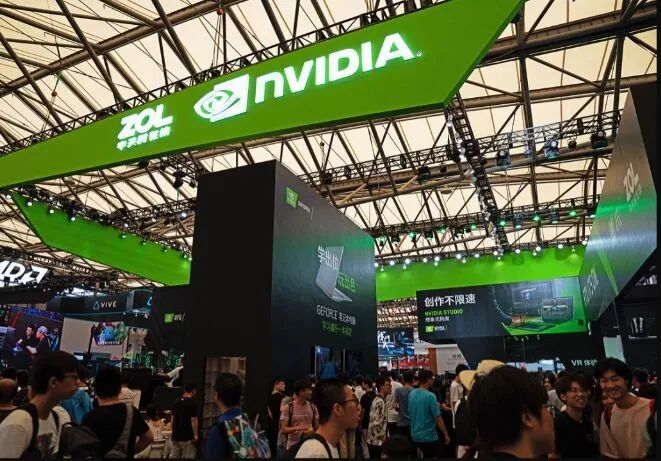
Image Source: Daily Economic News, Photographer Tan Yuhan
He emphasized that the future trillions of dollars in AI spending will benefit many tech giants, but this should not be misunderstood as a threat to Nvidia’s champion status. From another perspective,Google’s progress with TPU, like AMD’s recent successes, is a healthy sign for the AI chip market, and more giants will join this “AI arms race” in the future.
However, the “threat faction” believes that Google is the only company capable of full-stack vertical integration, from underlying chips, customized networks, compilers to upper-layer AI models and applications.This capability allows it to build a closed but efficient ecosystem, posing a substantial threat to Nvidia.
Ben Reitz warned that if Google wins the AI war, it will impact hardware suppliers like Nvidia and AMD, as well as cloud service providers like Microsoft and Amazon.
The focus of the controversy centers on Nvidia’s core “moat”—the CUDA software platform. Mizuho Securities analyst Vijay Rakesh pointed out thatthe vast developer community and tool library accumulated over more than a decade of CUDA create a very high barrier to entry.Although Google has launched programming languages like JAX and attempted to lower the usage threshold through software like TPU command center, it still has a long way to go to shake CUDA’s “standard” status.
Analyst David Wang from CMB International also believes that AI models are still evolving, and while ASICs have advantages in energy consumption and efficiency, the initial investment and technical barriers associated with algorithm integration are high, and the number of companies capable of self-developing ASIC chips is limited.The short-term increase in ASIC market share does not affect Nvidia’s industry-leading position.
However, market cracks have begun to appear: Google previously announced it would supply up to 1 million TPU chips to AI startup Anthropic, a move seen as a long-term challenge to Nvidia’s dominance. The potential collaboration with Meta further suggests that TPU could become a significant alternative to Nvidia chips among large-scale customers.
Asset management company Future Fund’s Gary Black believes thatalthough Nvidia chips are still the gold standard for computing power, the rumors of collaboration between Google and Meta mark the rise of alternatives.
In response, Nvidia is actively addressing the situation: CEO Jensen Huang is closely monitoring TPU developments, binding investments with potential customers like OpenAI and Anthropic, and emphasizing that its platform is “a generation ahead of the industry” and “supports all-scenario AI computing” to counter the limitations of TPU’s specificity.
(Disclaimer: The content and data in this article are for reference only and do not constitute investment advice. Investors act at their own risk based on this information.)
Reporter|Yue Chupeng
Editor|He Xiaotao Gao Han Yi QijiangProofreader|Duàn Liàn

|Daily Economic News nbdnews Original Article|Unauthorized reproduction, excerpting, copying, and mirroring are prohibitedIf you need to reprint, please apply for authorization from the official account.