Security Operations Center (SOC), also known as Information Security Operations Center (ISOC), is a center that integrates personnel, processes, and technology, responsible for 24/7 monitoring of all activities across endpoints, servers, databases, web applications, websites, and other systems to detect potential threats in real-time; preventing, analyzing, and responding to cybersecurity incidents to improve the organization’s cybersecurity posture.
SOC can also collect the latest threat intelligence, track infrastructure and attack groups, and proactively deploy security measures to identify and remediate vulnerabilities in systems or processes before attackers exploit them.

SOCWhat are its core functions?
1.Threat Detection and Response
Identifying abnormal activities through log analysis and Indicators of Compromise (IoC), detecting potential attacks in real-time.
Utilizing Security Information and Event Management (SIEM) tools to aggregate log data and generate alerts.
2.Asset and Vulnerability Management
Inventorying network assets (servers, databases, applications, etc.), assessing vulnerabilities, and developing remediation plans.
Implementing patch updates, firewall adjustments, and security policy optimizations.
3.Incident Response
Isolating infected devices, running antivirus tools, and analyzing the root cause of incidents.
Developing incident response plans to address future attacks.
SOCWhat is its role?
Organizations can configure the functions of the SOC according to their needs. Generally, the functions of the SOC are divided into three parts:
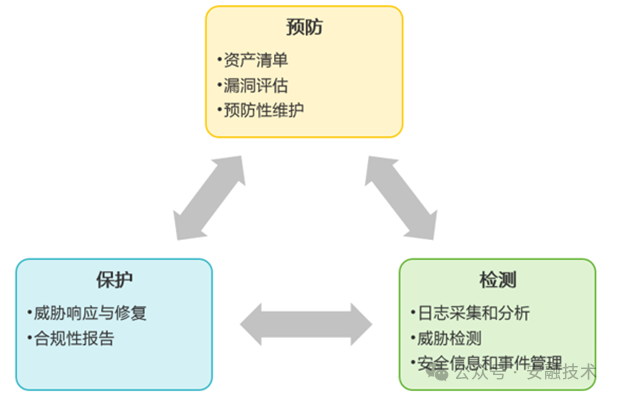
SOCHow to select?
IT leaders in organizations can approach the selection of Security Operations Center (SOC) products from the following key aspects:
1.Clarify Your Needs
• Business needs assessment
• Understand the security needs of various business systems in depth; for example, the financial industry may focus more on transaction security and data compliance, while internet companies may prioritize network security and user privacy protection. Clearly identify the critical data, important assets, and potential security risk points of business systems so that the SOC product can monitor and protect accordingly.
• Consider the organization’s business scale and future development plans, selecting a SOC product that can flexibly scale to meet changing security needs as the business grows. For instance, if the organization plans to expand new business lines or increase user numbers in the future, the SOC product should have the corresponding scalability to cope.
• Define security objectives
• Based on the organization’s security strategy, determine the security objectives that the SOC product needs to achieve, such as reducing the frequency of security incidents, shortening the response time to security incidents, and minimizing losses caused by security incidents. These objectives will guide IT leaders to focus on specific functions and performance indicators of the product during the selection process, such as the accuracy of event detection and automated response capabilities.
2.Evaluate Product Functions
• Data collection and integration capabilities
• Check whether the SOC product supports the collection of various data sources, including but not limited to network device logs, server logs, application logs, cloud service logs, etc. For example, for organizations using multiple cloud services, the SOC product should be able to effectively interface with mainstream cloud platforms (such as Alibaba Cloud, Tencent Cloud, AWS, etc.) to collect relevant security data.
• Assess its data integration capabilities, whether it can standardize and unify data from different formats and sources for effective analysis and correlation later. For example, using data transformation tools or built-in data integration engines to convert Syslog logs, JSON formatted logs, etc., into formats suitable for analysis.
• Security analysis and detection capabilities
• Focus on the product’s security analysis engine, including rule engines, machine learning engines, threat intelligence engines, etc. The rule engine should have a flexible rule definition and update mechanism, allowing for quick customization of rules based on the organization’s own security policies and business scenarios. The machine learning engine should have the capability to learn and analyze massive amounts of data, automatically discovering unknown threats and anomalous behaviors.
• Understand its integration and application of threat intelligence, whether it can obtain and update external threat intelligence in real-time, such as malicious IP address databases, malicious domain databases, etc., and correlate it with internal data to enhance detection capabilities for advanced threats.
• Incident response and handling capabilities
• Examine the SOC product’s automated response functions, such as whether it can automatically trigger security incident response processes based on predefined rules, including blocking network connections, isolating infected devices, restoring system states, etc. For example, upon detecting a malware intrusion, it should automatically isolate the infected endpoint to prevent further spread of the malware.
• Evaluate its integration capabilities with existing security tools and systems in the organization, such as firewalls, intrusion detection systems, endpoint security software, etc., to achieve coordinated response and handling, improving overall security protection effectiveness. For instance, the SOC product can interact with firewalls to automatically adjust access control policies based on detected threats.
3.Consider Technical Architecture
• Scalability
• Choose a SOC product that adopts a modular architecture, making it easier to expand and upgrade functions based on future needs. For example, as the organization’s requirements for data privacy protection increase, it should be easy to add privacy protection modules.
• Focus on its scalability in data processing and storage, whether it can support rapid growth in organizational data volume, such as improving system scalability through distributed storage and computing architectures.
• Compatibility
• Ensure that the SOC product is compatible with the organization’s existing IT infrastructure and security systems, including operating systems, databases, middleware, etc. For example, if the organization heavily uses Linux operating systems, the SOC product should support data collection and analysis in the Linux environment well.
• Consider its compatibility with other security products, such as whether it can seamlessly integrate with existing identity authentication systems, encryption systems, etc., to form a unified security protection system.
4.Emphasize Vendor Strength
• Technical strength and innovation capability
• Understand the vendor’s investment in technology research and development in the security field and its innovation capabilities, whether it can continuously update and optimize the SOC product to address the ever-changing security threats. For example, whether the vendor has a dedicated security research team that can promptly identify and respond to new attack methods.
• Check the vendor’s patents and intellectual property status in SOC technology, which reflects its technical strength and innovation capabilities to some extent.
• Service capability and support
• Assess the vendor’s pre-sales, sales, and post-sales service capabilities, including the professionalism, response speed, and service attitude of the technical support team. For example, whether they can provide 7×24 hours of technical support service to promptly resolve issues encountered by the organization during use.
• Understand the vendor’s training and consulting service situation, whether they can provide comprehensive SOC product training to help the organization’s security team quickly master the product’s usage and maintenance skills.
5.Focus on Cost and Benefits
• Cost assessment
• Consider the procurement cost, deployment cost, and operational cost of the SOC product comprehensively. In addition to the purchase cost of the product itself, consider the investment in hardware, network bandwidth, storage resources, etc., as well as the costs of software upgrades, technical support, and personnel training in the future.
• Calculate the Total Cost of Ownership (TCO), assessing the overall cost of using the SOC product over a certain period, including direct and indirect costs, such as savings from reduced losses due to security incidents.
• Benefit measurement
• Evaluate the effectiveness of the SOC product in enhancing the organization’s security protection capabilities, such as whether it can effectively reduce the occurrence rate of security incidents and decrease the time taken to handle security incidents.
Interpretation of Analysis and Considerations for SOC Technology Selection:
• Data Collection Technology Selection
• Syslog: This is a standardized log transmission protocol widely used in various devices and systems, capable of transmitting log information in a unified format to the SOC platform for centralized management and analysis.
• API Interfaces: Through interfaces such as RESTful API, data interaction with various application systems, cloud services, etc., can be achieved to obtain richer data sources, such as user operation records of business systems, resource usage of cloud platforms, etc., to meet the SOC needs for multi-source data collection.
• Agent: In scenarios requiring deep data collection, deploying lightweight Agent clients can achieve detailed monitoring and data collection of hosts, servers, etc., including system performance metrics, process information, file changes, etc., helping to promptly identify potential security threats.
• Network Mirroring: For the collection of network traffic data, network mirroring technology can real-time replicate traffic information in the network, providing the SOC with raw network communication data for detecting network attacks, data leaks, and other network-related security events.
• Data Storage Technology Selection
• Elasticsearch: It has powerful full-text search capabilities, able to quickly search and query massive log data, while supporting flexible data indexing and distributed storage architecture, suitable for storing and managing structured and unstructured log data, facilitating event correlation analysis and historical data tracing for the SOC.
• InfluxDB: Focused on the storage and processing of time-series data, for data related to network traffic, system performance metrics, etc., InfluxDB can efficiently store and query data that changes over time, supporting high-concurrency writes and fast reads, aiding in real-time monitoring and analysis of time-series security data.
• Neo4j: As a graph database, Neo4j can model and store entities and relationships in security events, such as the relationships between users and devices, IP addresses and attack behaviors, etc. Through graph algorithms, it can quickly discover security threat patterns hidden in complex relationships, providing strong support for deep analysis and threat hunting in the SOC.
• HDFS: For large-scale data storage needs, HDFS, as a distributed storage system for big data, has high reliability and scalability, capable of storing massive raw log data and analysis result data, providing foundational support for long-term data retention and offline analysis in the SOC.
• Real-time Computing Technology Selection
• Apache Kafka: As a high-throughput message queue system, Kafka can efficiently receive and buffer real-time data streams from different data sources, ensuring the order and integrity of the data, and supports distributed deployment and high availability, providing a stable data transmission channel for real-time data processing in the SOC, ensuring timely access to the latest security event data.
• Apache Storm/Flink: These two real-time stream computing frameworks can perform real-time computation and analysis on data streams in Kafka, quickly processing and responding to security events, such as real-time anomaly detection on network traffic data, real-time risk assessment on user behavior data, etc., achieving timely discovery and early warning of security threats.
• Redis: As a high-speed caching and session storage system, Redis can store frequently accessed data and temporary session information, such as user login status, security policy cache, etc., improving the data reading speed and processing efficiency of the SOC system, accelerating the response speed to real-time security events.
• Security Analysis Technology Selection
• Rule-based analysis: By using predefined security rules, such as specific attack characteristics, anomalous behavior patterns, etc., to match and detect the collected data, it can quickly discover known security threats, suitable for common attack scenarios and compliance checks, but has limited detection capabilities for new threats.
• Machine learning and artificial intelligence analysis: Utilizing machine learning algorithms and artificial intelligence models, such as supervised learning, unsupervised learning, deep learning, etc., to learn and analyze large amounts of historical and real-time data, automatically discovering hidden patterns and anomalous behaviors in the data, improving detection capabilities for unknown threats and complex attacks, such as anomaly detection based on user behavior analysis, DDoS attack detection based on network traffic, etc., but requires substantial data and computing resources for model training and optimization.
• Threat intelligence integration: Integrating external threat intelligence sources with the SOC system, such as malicious IP address databases, malware sample libraries, APT organization information, etc., and performing correlation analysis with internal real-time data can timely discover security events related to known threats and take preventive measures in advance, enhancing the SOC‘s defense capabilities against advanced threats.
• Visualization Technology Selection
• Data visualization tools: Choose powerful and user-friendly data visualization tools, such as Tableau, Qlik Sense, Kibana, etc., that can present complex SOC data in intuitive charts, dashboards, etc., such as security event statistics charts, network topology maps, security situation maps, etc., helping security analysts quickly understand the current security status and trends, facilitating decision-making and reporting.
• Customized visualization development: For some special visualization needs, customized development may be required, such as developing visualization interfaces with specific interactive functions, integrating data from other internal systems, etc., which requires considering the development flexibility and scalability of the selected technology, as well as compatibility with existing systems.