Click the blue text above to follow us

Introduction

On November 24, 2025, the European Commission organized a simulation exercise in Brussels regarding semiconductor supply chain disruptions, aimed at enhancing Europe’s preparedness for crises under the “EU Chips Act”.

1. Overview of the Drill: A Simulation and Response to a “Chip Crisis”
ARTIFICIAL INTELLIGENCE
The ChipDiplo Alliance, co-funded by the EU, facilitated this event by constructing a fictional yet plausible scenario that impacts global semiconductor manufacturing centers, leading to supply chain disruptions.
The drill has been in preparation for several months, with participants from all 27 member states, including members of the European Semiconductor Council and the Council’s Competitiveness and Growth Working Group.
During the event, participants analyzed the impact of chip shortages on European industries, particularly in critical areas such as energy, transportation, healthcare, digital infrastructure, aerospace, security, and defense—sectors defined by the “Chips Act”.
Attendees discussed options to mitigate the crisis’s impact, including mechanisms from the EU Chips Act crisis toolbox.
These exercises fostered cohesion and consensus among EU member states and institutions regarding the challenges of semiconductor supply chain resilience.

2. What Constitutes a Crisis? The Two “Red Lines” Defined by the Act
ARTIFICIAL INTELLIGENCE
According to Article 23 of the “EU Chips Act”, a semiconductor crisis is deemed to occur when both of the following conditions are met:
1. Severe supply chain disruption: There is a significant disruption in the semiconductor supply chain within the EU, or there are serious obstacles to semiconductor trade, leading to a substantial shortage of semiconductors, intermediate products, and raw materials.
2. Serious impact on critical sectors: The aforementioned shortages hinder the supply, maintenance, or servicing of essential products used by critical sectors, causing significant damage to their operations due to their impact on social, economic, and union security.

In simple terms, the supply chain issues must be severe enough, and the shortages must actually impact core industries that sustain social operations, such as energy, transportation, healthcare, and digital infrastructure, for a crisis state to be officially recognized.

3. How to Respond? The “Roadmap” for Crisis Activation and Management
ARTIFICIAL INTELLIGENCE
The “Chips Act” does not automatically activate crisis responses; rather, it has a clear decision-making process and management mechanism:
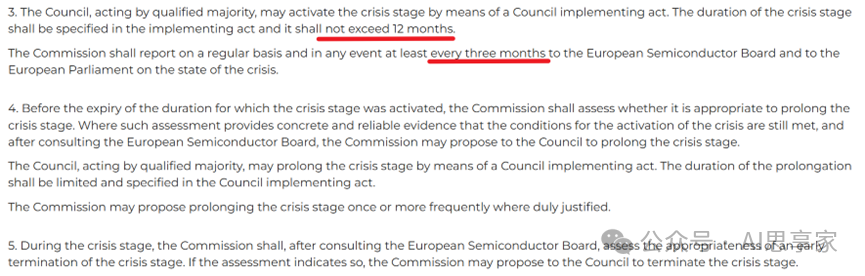
• Decision-making and timelines: The activation of a crisis must be proposed by the European Commission after consulting the European Semiconductor Council, and then approved by the EU Council through a qualified majority vote to take effect. Once activated, the initial duration of the crisis phase shall not exceed 12 months.
• Monitoring and reporting: During the crisis, the European Commission must report the status of the crisis to the European Semiconductor Council and the European Parliament at least every three months.
• Extension and termination: If the crisis is not resolved by the expiration date, the Commission may recommend an extension to the Council, but each extension must be justified and have a clear timeframe. Similarly, if the crisis ends early, the Council may decide to terminate the crisis phase based on assessment results.

4. Underlying Reasons: Why is the EU Preparing in Advance?
ARTIFICIAL INTELLIGENCE
The reason the “EU Chips Act” places crisis response as a core component is that the EU deeply recognizes the vulnerability and strategic importance of the semiconductor supply chain. The preamble of the Act mentions that the global chip shortage caused by the COVID-19 pandemic severely impacted various industries in Europe, especially the automotive sector, highlighting the EU’s excessive reliance on foreign chip suppliers. This dependency is seen as a structural weakness that threatens Europe’s economic security and digital sovereignty.
Therefore, establishing a clear crisis monitoring and response mechanism through legislation aims to enhance the EU’s ability to foresee and withstand future crises, ensuring that coordinated actions can be swiftly taken to maintain the operation of critical sectors during severe supply chain disruptions.

5. Key Role: The ChipDiplo Alliance
ARTIFICIAL INTELLIGENCE
The ChipDiplo Alliance serves as the EU’s “think tank + coordination center” in the field of semiconductor diplomacy, with the core mission of strengthening the EU’s economic security and developing Europe’s economic diplomacy policy.
ChipDiplo’s three main missions:
-
Enhance risk assessment and information sharing among EU semiconductor stakeholders,
-
Improve internal coordination,
-
Promote effective international collaboration through balanced external partnerships.
Conclusion

This proactive drill indicates that the EU is shifting from passive responses to actively positioning itself in the global semiconductor game. Through legislation and coordinated actions, the EU aims to strengthen supply chain security and be well-prepared for future uncertainties and challenges.
Reference Links:
https://digital-strategy.ec.europa.eu/en/news/commission-and-member-states-rehearse-coordinated-response-semiconductor-supply-chain-shortages
https://www.european-chips-act.com/European_Chips_Act_Article_23.html
https://digital-strategy.ec.europa.eu/en/news/chipdiplo-consortium-selected-support-international-diplomacy-semiconductors

end
*This article is copyrighted by the 【AI Think Tank】 public account, please indicate the source when reprinting.