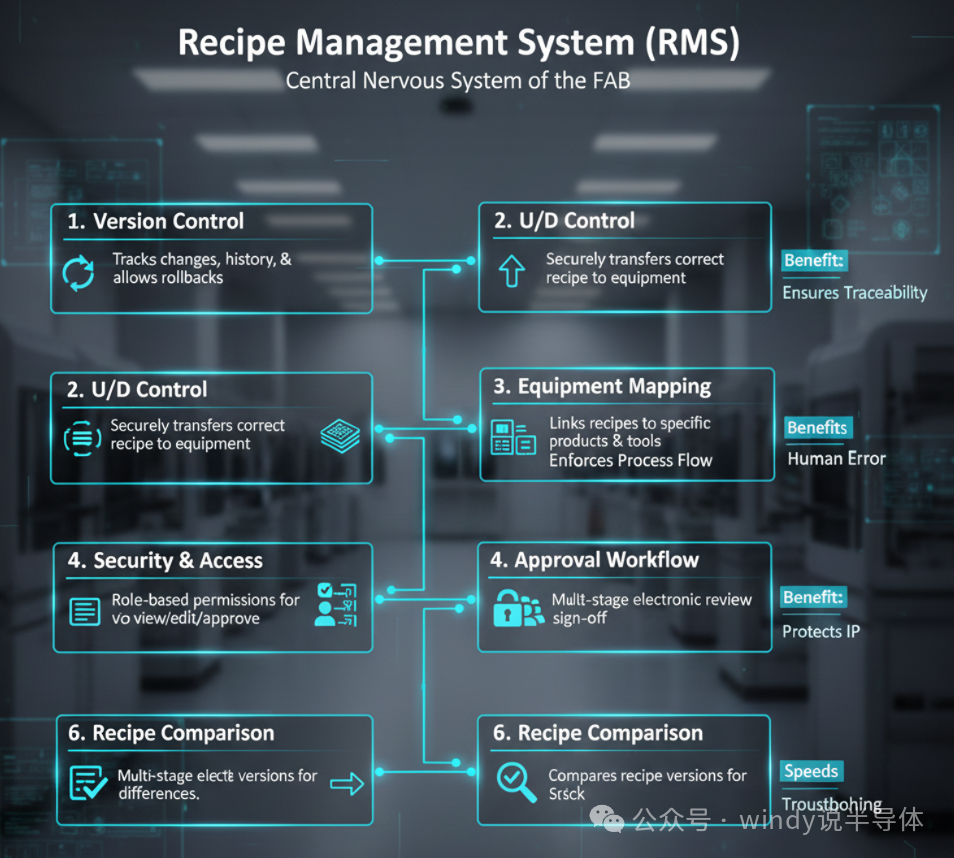
In the highly automated and demanding environment of semiconductor manufacturing, ensuring the precision and repeatability of thousands of process steps is key to success. The Recipe Management System (RMS) is one of the core infrastructures to achieve this goal. RMS is not just a document repository; it is the “neural hub” connecting process engineers, automation systems, and production equipment.
1. What is a Semiconductor Recipe?
In semiconductor manufacturing, a “recipe” refers to a detailed set of instructions used to control specific equipment (such as etchers, deposition furnaces, photolithography machines, etc.) to perform specific process steps. A recipe contains hundreds or even thousands of parameters, such as:
-
Temperature
-
Pressure
-
Gas Flow Rates
-
RF Power
-
Process Time
-
Wafer Transfer Sequence
A slight deviation in any parameter can lead to wafer scrap, so the management of these recipes must be extremely strict and controlled.
2. Core Functions of the Recipe Management System (RMS)
A modern semiconductor RMS needs to provide the following key functions to ensure production efficiency, quality, and safety:
| Function Module | Description | Key Benefits |
| Versioning | Strictly records the history, author, and time of each change to the recipe. Allows for rollback to old, validated versions at any time. | Ensures process traceability and stability, preventing unauthorized changes. |
| Upload/Download Control | Centralized management of recipes, responsible for securely transmitting the correct recipe to designated manufacturing equipment. | Prevents Human Error, ensuring the equipment operates with the correct version. |
| Equipment Mapping | Precisely associates the required recipe version for specific products and process steps with specific equipment in the wafer fab. | Enforces process flows, ensuring wafers run the correct recipe on the right equipment. |
| Security & Access | Sets different viewing, modification, and approval permissions based on user roles (engineers, operators, maintenance personnel). | Protects critical process intellectual property (IP), preventing malicious or accidental changes. |
| Approval Workflow | Implements a multi-stage electronic approval process. New recipes or significant changes must be validated and approved by multiple engineers and managers. | Ensures all recipe changes undergocomprehensive review and risk assessment. |
| Recipe Comparison | Allows engineers to quickly compare different versions of the same recipe or similar recipes on different equipment. | Acceleratestroubleshooting and process optimization. |

3. Importance of RMS in Semiconductor Manufacturing
RMS is one of the key pillars for achieving CIM (Computer Integrated Manufacturing), and its importance is reflected in:
3.1. Ensuring Process Consistency and Yield
Imagine if a wafer in the same production batch is processed on two different etchers, each loaded with different versions of the same recipe; the final yield cannot be guaranteed. RMS ensures that all equipment uses a validated, unified recipe version during specific processes throughcentralized, version-controlled management, thereby ensuringprocess repeatability and high yield.
3.2. Increasing Automation Levels
RMS is closely integrated with MES (Manufacturing Execution System). When a wafer batch arrives at the equipment, MES informs RMS of the required recipe ID, and RMS automatically downloads the correct recipe to the equipment,eliminating the need for operator manual input or selection, significantly reducing operation time and errors.
3.3. Facilitating Knowledge Management and Transfer
Recipes are the core intellectual property of a wafer fab. RMS digitizes and structures every process improvement and parameter adjustment through detailed version history and approval processes, aiding in the long-term transfer of knowledge and rapid development of new processes.
4. Workflow of RMS (Example with MES Integration)
A typical recipe download and execution process is as follows:
-
Wafer Arrival: A wafer batch (Lot) arrives at a manufacturing device (e.g., PECVD).
-
MES Query: The device or automation system reports the Lot ID and the next process step to MES.
-
Recipe Request: MES sends a request to RMS based on the Lot’s routing and process rules: “Lot XYZ needs to execute process Step 123 on device ABC, the required recipe ID is P5.0.”
-
RMS Verification and Download:
-
RMS first verifies whether recipe version P5.0 is approved and valid.
-
RMS verifies whether device ABC is authorized to run this recipe.
-
If verification passes, RMS securely downloads the recipe file from the central database to the local controller of device ABC.
Device Execution: The device controller loads and executes recipe P5.0, processing the wafer.
Result Recording: Production data (Sensor Data, Recipe Parameters Used) is uploaded back to MES and SPC (Statistical Process Control) systems.
5. Conclusion
In the complex ecosystem of semiconductor manufacturing, the Recipe Management System (RMS) is a key tostable, safe, and efficient production. It tightly integrates core process knowledge with automated production lines, minimizing human errors and ensuring extremely high process consistency. For any wafer fab pursuing excellent yield and rapid iteration, a robust and flexible RMS is an indispensable foundation.
| Dimension | Feature/Function Description | Key Value and Benefits |
| Definition and Positioning | Centralized management and control of all manufacturing equipment (such as etchers, deposition furnaces, photolithography machines) process parameter instruction sets (i.e., recipes). | Digital carrier of the wafer fab’s core intellectual property, ensuring processuniformity. |
| Core Function: Version Control | Records timestamps and version locks for every creation, modification, and approval of recipes. Supports rollback to historical versions at any time. | Ensures processtraceability and stability, preventing unauthorized modifications that lead to yield fluctuations. |
| Core Function: Upload/Download Control | Automatically and securely transmits approved recipe versions from the central server to designated manufacturing equipment (or uploads from the equipment). | Eliminates Human Error, ensuring equipment always runs thecorrect recipe version. |
| Core Function: Approval and Permissions | Enforces multi-level electronic approval workflows (e.g., engineer → manager → QA). Manages access and modification permissions based on user roles (Role-Based Access Control, RBAC). | Ensures process safety, complying with quality management system requirements, avoiding core technology leaks or accidental damage. |
| Core Function: Equipment Mapping | Precisely associates specific products, process steps, and equipment types with uniquely approved recipe versions. | Enforces process routes, preventing wafers from using incorrect recipes on wrong equipment, achievingautomated error prevention. |
| System Integration | Deep integration with MES (Manufacturing Execution System), triggered by MES for automatic recipe downloads; connected to SPC (Statistical Process Control) systems, providing real-time monitoring data of recipe parameters. | Achieves high automation (CIM), enhancing production efficiency; incorporates recipe parameters intoquality monitoring systems. |
| Impact on Yield | Ensures high consistency of process parameters between production batches and equipment. | Maximizes yield and process repeatability, shortening new process introduction time. |
| Impact on Efficiency | Automated recipe selection and transmission process, requiring no manual intervention from operators. | Accelerates production cycle time, reducing downtime and operator workload. |