For the GESP Level 2 Exam: C++ 202409 Level 3 Palindrome ConcatenationThis is a challenging problem. For students, understanding palindromes is relatively simple, but if they do not read the problem carefully and consider the constraints, the algorithm becomes quite complex.Problem statement: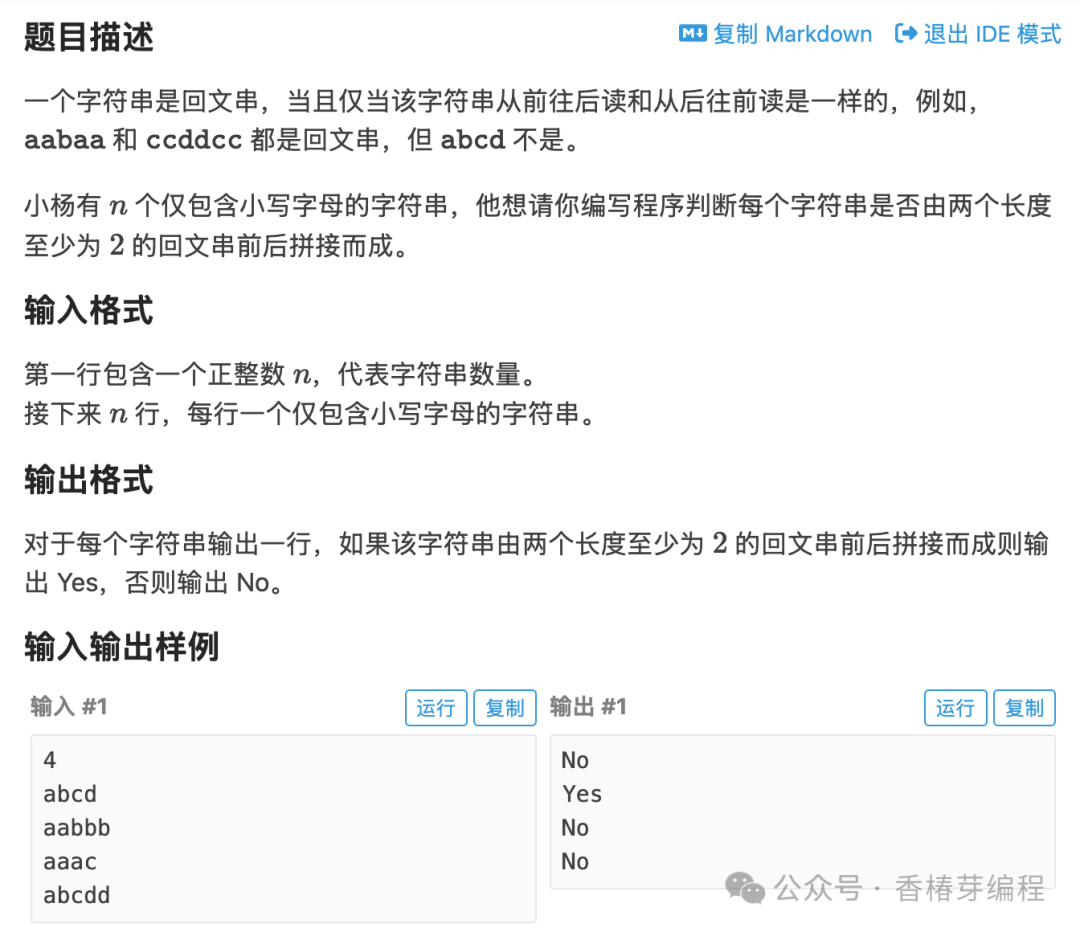
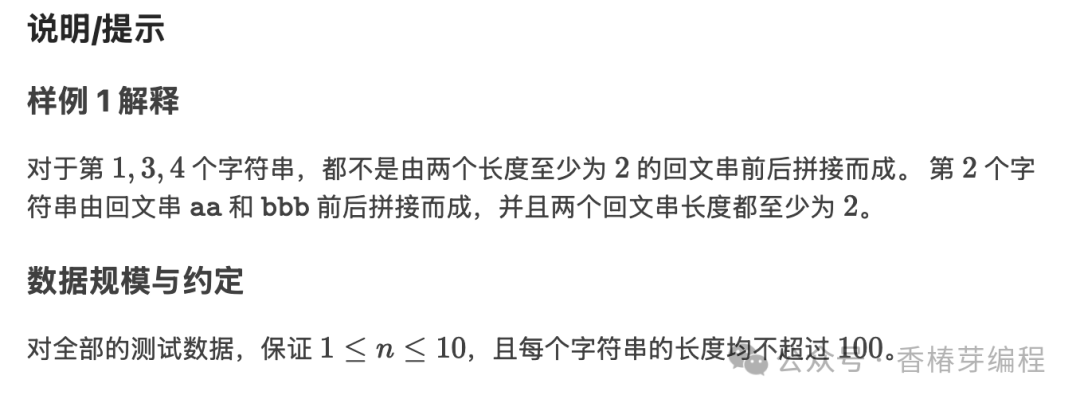
Solution Approach:
First: it is essential to read the problem carefully and not rely on one’s own assumptions about palindrome checking. Otherwise, the algorithm becomes very complicated.
Key point: The requirement is for two palindromes (abcbaaaaccc, which does not satisfy the palindrome requirement of the problem), many students make assumptions.
Finally: the length must be greater than 2.
#include <bits/stdc++.h>using namespace std;int main(){ int n; cin >> n; while (n--) { // Simplified loop structure string s; cin >> s; string flag = "No"; // Define flag int len = s.size(); // Split position j: length of the first half is j (at least 2), length of the second half is len-j (at least 2) for (int j = 2; j <= len - 2; j++) { string s1 = s.substr(0, j); // First half: [0, j) string s2 = s.substr(j); // Second half: [j, end), adjust split position string s1_r = s1; reverse(s1_r.begin(), s1_r.end()); // Reverse string string s2_r = s2; reverse(s2_r.begin(), s2_r.end()); // Reverse string // Check if both parts are palindromes if ((s1 == s1_r) && (s2 == s2_r)) { flag = "Yes"; break; // Exit loop immediately upon finding } } cout << flag << endl; // Output flag } return 0;}
reverse(v.begin(), v.end()); means to “reverse the order” of a sequence (such as an array, string, or container) – like flipping a string of beads from left to right, swapping the first and last elements, the second and second-to-last, until reaching the middle.Example: Array [1,2,3,4,5] reversed → [5,4,3,2,1] String “abcde” reversed → “edcba”If this method has not been taught, a loop concatenation can also yield the reversed string. |
Isn’t it simple?
The importance of reading the problem carefully; many students, under time pressure, do not read the problem thoroughly, repeatedly submit tests, try numerical patterns, and make assumptions about the logic…
| Programming! It is about training thought processes, using the simplest thinking to accomplish the most complex tasks. Of course, simple thinking does not mean simple code.In everything, complete it first, then perfect it!Therefore, this code has many areas for optimization… |
Have you learned it?