Introduction: The HTTP Status Code Shelved for Decades
In the long history of the internet, there has been a status code that has been “reserved” for decades—HTTP 402 Payment Required. Since the inception of the HTTP/1.1 standard, this status code has been like an “empty room” in the internet world, with a sign on the door saying “Payment Required to Enter,” but no one has ever had the key.
Until Coinbase launched the x402 protocol, this door was finally opened.
HTTP 402: The “Original Sin” of the Internet?
What is HTTP 402?
HTTP 402 is a standard but almost never used status code, meaning “Payment Required to Access This Resource.” Imagine when you visit a webpage or call an API, the server tells you: “Sorry, this resource requires payment. Please pay before accessing it.”
Why is it called the “Original Sin”?
The ideal at the birth of the internet was the free flow of information, but the reality is that content creators and service providers need revenue to sustain operations. This contradiction between ideal and reality has been referred to by some as the “original sin of the internet”—we created a free web but did not build in a payment mechanism.
x402 Protocol: Reactivating the Forgotten Status Code
The Core Idea of x402
The x402 protocol aims to solve this problem. It reactivates the HTTP 402 status code, allowing the internet to natively support payment functionality, particularly suitable for:
- • Machine-to-Machine Payments (transactions between AI agents)
- • Pay-per-Use Models (API calls, paid content)
- • Micropayments (no need for account registration or traditional payment channels)
How x402 Works
Let’s understand the workflow of x402 through a vivid example:
Scenario Setup
Imagine your AI assistant wants to call a weather forecast API to get tomorrow’s weather information, but this API requires payment.
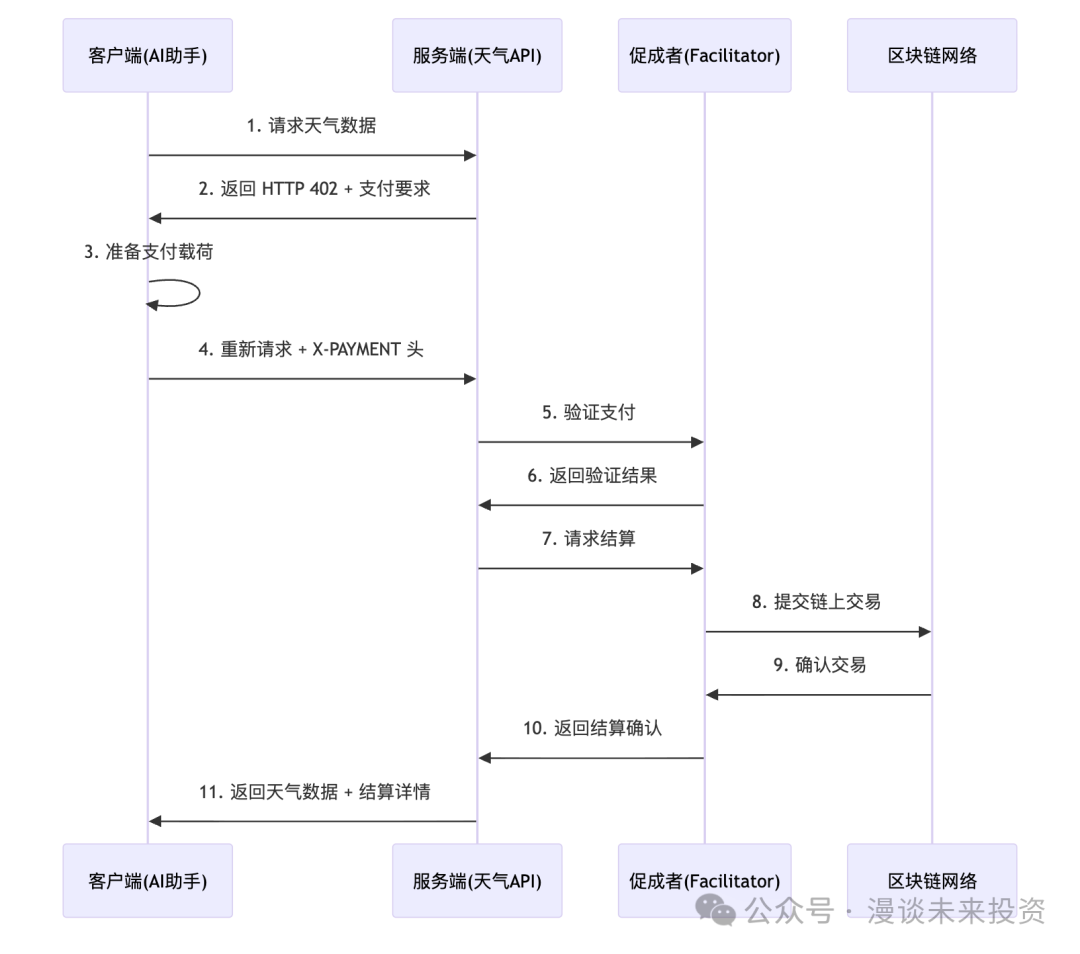
Detailed Steps Analysis
Step 1: Initiate Request
- • The AI assistant sends a standard HTTP GET request to the weather API
Step 2: Payment Requirement
- • The server returns the HTTP 402 status code and includes payment details in the response body:
- • Amount to be paid (e.g., 0.01 USDC)
- • Type of payment currency
- • Payment address
- • Other necessary information
Step 3: Prepare Payment
- • The AI assistant’s wallet creates a signed payment payload based on the payment requirements
Step 4: Resend Request
- • The AI assistant sends the same request again, but this time includes the
<span>X-PAYMENT</span>field in the HTTP header
Steps 5-6: Validate Payment
- • The server validates the payment payload’s validity (usually through a facilitator service)
Steps 7-10: Settlement
- • If the payment is valid, the server initiates the blockchain settlement process
- • The facilitator submits the transaction to the blockchain and waits for confirmation
Step 11: Complete Transaction
- • The server returns the requested weather data and includes settlement details in the
<span>X-PAYMENT-RESPONSE</span>header
Core Components of x402
1. Client and Server
Client can be:
- • User-operated applications
- • Autonomous AI agents
- • Programmatic services acting on behalf of users or systems
Server can be:
- • API services
- • Content providers
- • Any HTTP resource that needs monetization
2. Facilitator
The facilitator is the “payment steward” in the x402 ecosystem, responsible for:
- • Validating the Payment Payload‘s validity
- • Handling Blockchain Settlement
- • Simplifying Integration Complexity
3. Wallet
For Buyers, the wallet is used for:
- • Storing USDC (currently the main supported currency)
- • Signing payment payloads
- • Programmatic authorization of on-chain payments
For Sellers, the wallet is used for:
- • Receiving USDC payments
- • Defining payment addresses in server configuration
Technical Advantages of x402
1. Stateless Design
- • No need for sessions or authentication
- • Each request is independent
2. HTTP Native
- • Perfectly compatible with existing network infrastructure
- • Can be easily integrated using standard HTTP libraries
3. Blockchain Agnostic
- • Supports multiple blockchain networks through facilitators
- • Not tied to specific cryptocurrencies or blockchains
4. Developer Friendly
- • Simple integration process
- • Clear API design
Application Scenario Outlook
1. AI Economy
Imagine a world where AI agents can autonomously pay for the services they need:
- • ChatGPT calls professional databases
- • Image generation AI purchases high-quality training data
- • Translation services call professional dictionary APIs
2. Microservices Monetization
- • Developers can easily monetize their APIs
- • Charge based on the number of calls or data volume
- • No need for complex billing systems
3. Content Creator Economy
- • Blog articles charged per read
- • Video content charged per viewing duration
- • Professional analysis reports charged per download
Challenges Faced
1. User Experience
For ordinary users, cryptocurrency payments still have a certain threshold.
2. Regulatory Compliance
Different regions have different regulations regarding cryptocurrency payments.
3. Network Congestion and Fees
Congestion in blockchain networks may affect the payment experience.
Conclusion: Redefining the Digital Economy
The x402 protocol is not just a technological innovation but a rethinking of the digital economic model. It truly enables the internet to have “native payment” capabilities, opening up new revenue models for creators, developers, and service providers.
From the HTTP 402 that was shelved for decades to today’s x402 protocol, we have witnessed how technology can be revitalized at the right moment. Perhaps years from now, looking back, the x402 protocol will become an important milestone in the history of internet economic development—the moment when “payment” was truly integrated into network protocols.
Technology always serves demand. When AI agents need to transact autonomously, when microservices need precise billing, and when content needs instant monetization, x402 emerges. It is not reinventing the wheel but, at the right moment, equipping the wheel with an engine.