Dear readers, as you know, programming languages, especially open-source ones, rely on the contributions of a group of core developers over a long period. Some programming languages have established foundations, supported by donations from large companies and community efforts, to maintain the income of their development teams.
Most have established foundations, such as Rust, but exceptions still occur.
Recently, two well-known code contributors in the Rust community, also referred to as authors, Nicholas Nethercote and Micheal Goulet, have started looking for jobs.
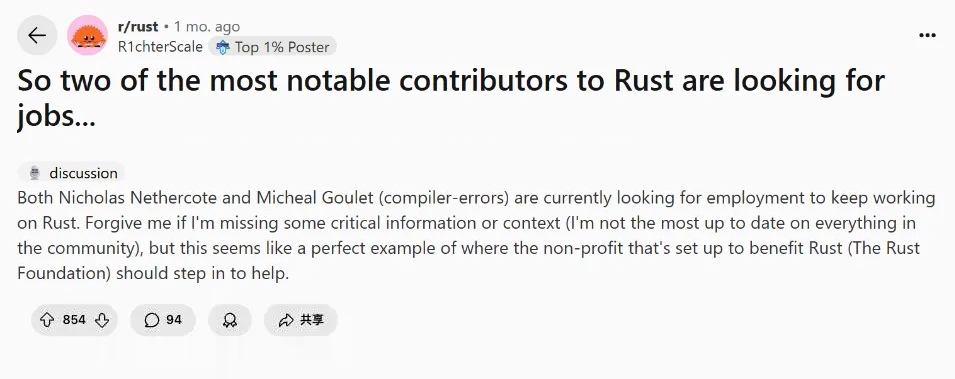
In the Rust community, it is rumored that these two are looking for jobs. It is important to note that these two are superstars of the Rust language, the core of the core, and this sudden job search has sparked discussions within the community.
Some say, what is the language foundation doing? It should step up and start paying salaries. Others argue that without guarantees, isn’t the core team in a precarious position?
Both developers are looking for jobs
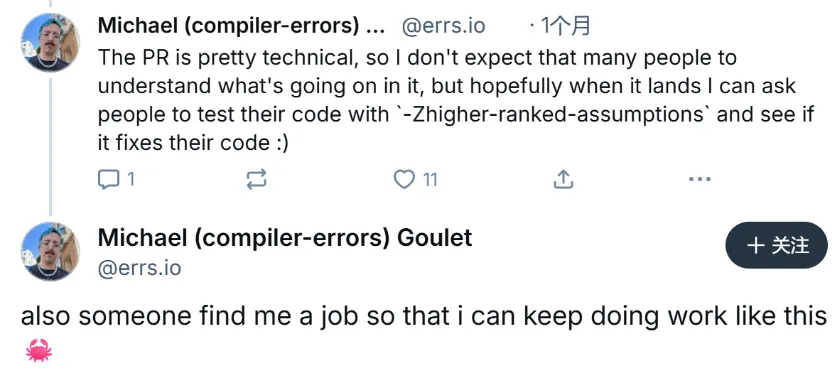
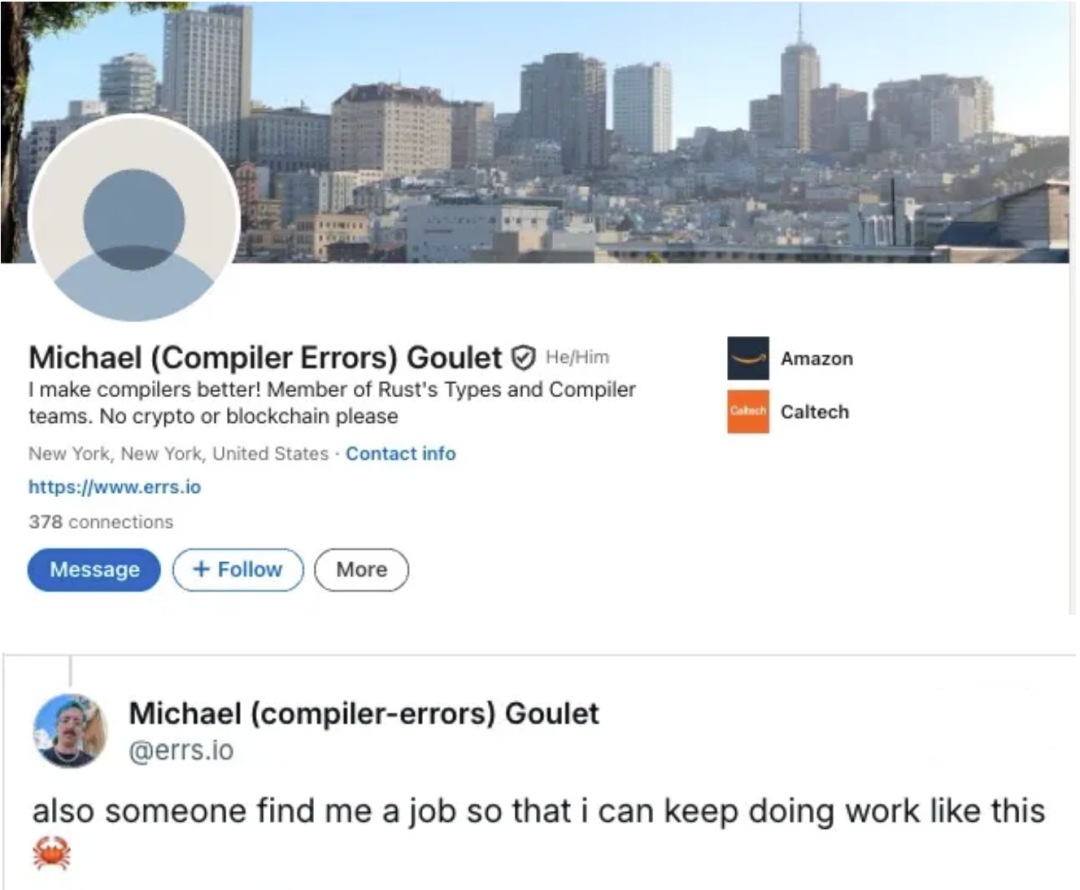
In July 2025, Micheal Goulet mentioned on the X platform while introducing a PR, “Who can help me find a job so I can continue this work?”
A few days later, Nicholas Nethercote also published an article on his personal website titled: “I am a Rust compiler engineer looking for a new job.”
Nicholas expressed himself more directly, writing:
“For the past 3.75 years, I have been fortunate to work in the Rust team at Futurewei, almost entirely free to improve Rust. This experience has been the highlight of my career. Unfortunately, due to budget cuts, the team is downsizing, and this job will likely end soon.”
In Nicholas’s view, besides the impact of international circumstances, another reason is that AI has taken away most of the funding and focus, leaving fewer resources for other technologies.
He candidly expressed what is lacking and what he desires: “Rust is a great project that deserves full-time personnel with salaries to maintain it. I hope to continue working in this direction.”
Thousands of submissions, proficient in compiler writing
Nicholas Nethercote also showcased his excellent achievements in the article. Here are some highlights:
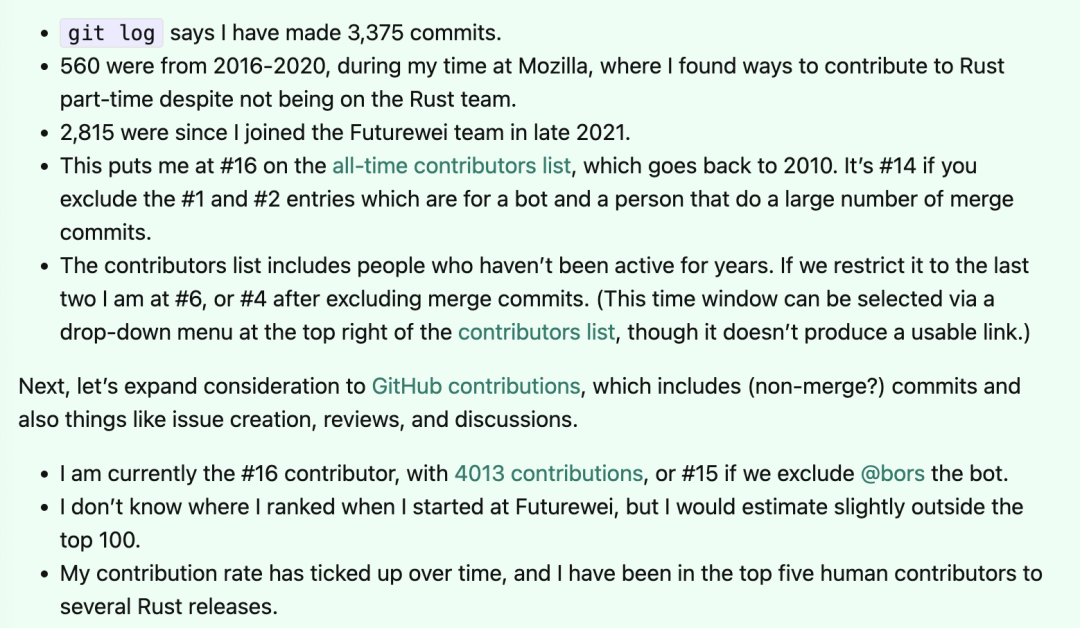
1. He has made 3,375 commits to the rust-lang/rust repository, with 2,815 of those during his three years at Futurewei.
2. Extending to GitHub contributions, he has a total of 4,013 contributions, currently ranking 16th globally (15th after removing bots).
3. He has reviewed almost all files in the Rust compiler directory, which contains over 700,000 lines of code; he has modified 75 out of 77 crates.
According to Nethercote, his core competencies include compiler performance optimization and benchmarking, lexical analysis, syntax parsing, AST and macro assembly extensions, compile-time error generation, data flow analysis frameworks, and code generation unit (CGU) splitting, among other projects or tasks.
Nicholas stated that the performance improvements, error message enhancements, and old code removals in the Rust compiler over the years all bear his influence. Many who have used Rust have benefited from his work.
Nicholas Nethercote humorously summarized: “The most common starting word in my commits is Remove. Out of 3,375 commits, 752 started with Remove.” He explained that just in terms of code deletion, he has removed 150,000 lines, which is a rare ability to effectively ‘delete code’ in a large and complex compiler project.
In addition to Nicholas Nethercote, he has also contributed to tools like rustdoc, clippy, cargo, and even maintained the “Rust Performance Handbook.” He has been active in the community for a long time. He is both a “performance optimization master” and a “code cleaner.”
From large-scale architectural restructuring to eliminating technical debt, he has personally taken action.
Job search goals: Full-time maintenance of Rust, rejecting blockchain and generative AI
Nicholas Nethercote outlined his job search intentions at the end of the article:
1) Preferred: Full-time maintenance of Rust;
2) Secondly: Open-source, interesting application projects using Rust;
3) Firmly reject: Blockchain/cryptocurrency, generative AI, quantitative trading, and leaving Melbourne.
Similarly, Micheal Goulet also mentioned in his LinkedIn profile that he firmly rejects development work in the direction of cryptocurrency or blockchain.
Why is Rust in a difficult position?
Many people will ask: Why is the Rust Foundation ineffective?
Subsequently, some people checked the financial disclosure data of the language foundation: In 2023, the foundation only had an income of $250,000, which is not enough to cover the cost of hiring a junior engineer.
Although the donations from large companies look impressive—Amazon, Google, Microsoft, Meta, etc., are all “platinum sponsors” of the Rust Foundation—this does not mean they are willing to spend money specifically to support developers. Some say: “These companies burn billions of dollars a year on various experimental tools without blinking, yet they are unwilling to spend hundreds of thousands to support a few core developers.”
Some veteran programmers lament: In the past, the designers of C and C++ mostly worked in universities or research centers, receiving research funding while developing the language; but in today’s open-source world, developers rely more on corporate sponsorship or working for the love of it.
More realistically and sparking more discussion is Nicholas Nethercote’s mention that “AI is taking away all resources,” and his firm rejection of generative AI. Some netizens speculate that perhaps it is precisely because of his stance in the job-seeking blog that he is having difficulty finding a new job.
Currently, investment institutions are pouring money into large models and GPUs, while large companies are allocating budgets to generative AI; yet system-level languages like Rust, even though they have moved beyond the “niche language” circle and have entered critical scenarios such as operating systems, browsers, databases, and cloud services—still seem to rely on a small circle of full-time developers.
Conclusion
Nicholas Nethercote’s latest diary indicates that he has found a job.

Update 2025-09-03: I found a new job and will start next week. I will release more details soon. Thank you very much to everyone who helped promote this article and to everyone who contacted me about job opportunities. Rust is being applied in many interesting places!
However, the future of Rust still requires consideration; it cannot rely solely on developers “working for the love of it.” There needs to be funding to support people’s livelihoods and more realistic approaches. Should we continue with the foundation and large company model, or is there a more innovative way?
Perhaps this is the answer the entire open-source community needs to provide. What do you think? Feel free to leave a comment.
Author: Chang Zhang
Related Links:
https://www.reddit.com/r/rust/comments/1mbyf5z/so_two_of_the_most_notable_contributors_to_rust/
https://nnethercote.github.io/2025/07/18/looking-for-a-new-job.html
https://x.com/skydotcs/status/1961989153253675164

Related Reading:
Brian Kernighan, co-founder of Unix, talks about Rust, distributions, and NixOS
Go, Python, Rust: Which one should we learn?
QT announces new bridging technology for Rust and other languages