Introduction
AI computing power has become the core productivity in the digital economy era, but the global AI industry is facing three major challenges: “insufficient supply, high costs, and an ecosystem yet to be built.” According to industry statistics, the average utilization rate of computing resources in the industry is only 30% to 40%, leading to serious waste of computing power. Leading technology companies in China have recently stated that they will significantly improve the utilization rate of computing resources through innovations at the software level.
As a leading company in high-performance AI modules and edge AI, Meige Intelligent has long focused on optimizing and enhancing edge AI computing power, leveraging key technologies such as SoC architecture, containerization and virtualization, memory bandwidth compression, algorithm quantization, and power strategy optimization. Meige Intelligent has formed a unique “software + hardware” collaborative advantage in the field of edge AI, providing a complete solution to enhance AI computing power utilization.
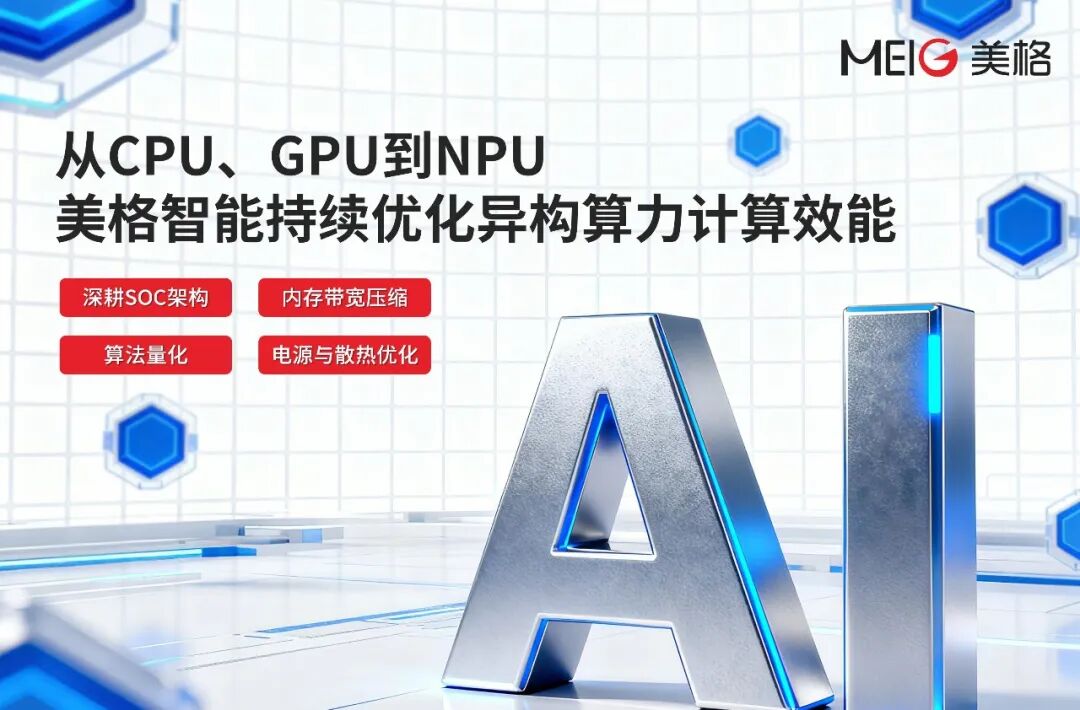
Optimizing SoC Architecture Scheduling: Unleashing the Collaborative Potential of CPU + GPU + NPU
The heterogeneous computing architecture is the core advantage of modern SoC chips. Meige Intelligent has been deeply engaged in SoC architecture for many years, maximizing the utilization of platform AI computing power through software-hardware collaboration, fully leveraging the unique advantages of each processor: CPUs excel at sequential control and general tasks, GPUs are suitable for parallel data stream processing, while NPUs specialize in scalar, vector, and tensor mathematical operations, serving as the core execution unit for AI workloads.
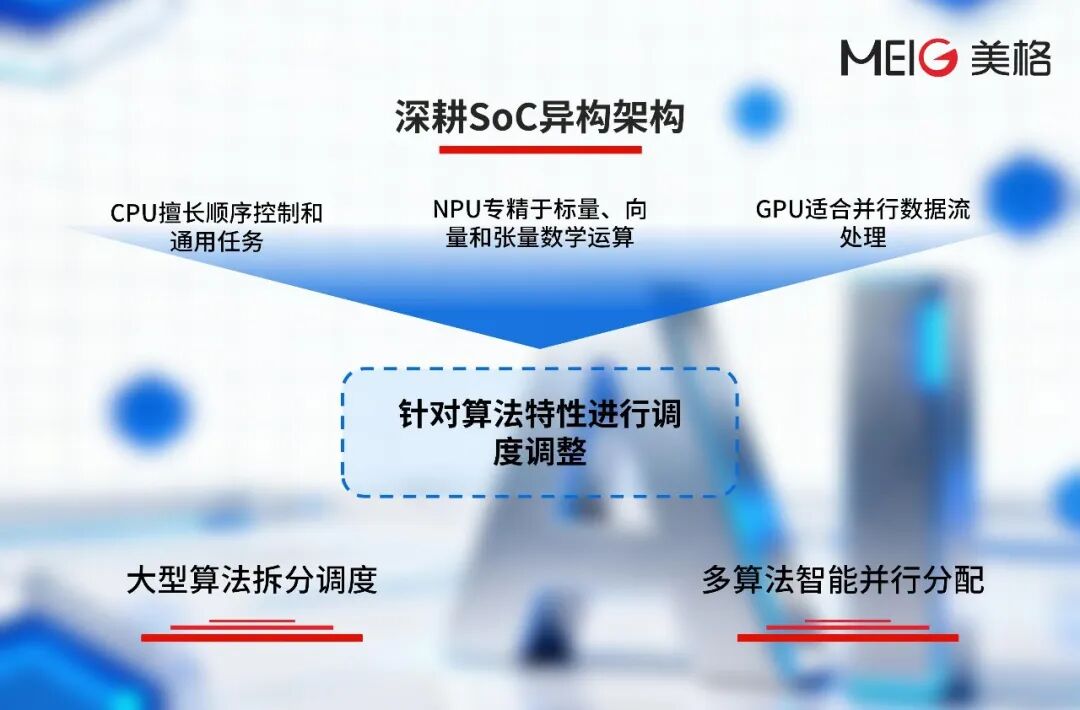
Meige Intelligent possesses leading capabilities in SoC integrated development, performance scheduling, and intelligent system R&D, and has accumulated rich experience in high-performance AI applications and virtualization. In response to the characteristics of AI algorithm applications, Meige Intelligent has conducted targeted large-scale algorithm scheduling and multi-algorithm parallel adjustments.
▶ In large-scale algorithm scheduling: By splitting and processing large algorithms in parallel, complex AI algorithms are decomposed into multiple parts, loading different parts onto the corresponding processors based on the computing characteristics of CPU, GPU, and NPU, achieving parallel computing power and multi-algorithm load balancing based on pipeline operations.
▶ In multi-algorithm parallel adjustments: Algorithms are allocated to the most suitable processors based on their different computing power requirements, avoiding resource contention and idleness, thus achieving full utilization of computing resources.
Breaking Through Memory Wall Bottlenecks: Enhancing Computing Efficiency with Compression and Quantization Technologies
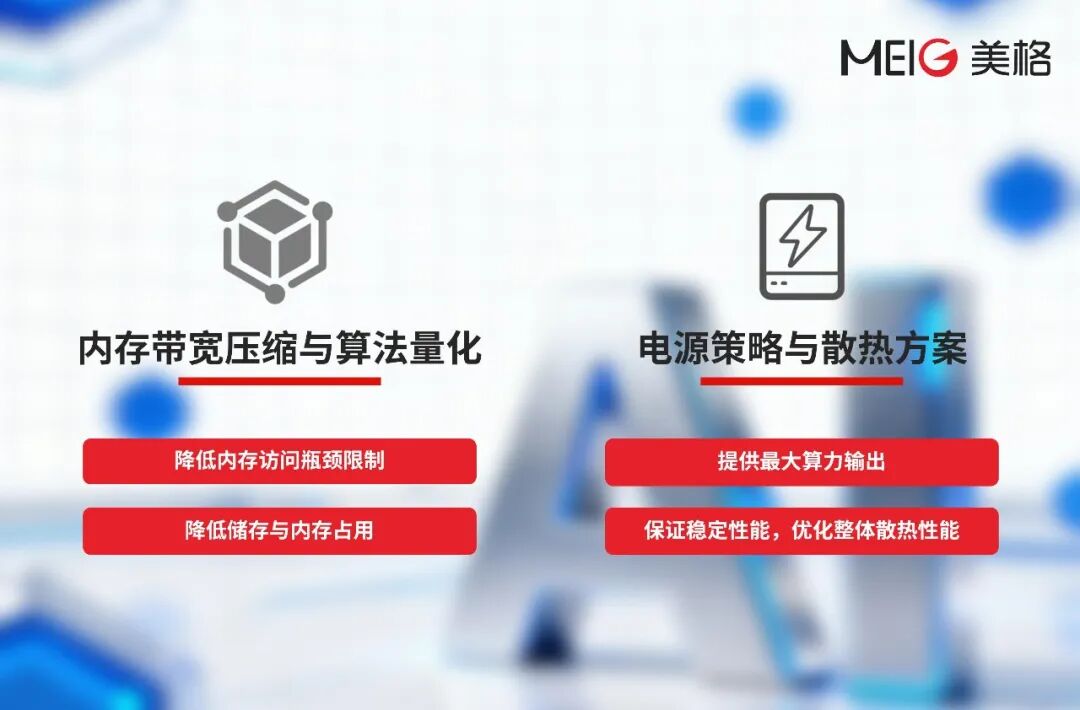
Memory bandwidth compression technology significantly reduces the impact of memory access bottlenecks on computing power by exchanging more data under limited memory bandwidth. This technology utilizes LPDDR5X memory to provide over 120GB/s bandwidth, meeting the high throughput requirements during 7B model inference.
Algorithm quantization technology employs a mixed quantization scheme based on quantization awareness, using INT4 precision for some layers, further reducing computational overhead and enhancing processing speed while keeping precision loss under control. Specific implementations include:
▶ Mixed Precision Quantization: Meige Intelligent supports INT4/FP8 mixed precision computing, highly compatible with the quantization format of the DeepSeek-R1 model. For example, after INT4 quantization, the model size is compressed from 28GB required by FP32 to only 2-4GB, significantly reducing storage and memory usage.
▶ Quantization Aware Training (QAT): During model training, pseudo-quantization nodes are inserted to simulate quantization effects, allowing the model to adapt to low-precision computing during the training phase, significantly reducing precision loss after quantization.
▶ Post-Training Quantization (PTQ): A small amount of calibration data is used to estimate the dynamic range of weights and activation values, determining quantization parameters without the need for retraining, shortening the adaptation cycle by 50%.
Strengthening Power and Thermal Design: Ensuring Continuous Output for High-Performance Computing
In addition to computing and memory optimization, power management and thermal design also directly affect the stability and continuity of computing power utilization. Meige Intelligent ensures stable performance of edge devices under power consumption constraints through multi-dimensional innovations.
In power management:
▶ Fine-grained Power Scheduling: The built-in power management chip (PMIC) in the module can independently monitor and dynamically adjust the power supply to different computing units (CPU/GPU/NPU) on the SoC. The system intelligently adjusts the operating voltage and frequency (DVFS technology) of each unit based on real-time computing power demands, minimizing overall power consumption while meeting performance requirements.
▶ Hierarchical Power Supply and Intelligent Standby: The module provides independent power domains for processors, memory, and communication units. In low-load scenarios, it can automatically turn off the power supply to non-essential functional units or put them into low-power sleep mode, significantly reducing standby power consumption, which is crucial for battery-powered mobile devices.
In thermal optimization:
▶ SIP System-in-Package and Underfill Technology: In high-end automotive-grade modules, Meige Intelligent adopts SIP (System-in-Package) technology to densely integrate multiple chips. By introducing Underfill technology, a specially formulated adhesive is filled between the chip and substrate, which not only significantly enhances the mechanical reliability of the module under vibration and thermal shock environments but also serves as an important pathway for heat dissipation, allowing heat to be more evenly conducted to the module substrate, optimizing overall thermal performance.
▶ Integrated Thermal and Structural Optimization: Meige Intelligent’s high-performance AI modules (such as AI computing boxes) adopt an integrated thermal design to ensure stable performance during prolonged operation. Structurally, by optimizing the internal layout of the module and using high thermal conductivity materials, efficient heat conduction paths are created. For example, some modules integrate shielding covers or heat dissipation plates that closely fit the chip surface, acting as a “thermal bridge” to quickly transfer heat to the module shell or the external heat dissipation system of the device.
Driving Edge Implementation: Empowering Industry Intelligent Upgrades with All-Scenario AI Modules
Meige Intelligent’s technical philosophy is not only theoretical but has been realized through a series of product implementations and practical use cases, achieving efficient utilization of edge AI computing power. By focusing on optimizing and enhancing edge AI computing power, it has formed its unique competitive advantage.
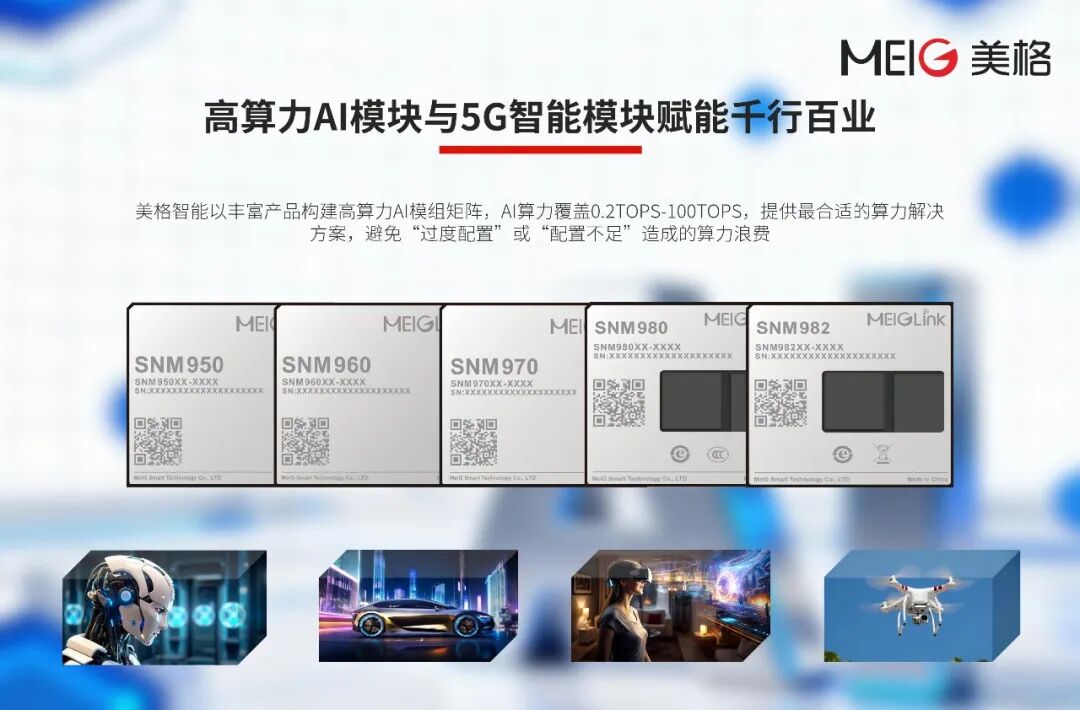
Meige Intelligent’s high-performance AI module products cover entry-level, mid-range, and flagship levels, corresponding to AI computing power coverage0.2TOPS-100TOPS, capable of executing various types of edge computing tasks on devices such as edge computing terminals, robots, and intelligent vehicle domain controllers. This comprehensive layout enables Meige Intelligent to provide the most suitable computing power solutions based on different application scenario requirements, avoiding waste of computing power caused by “over-provisioning” or “under-provisioning.”
Meige Intelligent has also made in-depth layouts in the integration of 5G and AI, with its 5G-A + Wi-Fi 7 dual-engine transmission solution supporting 10Gbps rates and intelligent antenna arrays, providing high-speed, low-latency connectivity for edge AI applications. Through a “local AI engine + cloud large model” dual-track architecture, Meige Intelligent has achieved full-stack intelligent upgrades from the device layer to the application layer. This edge-cloud collaborative architecture not only leverages the efficiency of edge computing power but also retains the infinite scalability of cloud computing power.
In scenarios such as humanoid robots, intelligent cockpits, drones, intelligent security, and smart homes, efficient edge computing power is playing an increasingly important role. In the future, with the further integration of AIGC and the Internet of Things, Meige Intelligent is expected to play a more significant role in accelerating the development of the artificial intelligence industry through its unique path of “software + hardware” collaborative optimization.
Previous Recommendations

Related Articles