Last year, ARM released the Cortex A73 and Mali G71 architectures at Tech Day. This year, they will introduce their successors, the A75 and A55 architectures, as well as the Mali G72 architecture. On May 26, news emerged that foreign media successfully uncovered ARM’s official PPT, fully leaking relevant information about these three new architectures.
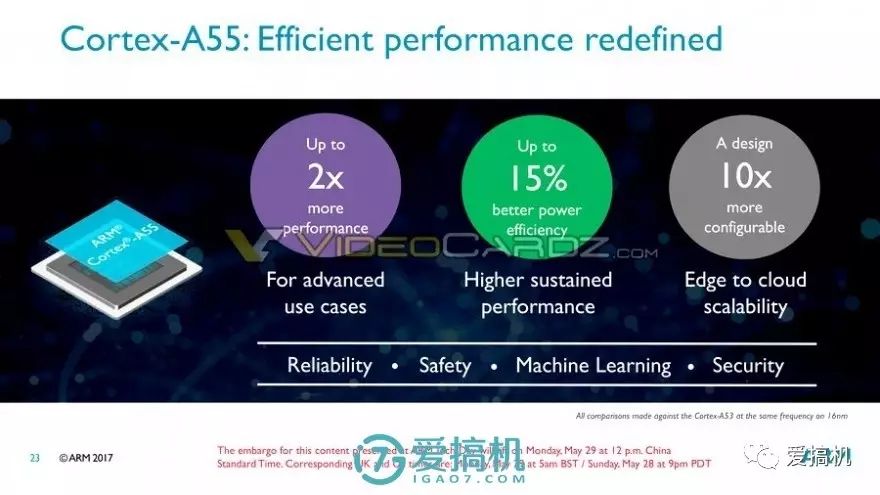
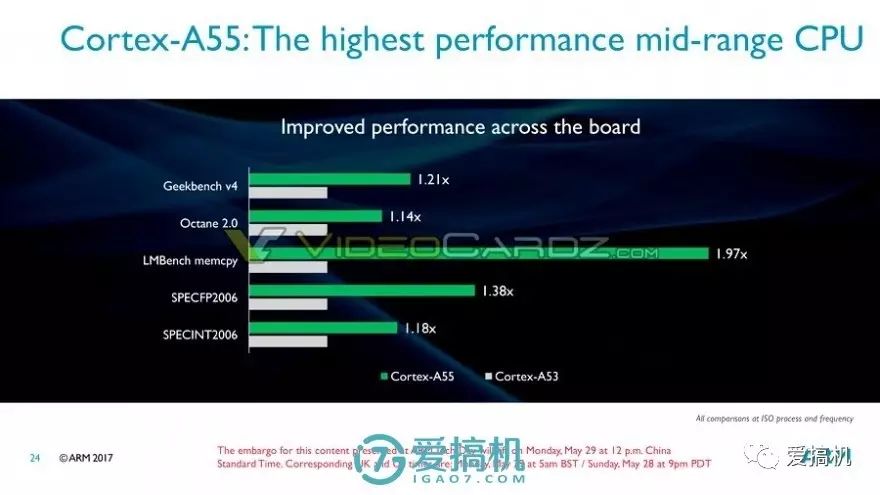
The A55 can deliver twice the performance, and a 15% efficiency improvement (note, this is efficiency, not power consumption), along with 10 times the customizability. The official claim is that the A55 is the strongest performing architecture in the mid-range products. In tests like Geekbench v4, compared to the A53, it can provide a performance boost ranging from 1.14 to 1.97 times.
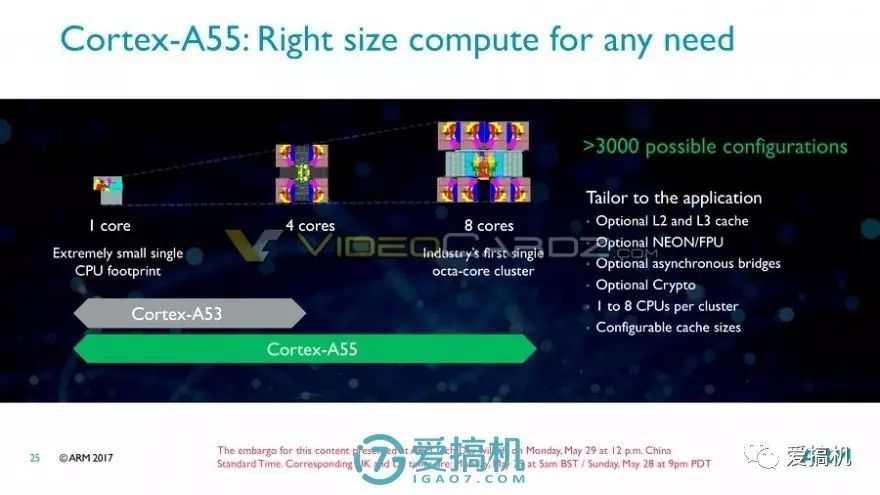
In terms of configurability, it offers over 3000 configuration possibilities, allowing choices for cache size, L2 and L3 cache, NEON/FPU, asynchronous connections, and encryption modules, enabling clusters of 1-8 cores. This is the first architecture that can include 8 cores in a single cluster (MediaTek is expected to be very interested).
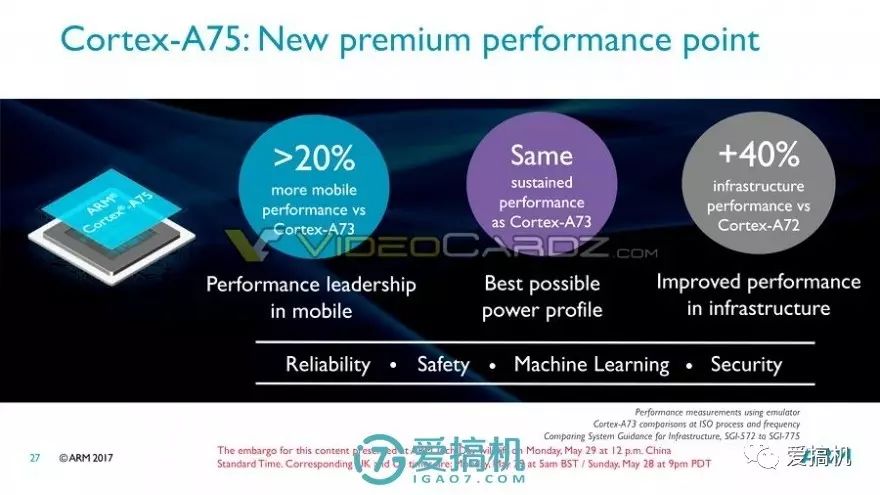
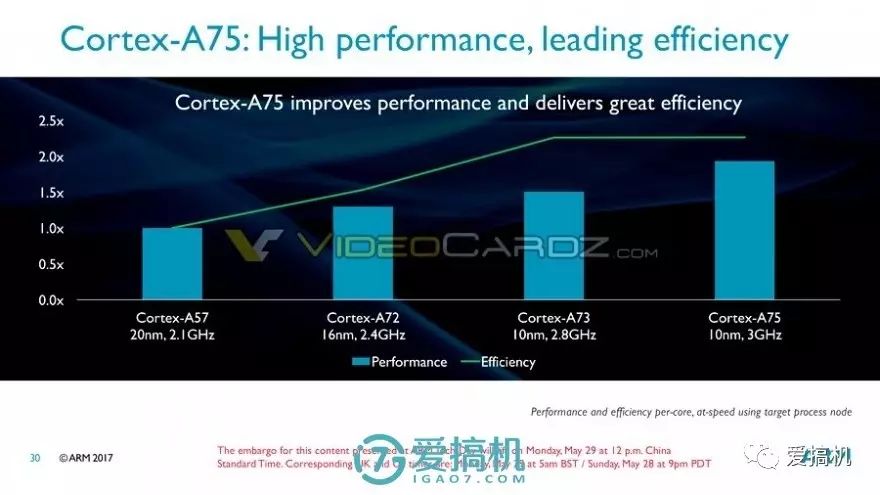
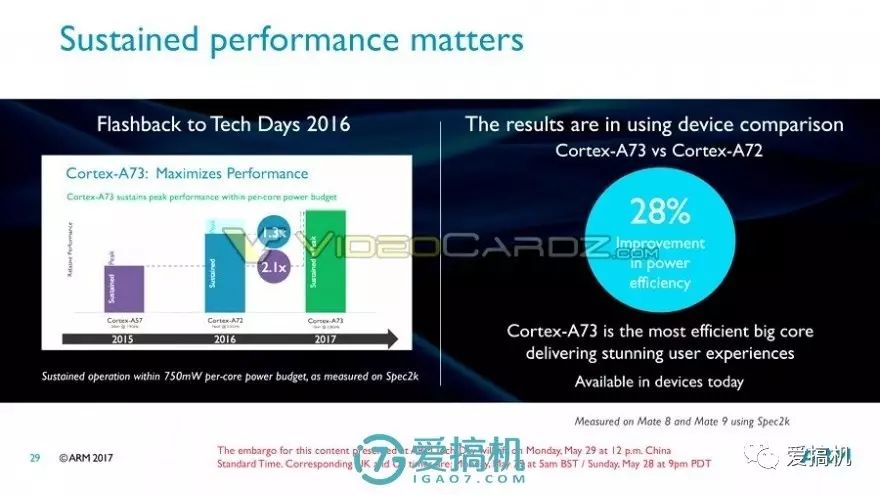
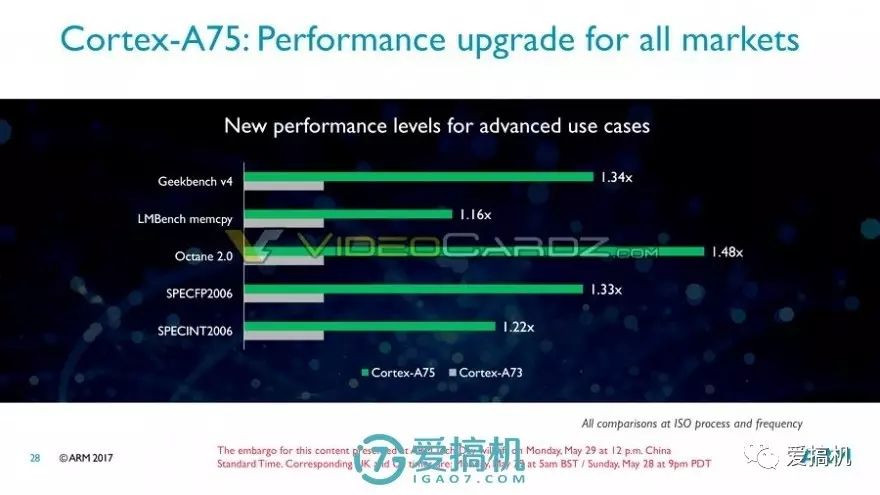
The A75 architecture shows a 20% performance increase over the A73 and a 40% baseline performance increase over the A72 architecture. In extreme performance comparisons, there is a 1.3 times increase over the A72 architecture from 2016, and a 2.1 times increase over the A57 architecture from 2015. In tests like Geekbench v4, compared to the A73, it can provide performance boosts ranging from 1.16 to 1.48 times. The PPT also mentions that the A73 remains the architecture with the highest efficiency among large cores, 28% higher than the A72.
Most surprisingly, ARM has set the A73 architecture’s preset frequency at 2.8GHz under 10nm technology (in reality, the A73 on Kirin 960 is only 2.36GHz), while the A75 reaches as high as 3GHz under 10nm.
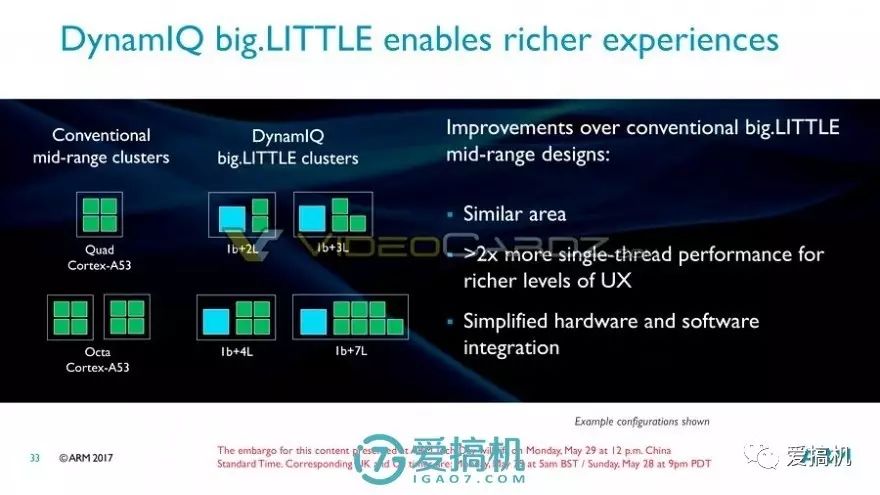
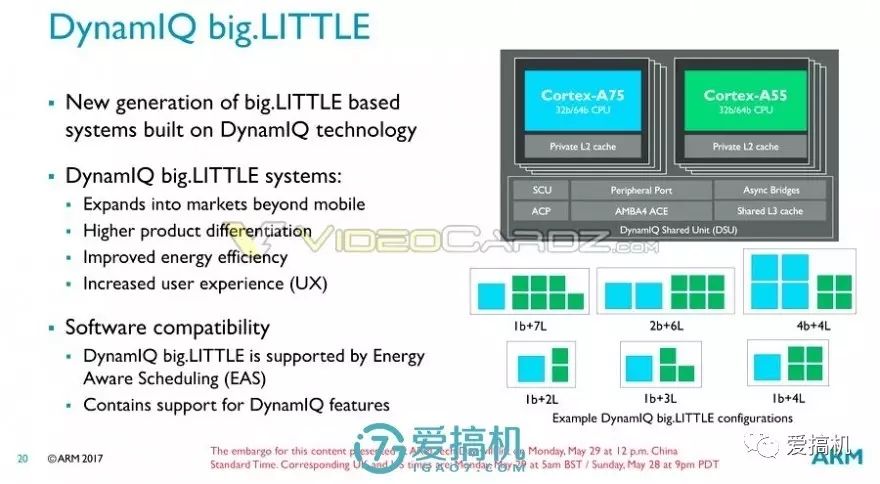
The big.LITTLE architecture has also been updated; the new DynamIQ big.LITTLE architecture is based on DynamIQ technology, which can provide a 2 times increase in single-thread performance in a similar core area and simplifies software and hardware. On the software side, this architecture supports EAS technology (Energy Aware Scheduling), but on the hardware side, the official details are vague, only mentioning that it can extend its use beyond mobile platforms, enhancing product differentiation, efficiency, and user experience.
It supports 3-way superscalar processors, with each core having exclusive L2 cache at the same speed as the core. It claims a 20% increase in single-thread performance on the A73 architecture while maintaining power consumption. Through DynamIQ technology, it can use DynamIQ shared units (DSU), allowing shared L3 cache within the cluster and supporting the latest A55 architecture.
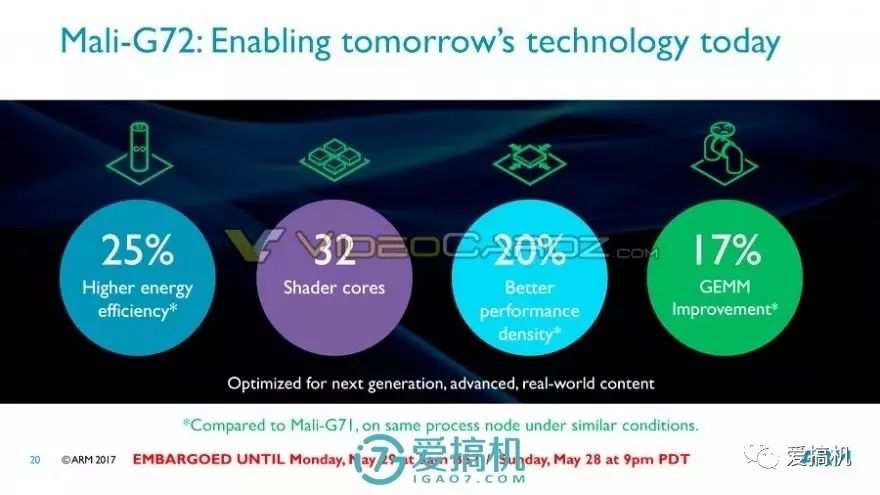
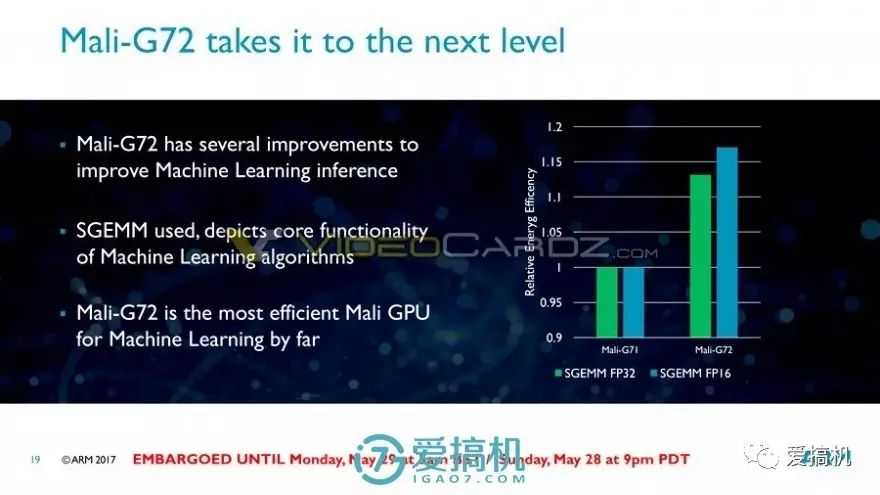
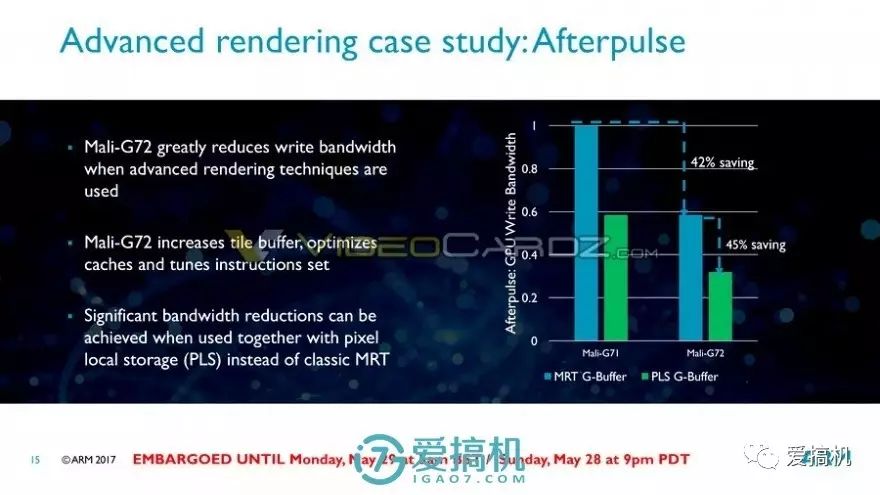
The official claim states that it can provide a 1.4 times improvement over the 2017 products (referring to the G71 architecture), optimized for scenarios such as gaming, machine learning, and mobile VR. It introduces new rendering technologies that significantly reduce write bandwidth usage; compared to G71, it can save 42% and 45% of write bandwidth in MRT G-Buffer and PLS G-Buffer, respectively. In machine learning, it achieves about a 1.15 times improvement in efficiency. The entire GPU architecture can deliver a 25% efficiency improvement, featuring 32 shader cores, with a 20% performance increase and a 17% improvement in GEMM.
The latest news is that Huawei, which is the first to launch the G72 architecture, has already acquired the licensing for the G72 architecture (but not for the A75 architecture). It is likely that this next-generation architecture will be seen in the next generation Kirin processors (hopefully Huawei will not follow the current misguided route of fewer cores and higher frequencies).


Readers Group of AiGaoJi
The AiGaoJi reader group is now open; readers interested in digital technology can scan the code to join the group to discuss current hot topics in the tech circle with the editors (after reaching 100 people, manual addition is required; those who wish to join the group should add WeChat ID: igao7XDXO, and they will be manually added to the group). You can also directly express your suggestions for review topics (which will be considered). The group will also periodically arrange “giveaway events”. AiGaoJi hopes to connect with readers and enthusiasts in a more down-to-earth manner, and we appreciate everyone’s support~~