
Introduction:
Amidst the buzzing sounds of machinery, a steel “giant” is precisely grabbing, transporting, and stacking metal components weighing dozens of kilograms with millimeter-level accuracy. It knows no fatigue, makes no complaints, and never makes mistakes—this is the truss robot, the “stable darling” of automated production lines. As the global manufacturing industry faces rising labor costs and efficiency bottlenecks, the industrial revolution sparked by truss robots is quietly reshaping the DNA of Chinese manufacturing.

01
An Industry Upgrade Driven by Necessity

Intelligent Technology
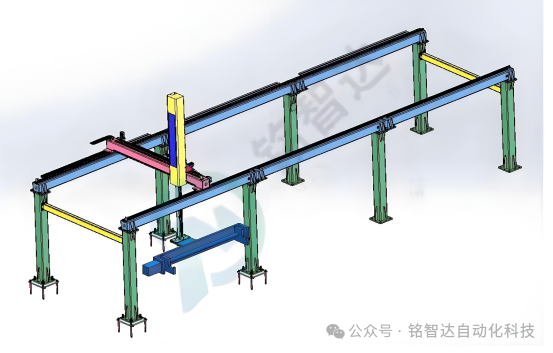
After the Spring Festival of 2025, in the workshop of a leading enterprise, a refrigerator shell production line that originally required 20 workers now only needs 3 technicians to monitor the equipment. Replacing them are 4 truss robots spanning 15 meters, which accurately grab steel plates at a speed of 3 times per minute, with an error of no more than 0.02 millimeters, equivalent to a quarter of a human hair.
This data reflects the profound changes occurring in China’s manufacturing industry: According to the Ministry of Industry and Information Technology, by 2024, the density of industrial robots in China will reach 392 units per 10,000 people, with truss robots accounting for over 40%, becoming the “standard configuration” for automation transformation.
The driving force behind this transformation directly addresses the three most painful points in the manufacturing industry:
Annual labor cost growth of 8%: The issues of recruitment difficulties and high turnover rates are becoming increasingly prominent.
Efficiency bottlenecks are hard to break through: The maximum speed of manual handling is about 1.5 times per minute, while truss robots can achieve over 5 times.
Challenges in quality stability: The uncertainty of manual operations leads to a long-term defect rate of 2%-3%, while robots can reduce this to below 0.1%.

02
Truss Robots: The “Smart Brain” Beneath the Steel Body
Intelligent Technology
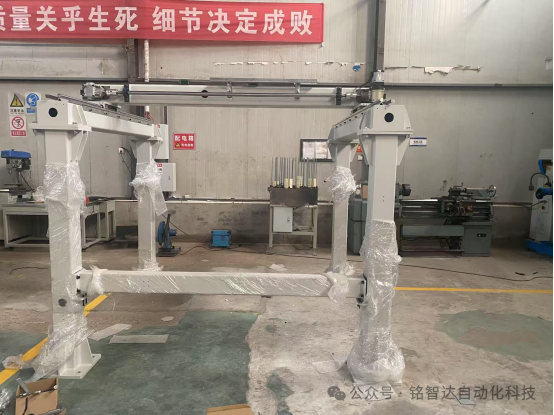
Unlike traditional articulated robots with flexible arms, truss robots utilize X, Y, and Z three-axis linear motion, a design that endows them with three unique skills:
01
Millimeter-level positioning: The “Sniper” of the Industry
Through the combination of servo motors and high-precision ball screws, the repeat positioning accuracy of the robot can reach ±0.02 millimeters. In the processing line of automotive engine blocks, this precision means that the assembly error of each bolt hole does not exceed the diameter of a human hair.
02
Modular customization: From “Standard Parts” to “Transformers”
The truss structure adopts a modular design that can be flexibly adjusted according to the height and span of the factory. A heavy machinery company even customized a “giant” model with a span of 25 meters and a load capacity of 2 tons for transporting wind turbine blades.
03
All-weather operation: The “Perpetual Motion Machine” of Manufacturing
In cold storage at -30°C, in casting workshops with excessive dust concentration, and in nuclear power equipment workshops with strong radiation, truss robots can operate stably. A food company reported that the failure rate of robots in -18°C environments is only 1/5 that of manual operations.

03
Disruptive Applications: From “Replacing Humans with Machines” to “Human-Machine Collaboration”

Intelligent Technology
When the robot grabs the refrigerator inner liner to the assembly line, the vision system immediately scans the QR code to obtain the process parameters, while the AGV cart synchronously delivers the compressor—this entire process requires no human intervention, and the production rhythm is increased to one unit every 12 seconds.
This transformation is triggering a chain reaction in multiple fields:
Home Appliance Industry: After introducing truss robots into a certain brand’s air conditioning production line, the single-line capacity increased by 300%, and labor costs decreased by 65%.
Logistics and Warehousing: In JD’s “Asia No. 1” warehouse, truss robots work in conjunction with shuttle cars to achieve an average of 100,000 items sorted automatically per day, with an accuracy rate of 99.99%.
Hazardous Operations: A chemical company replaced manual handling of corrosive liquids with explosion-proof truss robots, reducing occupational disease cases by 12 each year.
More noteworthy is the new model of “human-machine collaboration.” The robot handles heavy lifting, while workers focus on precision assembly, with both sides achieving “soft contact” through force control sensors, ensuring safety while improving efficiency. This model has increased enterprise capacity by 40%, while worker satisfaction scores have risen by 25%. According to the International Federation of Robotics, it is predicted that by 2028, the market size of truss robots in China will exceed 20 billion yuan, with a compound annual growth rate of 18%.
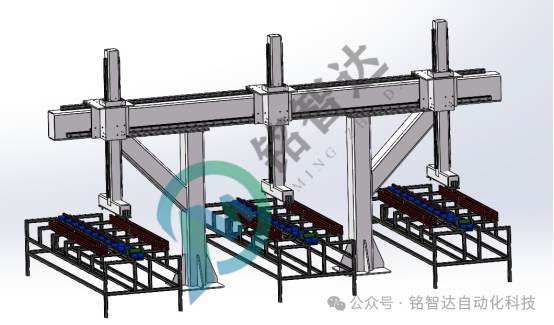

The evolution of robots reflects the future of Chinese manufacturing.
When we discuss truss robots, we are essentially exploring a deeper question: In an era of diminishing demographic dividends, how can Chinese manufacturing maintain its competitiveness? The answer may lie in the precise trajectories of these steel arms—they are not just cold machines but also a bridge for China to transition from a “manufacturing giant” to a “smart manufacturing powerhouse.” This transformation led by truss robots will ultimately allow the words “Made in China” to stand more firmly and walk further on the world stage.
MINGZHIDAKEJI


End
Contact Us
Phone: 0531-69950775
Website: http://www.mingzhida.cn
Address: 13788 Century Avenue, Lixia District, Jinan City
Company Profile
Mingzhida Technology is a comprehensive high-tech enterprise integrating industrial automation R&D and manufacturing, customized truss robots, automatic assembly tightening machines, and automation systems. The company holds multiple national patents and has obtained several software copyrights, as well as ISO9001 quality management system certification. Major products include: truss robots, locking machines, clamp assembly equipment, tightening equipment, lifts, testing equipment, automatic feeders, automation equipment, automatic assembly lines, etc., covering all aspects of manufacturing production, processes, transportation, and assembly, providing overall automation transformation solutions for manufacturing processes, production technology and innovation solutions, intelligent production logistics system solutions, and customized flexible production lines, automatic assembly lines, production equipment, testing equipment, process equipment, tooling fixtures, transportation tools, and storage facilities.