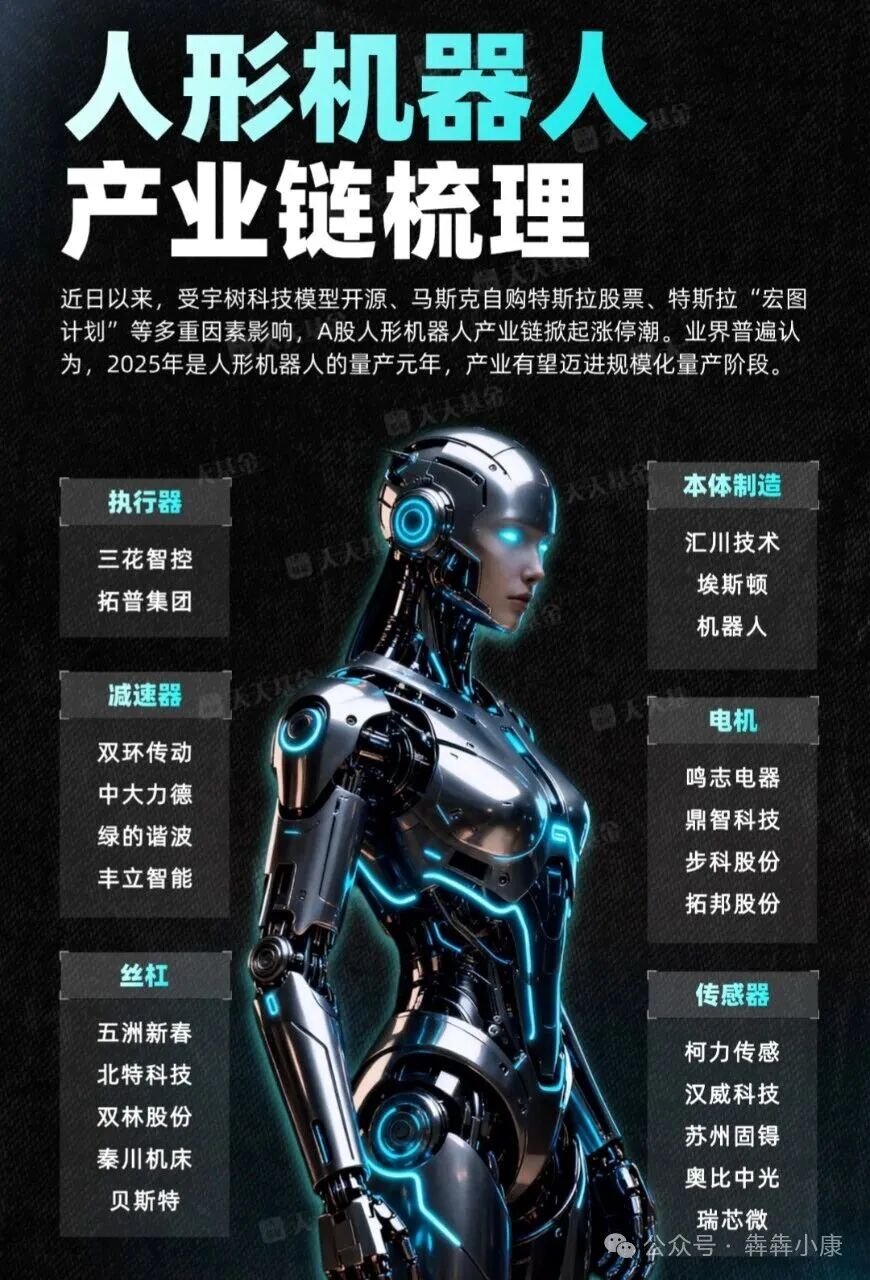
Recently, influenced by multiple factors such as Yushu Technology’s model open-source initiative, Musk’s purchase of Tesla stocks, and Tesla’s “Grand Plan”, the A-share humanoid robot industry chain has experienced a surge in stock limits. On September 17, the humanoid robot concept became active again, with Lihexing reaching a 20% limit up, and Haoneng Co., Ltd. and Junsheng Electronics also hitting their limits. On the evening of September 15, Yushu announced the open-source of UnifoLM-WMA-0. UnifoLM-WMA-0 is Yushu Technology’s open-source world model for various types of robot bodies—an action framework designed for general robot learning, with its core component being a world model that understands the physical laws of robot-environment interactions. Meanwhile, Tesla’s Optimus robot has also made significant progress. Tesla CEO Musk stated that a technical assessment of the AI5 chip design is planned for Saturday, and a meeting regarding artificial intelligence/autonomous driving systems, the Optimus robot, and vehicle production will be held next week. CITIC Securities pointed out that Musk has repeatedly emphasized the complexity and importance of dexterous hands in public, predicting that dexterous hands will be a key focus of the Optimus V3 version, and the related supply chain is worth continuous attention. After a two-year hiatus, Tesla is set to release its third-generation new product, and after initial production setbacks, the outlook for next year is gradually becoming clearer, positively impacting the sector’s beta performance. Northeast Securities believes that humanoid robots will be a key industry for development over the next decade, focusing on components with significant value and barriers such as sensors, lead screws, and reducers. This year, policies aimed at equipment upgrades and economic stimulation are expected to continue, likely driving the recovery of general sectors such as machine tools. Huachuang Securities emphasizes three core logics regarding humanoid robots: 1) The new technology direction focuses on cost reduction and lightweight design, paying attention to axial flux motors, MIM powder metallurgy, and rotary transformers; 2) The “robot +” targets in application scenarios, where the leading scenarios not only determine the path for mass production of domestic robots but also largely dictate the upper limit of their market space. The trend of B-end volume release is already quite clear, especially in high-repurchase, high-demand, and low-tolerance application fields such as smart logistics, textiles, and special industries; 3) The two major sectors of robots from 1 to 10: equipment, data, and vision.