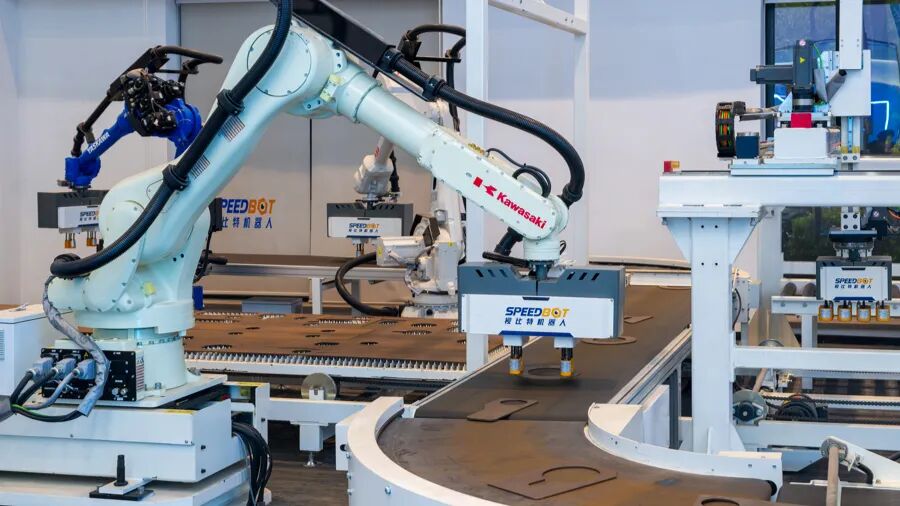
The 2025 Baoshan Intelligent Robotics Industry Conference and Carnival will be held from November 21 to 22. The Smart Bay will welcome a large number of robots, including a lion dance performance by Yushu Technology’s robotic dog and combat performances by humanoid robots, as well as kung fu dance by Zhongqing Robotics, along with exhibitions of humanoid robots, legged robots, wheeled robots, dexterous hands, sensors, and other robots and components.
In the context of Baoshan District actively promoting the construction of a trillion-level industrial cluster for robots and high-end equipment, what is the significance of holding the industry conference for two consecutive years? What ‘thirst-quenching’ measures will the Shanghai Robotics Industry Park, as the core carrying area, introduce for enterprises?
Leveraging Strengths to Explore Breakthroughs
Having been deeply involved in the robotics and intelligent manufacturing industry for twelve years, the Shanghai Robotics Industry Park has gathered 300 key enterprises, with over 80% focusing on robotics and related fields, creating a complete industrial chain ecosystem covering core component R&D and manufacturing, body technology and mass production, system integration, and application services. Here, different types of robotics companies showcase their strengths, forming a virtuous development pattern of ‘leading enterprises guiding, and small and medium-sized enterprises coexisting.’
In the field of industrial robots, Fanuc, one of the ‘four major families,’ has already established its China headquarters, and its third-phase ‘super intelligent factory’ is the largest robot base globally outside Japan. Currently, Gongchuan Technology, invested by Yaskawa Electric from the ‘four major families,’ has also arrived in the park. General Manager Lu Yifeng introduced that Gongchuan Technology focuses on the R&D and production of robots for handling LCD and perovskite panels, with products featuring micron-level operational precision and dust-free design, achieving ±0.2mm positioning accuracy, meeting ISO Class 4 cleanroom requirements, and catering to the special needs of the LCD display and perovskite photovoltaic fields. ‘Relying on Baoshan’s industrial chain foundation and the park’s ecological advantages, we plan to trial-produce two devices by the end of the year, with an expected production capacity of over 500 units next year and an annual sales revenue expected to exceed 100 million yuan.’
In the humanoid robot sector, enterprises in the park are also leveraging their strengths to explore breakthroughs. Depu Intelligent, which just landed in June, is a joint venture between Furande Co., Ltd., which has deep roots in the automotive industry, and Shanghai Kepler Robotics Co., Ltd. The latter’s developed blue-collar humanoid robot ‘K2 Bumblebee’ has already made significant strides in industrial scenarios, possessing not only flexible working capabilities but also industry-leading technical performance, such as a single-arm load capacity of up to 15 kilograms. The strong partnership formed by Depu Intelligent will continue to focus on the industrial sector, developing robots with load-bearing capabilities.
Shibite (Shanghai) Robotics Technology Co., Ltd., known for its outstanding visual capabilities, is targeting the welding application scenarios in the shipbuilding industry. General Manager Liu Tingting stated that after years of collaboration with shipyards, the company discovered that workers had to bend over and hold spray guns for welding, making the working environment unbearable during the high summer temperatures. Leveraging its familiarity with production lines and technical accumulation, the company has taken a new step by developing a humanoid robot that stands 1.8 meters tall and weighs 75 kilograms. ‘From hardware, underlying software to perception algorithms, all are self-developed. This robot will achieve seam tracking and detection through visual guidance, aiming to solve the industry’s pain points of harsh welding environments and high operational difficulties.’
Transforming the Park into a ‘Real Scene Collective’
The Shanghai Robotics Industry Park positions itself as an ‘industrial service partner.’ To this end, the park not only focuses on regular investment attraction but also pays special attention to enterprise services, building platforms and supplementing elements around the core needs of enterprise development. Several significant initiatives to be announced at the industry conference are tailored for enterprises.
For example, establishing a Baoshan Embodied Intelligence Data Collection Center. Robotics companies generally look forward to this, with some saying, ‘Data is the cornerstone of generalization capabilities. Relying on ourselves to train in simulated scenarios, the reliability and stability of the data may reach 95%, but to improve further, high-quality real scene data is needed.’
The park aims to address such needs by co-building with companies like KUPAS and Yushu, integrating a batch of real production line scenarios to provide foundational support and services for humanoid robot R&D training, avoiding the limitations of manually constructed scenarios. Among them, KUPAS will play a role as a professional functional corpus service operation platform, establishing standardized data collection processes, enhancing the capabilities of enterprise data collection personnel, and ensuring high quality and usability. The park’s management stated that the center’s framework construction and site selection have been completed, and as more participants join, the entire park is expected to become a ‘real scene collective,’ allowing enterprises to switch scenes as needed.
Focusing on upstream and downstream collaboration in the industrial chain, the park has partnered with China Telecom to create a supply chain platform for the Shanghai Robotics Industry Park. This platform incorporates the core products of enterprises within the park, allowing companies to search for required products through an app, obtaining supplier names and contact information, achieving ‘in-park procurement and zero-distance connection.’ According to reports, the platform’s version 1.0 focuses on information connection, while the future version 2.0 is expected to realize online procurement functions, further reducing logistics and time costs for enterprises.
Promoting the establishment of the Baoshan Fudan Robotics Joint Innovation Center and forming a ‘Humanoid Robot Innovation Consortium,’ the park has also made efforts to seize the development opportunities in the embodied intelligence track. With the support of Baoshan District, the park will further assist leading enterprises and research institutions in jointly building a humanoid robot pilot verification platform, strengthening the deployment of processing facilities such as 3D printing, machining, PCB processing, and non-standard components, to meet the needs of humanoid robot core components and body prototype design, flexible manufacturing, and small-batch production.
Optimizing Spatial Layout with a ‘Cluster’ Concept
According to Zhang Ying, General Manager of the Shanghai Robotics Industry Park, the long-term goal of the park is to create a globally influential robotics and intelligent manufacturing industrial cluster and application ecosystem. In the future, the park will continue to deepen the development strategy of the industrial cluster, strengthen the extension and integration of the chain, relying on the Shoubiao Special Fund to cultivate new economic momentum; accelerate the release and construction of self-owned industrial space in the park, implementing the ‘build a nest to attract phoenixes’ strategy, creating a source of innovation and entrepreneurship and a growth highland; and continuously promote international development strategies, linking enterprises to enhance brand influence, strengthen core competitiveness, and expand global markets.
From the district level, Baoshan is optimizing spatial layout with a ‘cluster’ concept. Among them, the Nanda ‘Humanoid Robot Innovation Port’ serves as the core engine for R&D training, intensively laying out computing power, corpus, training fields, pilot verification, and other functional platforms, providing enterprises with an innovative environment that integrates open-source R&D, functional training, innovation incubation, and scene applications, creating a highland for humanoid robot innovation; the Shanghai Robotics Industry Park and its industrial radiation area serve as a solid foundation for industrialization, accelerating the introduction and cultivation of humanoid robot component and body manufacturing enterprises, supporting industrial robot and service robot enterprises in humanoid robot R&D and manufacturing; and the Baoshan High-tech Zone and other ‘application bases’ serve as a broad stage for demonstration and promotion, actively promoting humanoid robots into factories, enterprises, and laboratories, creating ‘humanoid robots + intelligent manufacturing’ application demonstrations, and supporting enterprises in conducting humanoid robot demonstration applications in segmented service fields.
‘One port, one park, one base’ will achieve functional complementarity and mutual linkage in development, providing enterprises with full lifecycle support from ‘0 to 1’ to ‘N,’ aiming to enable innovative results to achieve ‘seamless transformation’ and ‘agile landing’ in Baoshan.
According to relevant officials in Baoshan District, only by solving real problems, meeting real needs, and creating real value in key areas, and honing technology in the complex environment of the real world, can we explore the future application paradigm of humanoid robots. To this end, Baoshan District will actively open up ‘high-value’ application scenarios in four major areas: manufacturing, cultural tourism, public services, and urban governance, inviting global enterprises to make Baoshan their ‘best testing ground.’
Source | Liberation Daily
About Us
The Shanghai Pilot Industry Promotion Center is a public institution directly under the Shanghai Municipal Economic and Information Commission, mainly responsible for promoting the development of leading industries such as artificial intelligence and integrated circuits, implementing planning policies, coordinating major projects, drafting standards and norms, developing and promoting application scenarios, researching industrial safety and development trends, and providing technical services for industrial information applications.