
On September 25, electric engineering machinery provider Boleton Technology Co., Ltd. announced a strategic cooperation with Xinjiang Mingyang Mining Construction Group, which plans to purchase no less than 1,000 electric mining trucks and related services by 2028. This follows Boleton’s significant progress in the electrification of mining after signing a zero-carbon mining cooperation agreement with Huawei Digital Energy in August.
Benchmarking against Tesla’s vertical integration path of “electric vehicles + solar storage + autonomous driving”, Boleton’s business model centers on “electric mining trucks + networked solar storage + autonomous driving”, focusing on the high energy consumption and high carbon emission mining sector. This cooperation further strengthens this business label.
With the support of Huawei’s networked energy storage, Boleton aims to address three major pain points in mining areas: unstable power supply, high costs, and carbon pressure, creating a “mining operating system”.
Founded in 2016, Boleton’s business covers the entire industry chain of clean energy production, storage, and utilization, providing integrated solutions for green energy management, hydrogen fuel and pure electric engineering machinery, mining trucks, heavy trucks, and autonomous driving products.
On May 7, 2025, Boleton Technology Co., Ltd. successfully listed on the main board of the Hong Kong Stock Exchange, claiming to be the world’s “first zero-carbon mining robot stock”.
01
Boleton vs. Traditional Giants:
“Vertical Integration” vs. “Incremental Transformation”
In the intelligent mining sector, Boleton’s competitors mainly fall into two categories: traditional engineering machinery giants like Caterpillar and Komatsu, and technology companies focused on autonomous driving in mining such as Xidi Zhijia and Taga Zhixing.
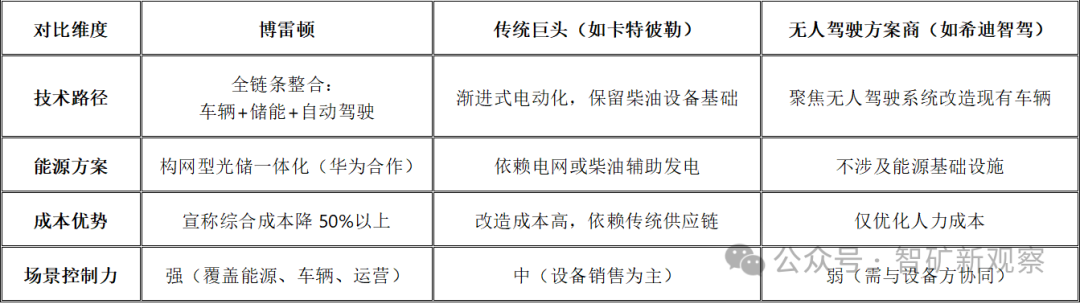
By comparison, it is not difficult to see that Boleton’s differentiated advantages lie in:
Full industry chain coverage: from wind and solar energy management to electric vehicles and autonomous driving, forming a closed-loop solution;
High technical barriers: networked energy storage must solve technical challenges such as black start and voltage ride-through, currently only a few companies like Huawei have the capability to implement it;
Financial imagination space: proposing to digitize green energy assets through RWA (real-world asset on-chain) to attract global capital.
02
Concerns Behind High Growth: Expanding Losses and Scene Limitations
Despite Boleton’s forward-looking technology and model, its business operations still face challenges:
Ongoing financial pressure: In the first half of 2025, revenue was 327 million yuan, but losses reached 174 million yuan, with a loss rate exceeding 50%. High R&D investment (in autonomous driving and energy storage integration) and a heavy asset operation model have led to cash flow pressure;
Scene dependency risk: The mining scene is closed and standardized, suitable for the implementation of autonomous driving, but the total market is limited. In 2024, its market share of electric wide-body dump trucks was only 3.8%, necessitating accelerated overseas expansion;
Complexity of technology integration: Although networked energy storage is technically advanced, its stability in remote mining areas in Africa and South America still needs verification, and in cooperation with Huawei, Boleton remains in the role of solution integrator.
03
The Future Deciding Factors: Global Implementation and Financial Model Innovation
Boleton’s business model represents a transformation in the engineering machinery industry from “selling equipment” to “selling zero-carbon operation services”. Boleton’s long-term value depends on two points:
Ability to replicate overseas mining on a large scale: Expanding into African and South American markets with Huawei is a key test. If it can validate the economic viability of “solar storage + mining trucks” in projects in Zambia and the Democratic Republic of the Congo, it will open up a trillion-level replacement space;
Breakthrough in financialization of energy assets: If it can convert green energy in mining areas into investable assets through blockchain, it could disrupt traditional mining financing models, but requires recognition from policy and capital markets.
Boleton’s advantage lies in its willingness to bet on a technological closed loop and global scenarios, but the risk lies in balancing heavy investment and a single scene. If it can continue to secure large contracts like that with Mingyang Mining and reduce technical risks through cooperation with Huawei, it is expected to become the “Tesla” of the intelligent mining sector. However, before turning losses into profits, the capital market will still need to be patient.

Feel free to share with your friends