Competing with Boston Dynamics Using the Xiaomi Model
/ 01 /
Product System Breakdown: From Quadruped Robots to Humanoid Robots with a starting price of $90,000
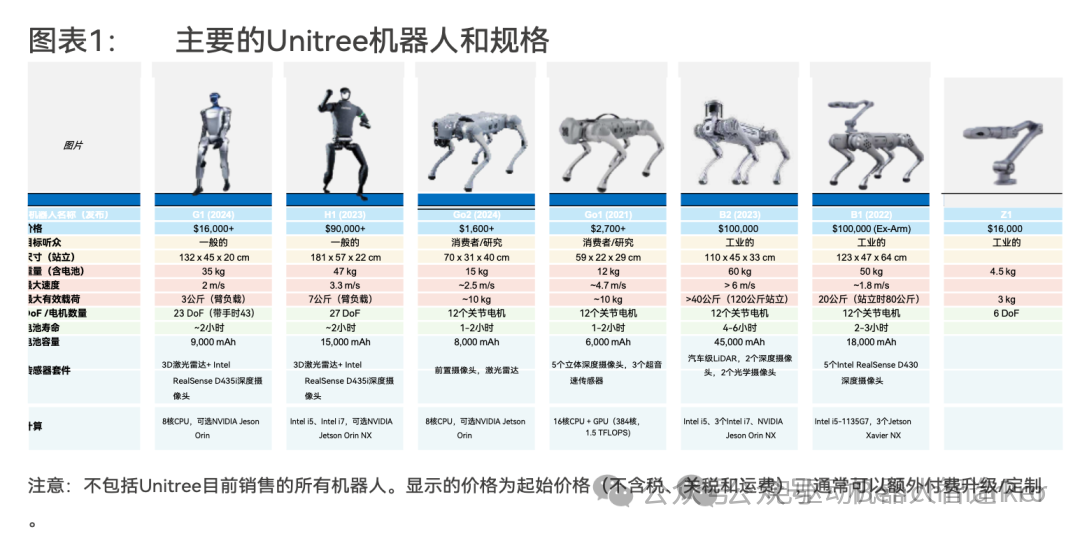
According to a Morgan Stanley report, Unitree Robotics’ product system mainly consists of three categories: quadruped robots, humanoid robots, and robotic components. The details are as follows:
First, Quadruped Robots:
So far, quadruped robots are Unitree Robotics’ core product. The consumer-facing quadruped robots are the Go series and the B series.
The B series, starting at $100,000, offers significantly higher performance, battery capacity, and computing power.Each quadruped robot is equipped with a range of advanced sensors, supporting advanced autonomy and machine vision capabilities, from Intel RealSense depth cameras to foot force sensors and4D LiDAR. The Go series is smaller and more affordable(starting at $1,600).
Many models can also be upgraded to include additional wheels for enhanced mobility and robotic arms. Management claims that by 2024, their global market share for quadruped robots will exceed 60%.
Second, Humanoid Robots:
Unitree Robotics’ humanoid robot models mainly include two: H1(released in August 2023) and G1(to be released in May 2024), positioned as general-purpose robots for home, commercial, or research purposes. However, so far, the main customers for Unitree’s humanoid robots are still research-oriented clients, such as universities and AI startups.
The H1 is a full-sized humanoid robot, standing 5 feet 11 inches tall, equipped with a larger battery, greater degrees of freedom, and enhanced computing power.
In contrast, the G1 is smaller(4 feet 4 inches) and more affordable, starting at $16,000, while the H1 starts at $90,000. Both humanoid robots can be upgraded to improve hand dexterity and are equipped with NVIDIA Jetson Orin SoC modules to enhance computing capabilities.
Third, Robotic Components:
In addition to providing complete robots, Unitree Robotics also manufactures proprietary robotic components, such as joint motors, cameras, and LiDAR sensors, to support third-party robot developers.
/ 02 /
Exploring Unitree Robotics’ Four Core Advantages,
From Efficient Engineering to Autonomy
In this report, Morgan Stanley summarizes Unitree Robotics’ business competitive strategy into four points: efficient engineering, self-developed components, customization, and AI/Autonomy(autonomy). The details are as follows:
First, Efficient Engineering:
Cost-effectiveness has always been one of the core value propositions of Unitree robots.
Before its establishment in 2016, CEO Wang Xingxing created theXDog quadruped robot while studying for his master’s degree at Shanghai University. At that time, XDog quickly gained attention for its unique low-cost yet high-performance design, ultimately leading Wang Xingxing to leave his job at drone manufacturer DJI and found Unitree Robotics.
Unitree Robotics does not rely on expensive components but instead opts for efficient engineering(minimizing the number of components) and recycling existing technologies whenever possible. For example, to reduce the cost of humanoid robots, Unitree Robotics leverages existing technologies developed for its quadruped robots while accelerating time to market.
In comparison to Tesla’s Optimus, which has 14 linear actuators + 14 rotary actuators; Unitree’s G1 humanoid robot, priced at $16,000, only has 23 joint modules/rotary actuators. In an interview, Wang Xingxing(founder of Unitree) stated that their approach is more suitable for mass production.
Second, Self-Developed Components:
Unitree Robotics designs most of the hardware used in its robots, including the motors and gearboxes used in the actuators. This allows them to maximize cost reduction while improving the overall performance of the robots.
In an interview with The Robot Report, Unitree Robotics’ marketing director Duke Huang stated:
“To improve performance and reduce costs, every detail is crucial. For example, reducing the number of wires and cables, minimizing the number of chips, and reducing screws, etc. These tasks may seem minor, but they are actually very critical and important. Except for the chips, almost all hardware in our robots is designed by ourselves.”
Third, Customization:
Most Unitree robots can be customized and upgraded to meet specific customer needs. Each robot typically offers different “tiers” with varying levels of sensors, computing, and physical capabilities.
Additionally, robots can be equipped with various add-ons, from improved hands for humanoid robots to wheels and robotic arms for quadrupeds. Unitree Robotics can provide streamlined models that only include what the customer needs, which is another way to enhance overall cost efficiency.
Fourth, AI/Autonomy (Autonomy):
Unitree Robotics is an official partner of NVIDIA’s Project Gr00t, which is NVIDIA’s general-purpose foundational model for humanoid robots.
According to Morgan Stanley, many of Unitree’s robots also have(or can be upgraded to include) NVIDIA Jetson Orin AGX modules for on-board generative AI capabilities.
With on-board computing and a comprehensive sensor suite on their robots, many AI robotics startups(including Skild AI and Field AI) have used Unitree robots as testbeds for their latest foundational models. Morgan Stanley noted that almost all of Unitree’s robots have autonomous navigation capabilities, which do not require advanced generative AI functions.
/ 03 /
Three Major Target Markets:
Consumer, Industrial, Educational Research
According to the Morgan Stanley report, Unitree Robotics’ customer base currently mainly covers consumer, industrial, and educational research fields.
In the consumer sector, Unitree Robotics has launched the Go2, Go1, and A1 series quadruped robots. These robots can be purchased directly from the Unitree website or through e-commerce channels such as Amazon and AliExpress.
Consumer-facing robots can be controlled via remote control or through the Unitree Go app on iPhone and Android. Although marketed to the consumer market, these robots are often equipped with high-end sensors(such as 4D LiDAR) and computing capabilities(Go2 can be upgraded to use NVIDIA Jetson Orin).
In the industrial sector, Unitree Robotics is pushing its high-end quadruped robots for industrial applications, used for inspection, material handling, safety, and rescue scenarios. Currently, Unitree Robotics has launched customized solutions specifically for automated inspection and search and rescue, where robots can perform searches for potential victims at disaster sites or automatically conduct repetitive yet critical inspection operations, thereby minimizing potential human errors and maximizing safety.
In educational research, due to the relatively low cost of certain models, Unitree Robotics’ robots are frequently used for robotics research and education. Known customers include Harvard University, Yale University, Carnegie Mellon University, Stanford University, and the Massachusetts Institute of Technology.
Additionally, AI foundational model startups, including Field AI and Skild AI, have confirmed they will conduct testing on Unitree robots.
/ 04 /
A Review of the Founding of Unitree Robotics
Unitree Robotics was founded by Wang Xingxing, a former graduate student at Shanghai University, who developed a high-performance quadruped robotic dog named “XDog” during his studies from 2013 to 2016.
Based on low-cost external brushless motors, XDog gained recognition for its affordable bill of materials(BoM) and high performance. Before the XDog video went viral, Wang Xingxing had worked at drone company DJI for a while, and this experience helped him secure angel investment early on when founding Unitree.
According to the latest information, Unitree Robotics is valued at 8 billion RMB, equivalent to about $1.1 billion, with the largest shareholder being Meituan’s Han Hai Information Technology(Shanghai) Co., Ltd., and other investors including Hexagon AB, Sequoia Capital China Fund, Xiangfeng China Fund, Matrix Partners, CITIC Securities, and the Beijing Robotics Industry Investment Fund(a government-supported robotics fund).
Unitree Robotics’ competitors include: UBTECH Robotics(9880.HK), Furi Intelligent, Xiaopeng Robotics, RobotEra, and Agibot. Global competitors include Tesla, Boston Dynamics, 1X Technologies, and Figure AI.
In the quadruped robot field, Unitree Robotics’ main competitors are Boston Dynamics and Deeprobotics, the latter serving over 100 companies across 26 provinces in China. Deeprobotics’ all-terrain model Lynx demonstrates its ability to overcome various extreme environments, with major clients including State Grid, Lenovo, Baosteel, China Minmetals, and several well-known universities.
Unitree Robotics’ timeline of development:
2013-2016: Wang Xingxing developed the quadruped robotic dog XDog while pursuing his master’s degree at Shanghai University. The robot is known for its low-cost bill of materials (BoM) and high performance.
June 2016: After the XDog video went viral online, Wang Xingxing officially founded Unitree with the support of local angel investors.
September 2017: Released an improved quadruped robot called “Laikago,” featuring proprietary motors, drive systems, and controllers.
January 2020: Released the A1 quadruped robot, aimed at being an economical educational and research tool. At launch, Unitree claimed it was the fastest and most stable small quadruped robot in China.
June 2021: Released the Go1 quadruped robot, known for its ultra-low price and enhanced perception capabilities. It was also equipped with a 16-core CPU + GPU AI computer to improve computing power.
August 2021: Raised “tens of millions of dollars” in Series A funding led by Shunwei Capital, with participation from Matrix Partners, Hexagon AB, and others.
April 2022: Raised 100 million RMB (approximately tens of millions of dollars) in Series B funding led by Matrix Partners and Dunhong Capital Management, with Hexagon AB participating. Hexagon also became an official partner of Unitree, planning to integrate Hexagon sensors into Unitree robots.
July 2023: Released the Go2 quadruped robot, equipped with 4D wide-angle LiDAR, controlled by a proprietary AI foundational model. Starting price is $16,000.
August 2023: Unitree released the H1, launching its first humanoid robot. The company claims it is “China’s first full-sized general-purpose humanoid robot.”
February 2024: Raised 1 billion RMB ($139 million) in Series B2 funding with participation from Meituan, Source Code Capital, and CITIC Securities.
May 2024: Released the G1 humanoid robot, which immediately attracted attention due to its price (starting at $16,000) and improved flexibility.
September 2024: Raised “tens of billions” of RMB in Series C funding led by the Beijing Robotics Industry Investment Fund, with participation from Meituan, Amber Capital, Shanghai Science and Technology Innovation Fund, Sequoia Capital China (Sequoia), and others.
Source: Silicon-based Observation Pro and Electric Drive Benchmarker, online. For learning and communication purposes only, can be deleted within 30 days.