At the recently concluded “Future Investment Initiative” conference in Saudi Arabia, Elon Musk made another astonishing statement: in the future, humans will no longer work to make a living, currency may completely disappear, and “going to work” will become a purely optional interest.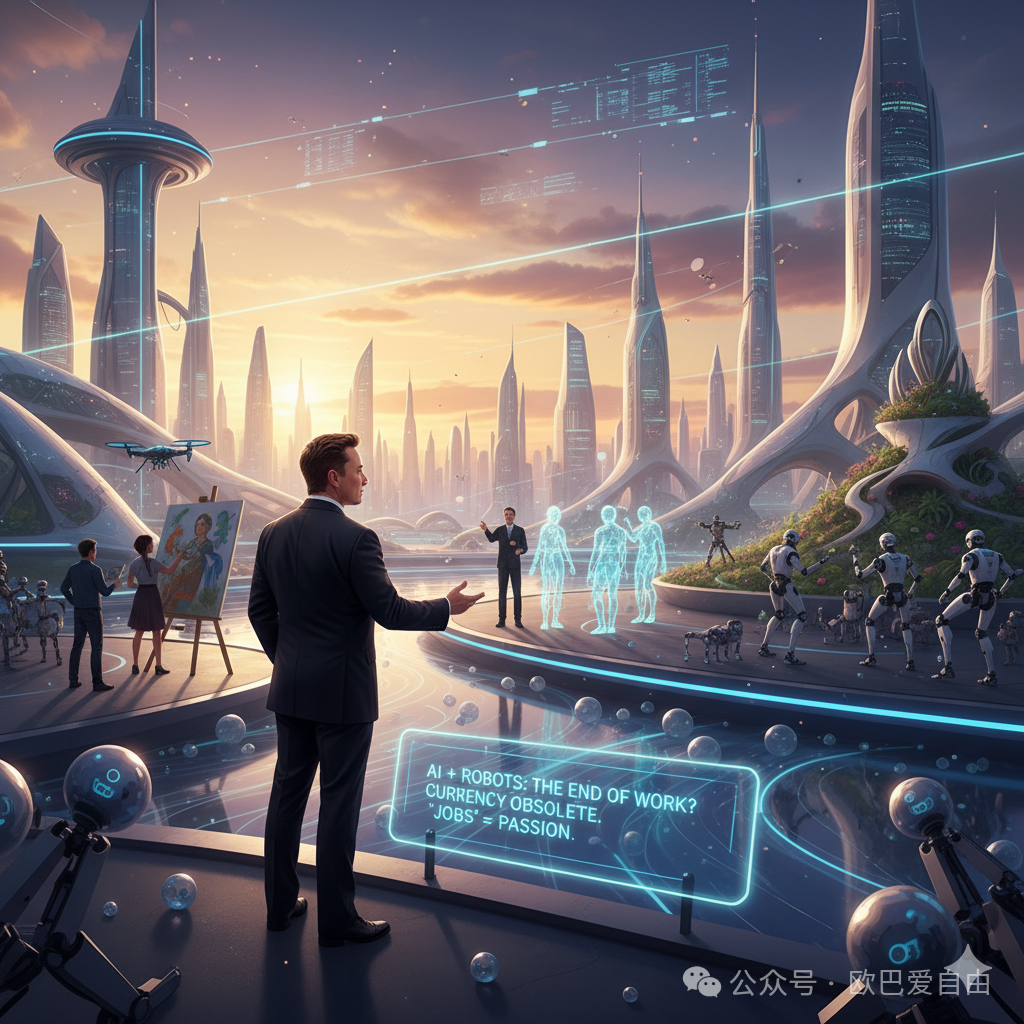 After hearing this description, my first reaction was: wait, why does this script sound so familiar? Isn’t this the ideal communist state of “from each according to his ability, to each according to his needs”?When “996” becomes “growing tomatoes”: Musk’s social simulation gameRegarding future work, Musk made a very down-to-earth analogy.He said that when AI and robots can take on the vast majority of production activities, humans going to “work” will be like today when some people choose to grow tomatoes in their backyard—not because they can’t buy tomatoes at the supermarket, but because they enjoy the process of planting.In that future, writing code, designing, writing poetry, or going to Mars to grow potatoes (given that he is Musk, this is likely true) will only be because “I like it,” not “I have to make a living.”It’s like our current weekend life: you can go to the supermarket to buy ready-made vegetables, but some people still prefer to set up a small garden on their balcony, exhausting themselves yet enjoying it. The future of work will likely be this **universal version of ‘balcony gardening’**—work will no longer be a shackle of survival, but the highest form of entertainment.The disappearance of currency: the billionaire’s “Versailles” or top insight?More daring than the idea of “not working” is Musk’s prediction about money: “Currency will no longer be important at some point in the future.”When the world’s richest person says “money is no longer important,” it is a form of dark humor. But this is not purely “Versailles.” Musk’s logic is based on the premise of “abundant resources”:When AI solves productivity bottlenecks and robots address labor shortages, the cost of goods and services will approach zero. When all resources are as readily available as air, the tool used to allocate scarce resources—”currency”—naturally loses its meaning.To support this view, he strongly recommended Iain Banks’ science fiction masterpiece series “The Culture”—which depicts a space utopia managed by super AI, where humans can freely explore themselves.Don’t rush, this “communism” is not that “communism”.Although the outcomes may seem similar, Musk’s vision fundamentally differs from classical communism.The traditional path: hoping for changes in social systems and adjustments in production relations.Musk’s path: relying on technological explosions—making AI and robots a new form of “super productivity” that directly and violently breaks the problem of resource scarcity.If Marx’s slogan was “Workers of the world, unite!”, then Musk’s subtext might be: “All humanity, lie flat, let AI do the work.”In conclusionNo matter whether this is another form of “communism,” the vision Musk paints is indeed appealing. Of course, he also left a blunt truth: “There is still a lot of work to be done from now until that time.” For us ordinary people, the good news is: in the future, we may not need to work for survival; the bad news is: to reach that future, we may have to work even harder now, or at least, strive to live until that time.