If we were to list the department most often overlooked by enterprises, yet most capable of reflecting customer experience, it would undoubtedly be the customer service center.
In industries such as telecommunications, banking, and the internet, customer service centers often play the role of “gatekeepers of customer experience.” They must address questions from all directions and provide accurate answers in the shortest time possible. However, the reality is that as business complexity increases, customer service teams are facing unprecedented challenges:
-
High labor costs: A large number of frontline customer service representatives require long-term training and regular assessments, with a high turnover rate for newcomers.
-
Rapid knowledge updates: Business rules, product policies, and promotional offers change daily, necessitating almost daily updates to the customer service knowledge base.
-
Stagnation in satisfaction improvement: Customers demand not just “correct answers,” but also “quick responses, warm interactions, and a personal touch.”
In this context, AI technology is seen as a beacon of hope. The emergence of large language models (LLMs) has completely opened up the possibilities for “intelligent customer service.” These models can understand natural language, generate fluent dialogues, and even simulate human tones. Theoretically, such AI customer service can provide 24/7 uninterrupted service, with high efficiency, low costs, and quick responses.
However, there is a significant gap between ideal and reality.
Initially, when we directly applied a general-purpose large model to customer service scenarios, the accuracy rate was only 2%. The model could indeed “speak,” but it often provided incorrect, incomplete, or even fabricated responses. Instead of improving customer experience, it led to more complaints.
Thus, we embarked on an exploration of intelligent customer service, aiming to evolve from 2% to continuous improvement.
This journey has no shortcuts, but it does follow a pattern. It is a clear and reproducible growth curve—the “Four-Stage Leap of AI Customer Service.”
1. Project Background: Why Develop Our Own Customer Service AI Agent?
As intelligent service becomes a key component of enterprise competitiveness, various AI customer service solutions have emerged in the market.
Some focus on voice recognition, some excel in text matching, and others market themselves as “intelligent Q&A” solutions selling pre-trained models. However, during the implementation process, we discovered a common issue:
General solutions can be deployed quickly, but they are difficult to use effectively.
The reason is simple—each enterprise has different business logic, customer demographics, and service processes.
A question from a bank customer and a question from a telecommunications user may appear identical at face value, but their underlying intentions are completely different. General models cannot understand this difference; they can only mimic but cannot truly comprehend.
We ultimately decided:
To not rely on external black-box systems, but to develop a controllable, scalable, and continuously optimizable customer service AI Agent system.
The project’s goals were clear from the outset:
-
Not just to create an AI that can “answer”;
-
But to build a “user-friendly, reliable, and evolvable” intelligent customer service partner;
-
To truly integrate it into the enterprise service system, becoming a long-term engine for business growth.
This means it must not only understand business knowledge but also possess continuous learning capabilities, allowing it to grow alongside the real customer service team.
2. Detailed Implementation Path: Precise Leaps Across Four Stages
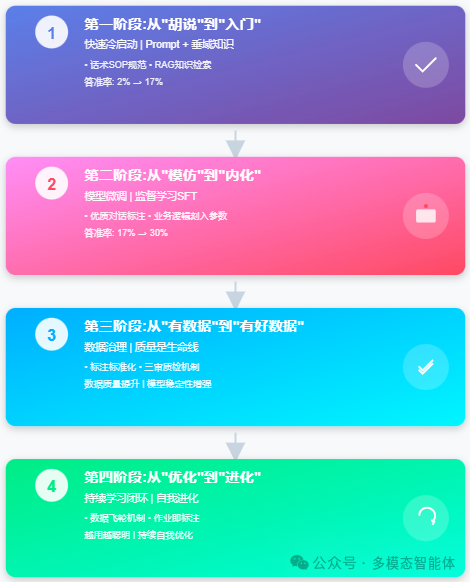
First Stage: From “Nonsense” to “Entry Level”—Rapid Cold Start (Prompt + Domain Knowledge)
When we first integrated the large model, its performance was both amusing and frustrating.
Faced with a simple question like “I want to transfer my broadband service,” its response was: “Please contact your local property management for transfer procedures.”—completely off-topic.
The root of the problem lies in the fact that while general large models are powerful, they lack any “industry knowledge” or “dialogue boundaries.” In customer service scenarios, this “freedom to express” has become a risk.
Thus, we initiated the first stage—”teaching AI to speak human language.”
① Prompt Engineering: Setting rules for AI using “dialogue scripts.”
We established detailed prompt rules for AI, such as:
-
Limiting its tone to “professional, patient, and polite”;
-
Forbidding it from fabricating answers, requiring it to reference the knowledge base;
-
Providing it with clear dialogue templates, such as “confirm first, then explain, and finally guide.”
These prompts serve as a dialogue SOP, giving AI a “customer service demeanor” from the start.
② Domain Knowledge Enhancement: Feeding it business “essentials.”
We digitized the FAQ, policy documents, and process documents from the customer service center, constructing a structured knowledge base. Through the RAG (Retrieval-Augmented Generation) mechanism, we enabled AI to “look up information” in the knowledge base before generating responses.
Stage Results:
In the first month after launch, the accuracy rate improved from 2% to 17%. Although still not perfect, the volume of customer complaints significantly decreased, and AI could handle over 80% of basic inquiries. It no longer “spouted nonsense” but was able to “engage in conversation,” achieving a true cold start success.
Second Stage: From “Imitation” to “Internalization”—Model Fine-Tuning (SFT)
Prompting and knowledge enhancement allowed AI to “follow instructions,” but it remained “passively executing.”
Whenever policies were updated or business adjustments were made, we had to manually update the knowledge base or rewrite prompts, which was highly inefficient. Worse still, while AI could imitate, it still did not understand business logic—like an actor who can recite lines but does not grasp the plot.
Thus, we decided to enter the second stage: enabling AI to “truly learn” the business.
① Principle: Supervised Fine-Tuning (SFT).
We selected a large number of historical customer service dialogues, with experienced customer service representatives manually annotating “high-quality responses.” These responses included real contexts, customer emotions, business logic, and correct handling methods.
Through SFT fine-tuning, we embedded this experience directly into the model parameters—transforming AI from merely “imitating customer service” to “becoming customer service.”
② Effect: From rote responses to flexible replies.
The fine-tuned AI can automatically recognize multi-turn contexts, for example:
When a customer asks, “I had a broadband overdue payment last month; can I still use it if I pay now?” AI no longer simply says, “You can pay the overdue amount,” but adds, “After payment, the system will automatically restore service within 15 minutes. If it has not been restored after 30 minutes, please reply ‘human’ to contact me for verification.”
This change in detail made users feel “understood.”
Stage Results: The accuracy rate exceeded 30%, and AI truly developed scene understanding and service awareness.
Third Stage: From “Having Data” to “Having Good Data”—Quality is the Lifeline
As the model became smarter, we encountered an unexpected problem:
The more data we had, the worse the model sometimes performed.
Upon investigation, we found that the issue stemmed from the quality of the annotated data. Some annotators had misunderstandings, some data rules were outdated, and some response styles were inconsistent. These “dirty data” could lead the model astray, even fostering incorrect habits.
Thus, in the third stage, we focused on “data governance.”
① Standardization: Establishing guidelines for annotations.
We developed a detailed annotation manual, clarifying response levels, logical sequences, and tone standards for different questions. For example:
-
Business-related questions must reference policy bases;
-
Complaint-related questions should demonstrate empathy;
-
Technical questions should guide users through operational steps.
② Detailed Quality Control: Ensuring every piece of data “feeds” the model.
We established a “three-review mechanism”: annotator → reviewer → quality control team, with each sample requiring validation.
Simultaneously, we introduced a scoring system to quantitatively assess data quality, with substandard samples being directly eliminated.
Stage Results:
Data quality significantly improved, and model stability increased. The consistency and accuracy of AI responses both improved, with the business team providing feedback for the first time: “AI’s answers can now be sent directly to customers.”
Fourth Stage: From “Optimization” to “Evolution”—Building a Continuous Learning Loop
As the model matured, new issues arose—businesses change daily, but AI does not automatically update.
If AI cannot continuously learn, it will gradually become “outdated” and lose value.
Therefore, the goal of the fourth stage is to enable AI to enter a self-evolution state.
① Data Flywheel Mechanism: Using real interactions to feed back into the model.
We added a “low-confidence monitoring module” to the system, which automatically flags AI responses that are uncertain and pushes them to human customer service for handling.
After customer service resolves the issue, the system automatically stores the question and correct answer, forming new training samples.
This creates a data flywheel:
The more it is used → the more data is collected → the more it learns → the more accurate it becomes.
② Work as Annotation: Making training costs nearly zero.
Traditional annotation requires manpower, time, and budget. We innovatively transformed “customer service’s daily work” into “model learning data.”
When customer service replies to users in the system, it automatically records the question, answer, and customer feedback, generating high-confidence samples for subsequent fine-tuning.
Stage Results:
The model entered a phase of continuous self-optimization. It no longer relies on periodic training but continuously strengthens itself through daily use, achieving an “ever-smarter” evolution loop.
3. Stage Results and Project Significance: Dual Improvement in Efficiency and Satisfaction
After four stages of evolution, the customer service AI Agent transitioned from an “auxiliary tool” to a “business partner.” We evaluated the project’s effectiveness from multiple dimensions:
|
Metric |
Cold Start Stage |
After Fine-Tuning |
After Data Optimization |
Continuous Evolution Stage |
|---|---|---|---|---|
|
Accuracy Rate |
2% |
17% |
35% |
60%+ |
|
Average Handling Time |
– |
↓15% |
↓32% |
↓50% |
|
First Contact Resolution Rate |
– |
↑12% |
↑28% |
↑45% |
|
Customer Satisfaction (CSAT) |
– |
↑9% |
↑18% |
↑30% |
More importantly, there were qualitative changes:
-
Human customer service transitioned from “problem solvers” to “customer relationship managers”;
-
AI handled over 80% of repetitive inquiries, allowing the customer service team to focus on high-value, complex tasks;
-
The enterprise achieved24/7 uninterrupted service, significantly enhancing service consistency and brand trust.
Conclusion:
Looking back over the entire journey, we summarized four keywords:
Phased advancement, small steps, data-driven, human-machine collaboration.
These four words can almost encapsulate any successful AI project.
AI is not achieved overnight; it is a continuously refined and feedback-driven evolutionary system. The success of the customer service AI Agent relies not on technical gimmicks, but on a solid understanding of business, optimizing processes, and accumulating data.
Looking to the future, the capabilities of the customer service AI Agent will continue to expand:
It will go beyond just “answering questions” to integrate into business processes, achieving proactive reminders, intelligent dispatching, predictive maintenance, and even identifying and resolving potential issues before customers voice them.
True intelligence lies not in how much AI can do, but in its ability to collaborate with humans, making every service interaction more efficient and warmer.
This journey, starting from 2%, is a microcosm of AI’s entry into the deep waters of business.
And the future of intelligent customer service is just beginning.