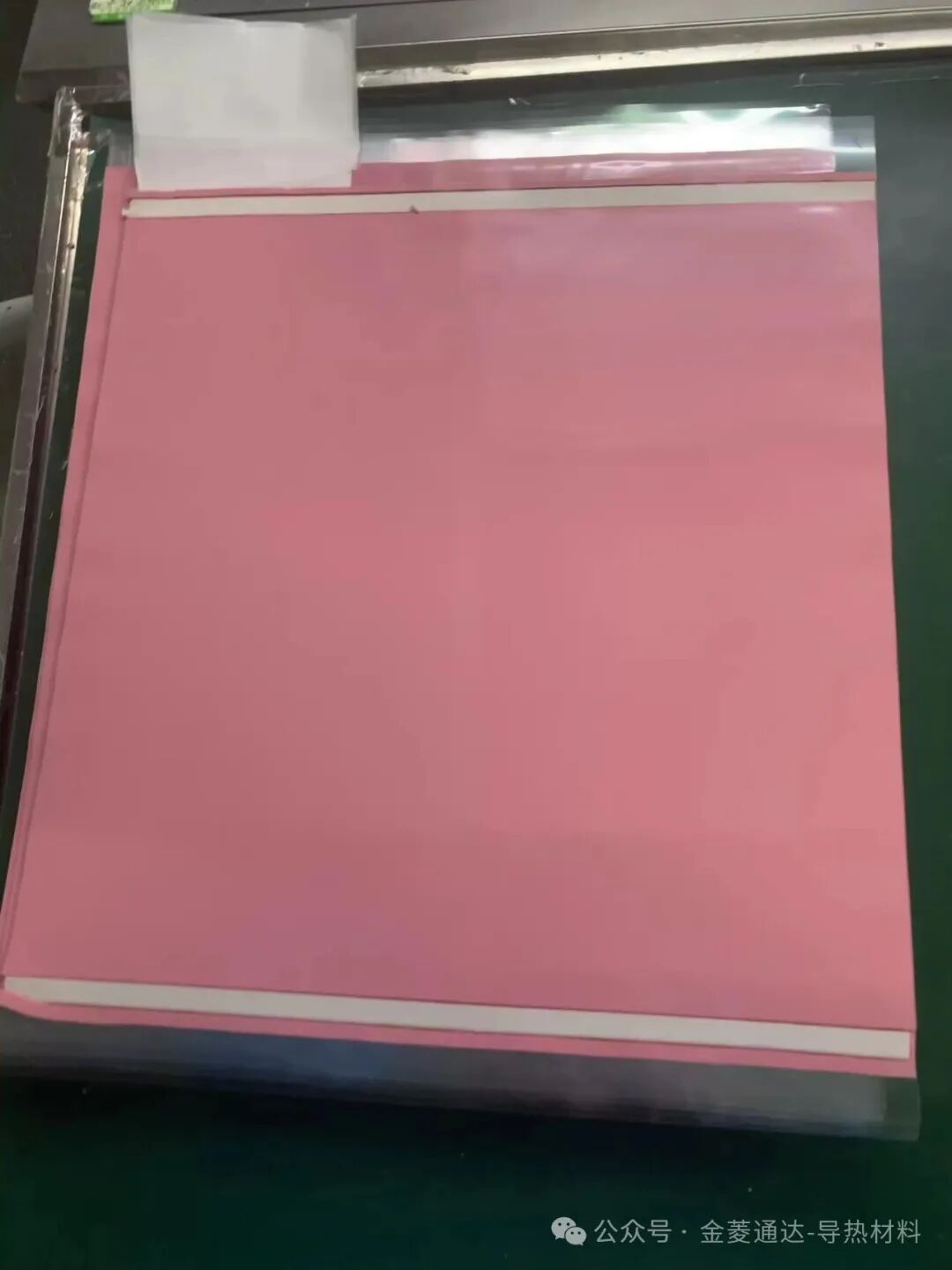
1. 5.0W Thermal Conductivity + 10kV/mm Insulation: The dual insurance solution for the motor winding group addresses the three major challenges of humanoid robot motors: high power density, high-frequency vibration, and confined spaces. The Jinling Tongda thermal conductive silicone sheet XK-P50 achieves a breakthrough in performance. • Efficient Heat Transfer: The thermal conductive silicone sheet XK-P50 features a thermal conductivity of 5.0W/(m•K) combined with a flexible substrate, allowing it to closely conform to the complex surfaces of the winding group, resulting in low thermal resistance. Tests show that it can reduce the temperature rise of the robot knee joint motor winding group and maintain long-term stability, with continuous operating temperatures remaining within target values; • Insulation Safety Barrier: The thermal conductive silicone sheet XK-P50 has a breakdown strength of 10kV/mm, effectively isolating high-voltage coils from the metal casing even during motor overload (current peaks reaching three times the rated value); • Extreme Environmental Resilience: It maintains elasticity in a wide temperature range of -50℃ to 200℃, with a thickness change rate of less than 2% after 1000 hours of vibration testing (frequency 20-2000Hz), perfectly adapting to dynamic scenarios such as robot walking and grasping. Measured data: In the application of this company’s biped robot knee joint motor, the Jinling Tongda thermal conductive silicone sheet XK-P50 improved motor efficiency by 5.2%, with significant optimization of the energy efficiency curve. 2. Selection of Thermal Conductive Silicone Sheets in an Open Source Ecosystem: Rigorous Validation Behind Technical Transparency As the world’s first publicly open technology robot company, this company has set three stringent thresholds for supply chain partners: reproducible performance, verifiable solutions, and adaptable costs. So, how did the Jinling Tongda thermal conductive silicone sheet XK-P50 stand out? “We require the thermal conductive silicone sheet to not only pass laboratory tests but also prove its reliability in dynamic operation of the entire machine,” revealed the company’s technical leader. “The Jinling Tongda thermal conductive silicone sheet XK-P50 showed less than 3% degradation in heat dissipation performance during 300 hours of continuous walking tests, with an insulation resistance retention rate of 98.7%. This data directly determines its qualification for specific applications.” More valuable to the industry is that the company has synchronized the material specifications, installation processes, and failure mode analysis of the Jinling Tongda thermal conductive silicone sheet XK-P50 to GitHub, available for global developers to reference. This full-process openness from material selection to technical validation not only recognizes the Jinling Tongda thermal conductive silicone sheet XK-P50 but also provides the industry with a reusable thermal management standard template. 3. Mass Production Delivery Capability: Adapting from Stringent Processes to Agile Responses The large-scale application of the thermal conductive silicone sheet XK-P50 relies on the customized production system of Jinling Tongda in the robotics industry: 1. Precision Manufacturing Process: The thermal conductive silicone sheet XK-P50 is produced using a fully automated die-cutting production line, with a thickness tolerance controlled within ±0.03mm and a surface fitting accuracy of 99.5%, allowing precise adaptation to the gaps between winding group coils; 2. Rapid Response Mechanism: The thermal conductive silicone sheet production base achieves “48-hour sample prototyping + 7-day bulk delivery,” combined with the company’s “open-source testing – small batch iteration – large-scale mass production” development rhythm, significantly shortening project implementation cycles; 3. Full Lifecycle Management: Each batch of thermal conductive silicone sheets undergoes thermal imaging detection, insulation withstand voltage testing, and RoHS/REACH environmental certification, with an on-site failure rate of less than 0.02%, meeting the high reliability requirements of scenarios such as medical rehabilitation robots. 4. From Single Material to Ecological Collaboration: Jinling Tongda’s Thermal Management Layout The successful application of the thermal conductive silicone sheet XK-P50 is just a “fulcrum” for Jinling Tongda in the robotics field. For scenarios involving controller chips, force sensors, battery modules, etc., the company has built a complete product line: • Jinling Tongda high thermal conductive gels XK-G30, XK-G65, XK-G120, XK-G140 (thermal conductivity 3.0-14.0W/(m•K)), suitable for controller chips and bionic joint dynamic deformation heat dissipation. The R&D director of Jinling Tongda stated: This deep collaboration is the core value of material innovation in an open-source ecosystem. Joining the open-source wave, making thermal materials an innovative “infrastructure” As the company reconstructs the robotics R&D ecosystem with open-source technology, Jinling Tongda is lowering the innovation threshold with reliable thermal material solutions. Whether you are a startup or an industry integrator, if you need exclusive technical information about the thermal conductive silicone sheet XK-P50 or wish to apply for test samples, feel free to consult us to unlock the infinite possibilities of thermal management for humanoid robots! Jinling Tongda – Expert in Thermal Solutions for Core Components of Robots, ensuring every bit of power is safe and efficient!