As humanoid robots gradually move towards industrialization, computing power chips have become the core foundation supporting their “intelligent brain.” Among them, edge AI chips are becoming a key driving force for robot intelligence due to their characteristics of low latency, low power consumption, and local computation.
01
What are Edge AI Chips?
Unlike chips primarily deployed in cloud data centers, edge AI chips are directly integrated into terminal devices, such as smartphones, automotive systems, wearable devices, and even the robots themselves. They can perform model inference and computation locally on the device, eliminating the need for network connectivity, thus providing the following advantages:
-
Privacy and Security: Sensitive data does not need to be uploaded to the cloud and is processed locally.
-
Real-time Response: Suitable for scenarios with extremely high latency requirements, such as facial recognition, instant voice interaction, and robot environmental perception.
-
Computing Power Distribution: Alleviates the pressure on cloud bandwidth and computing power, making cloud-edge-end collaboration more efficient.
In the field of humanoid robots, the importance of edge chips is even more pronounced. Robots need to quickly perceive and make decisions in complex environments, and relying solely on the cloud can be constrained by latency and network fluctuations, while edge computing power allows robots to achieve instant feedback and high autonomy.
02
Technical Architecture and Optimization Directions
The hardware design of edge AI chips typically includes various computing units such as CPU, GPU, NPU, DSP, and LPU, with each unit responsible for general computing, parallel acceleration, neural network inference, signal processing, and low-power standby functions. Under limited energy consumption and storage conditions, chips often combine methods such as model compression, parameter quantization, and network pruning to enhance efficiency.
Moreover, the software ecosystem is also crucial for the successful deployment of edge chips. Mainstream lightweight frameworks (such as TensorFlow Lite, ONNX Runtime, Core ML, etc.) are widely used for edge inference. At the same time, security mechanisms such as Trusted Execution Environment (TEE) and data encryption modules ensure the reliability of sensitive information during local processing.
03
Representative Products from International and Domestic Markets
In the edge chip sector related to humanoid robots, both international and domestic manufacturers have their own focuses:
-
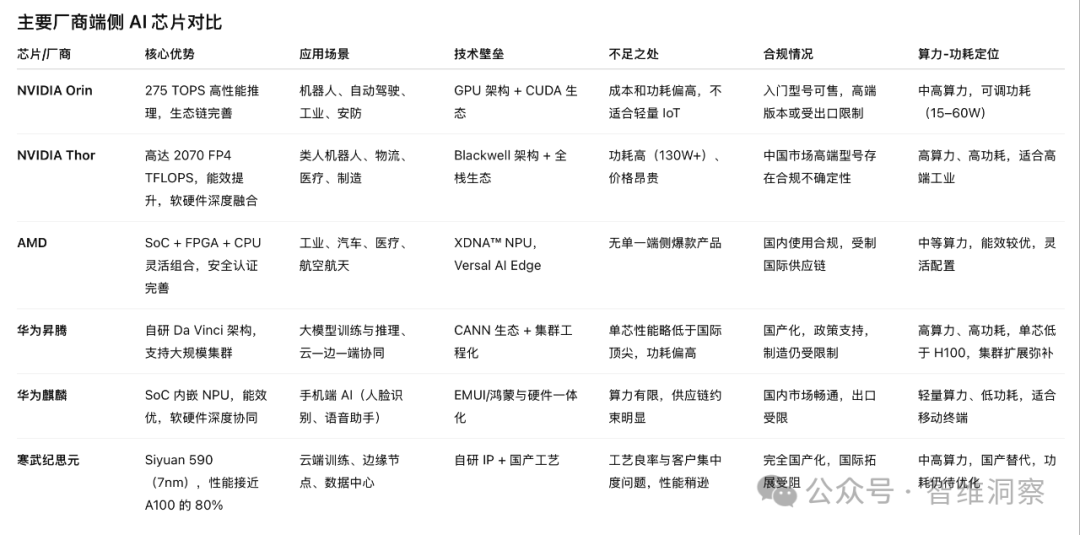
NVIDIA Orin is known as a “mini supercomputer,” capable of reaching up to 275 TOPS, widely used in robotics, autonomous driving, and industrial automation. Its advantages lie in strong computing power and a comprehensive JetPack and Isaac ROS toolchain, but it has relatively high power consumption and cost.
-
NVIDIA Thor is a high-end platform for humanoid robots and physical AI, capable of achieving strong real-time inference on a single board, with significant energy efficiency improvements. Companies like Amazon Robotics and Boston Dynamics have already adopted it. Its disadvantages include high power consumption (130W+) and expensive pricing.
-
AMD has chosen a different path, providing customized solutions through the collaboration of CPU, FPGA, and SoC. The Ryzen Embedded integrates the XDNA™ NPU, suitable for power-sensitive environments; the Versal AI Edge emphasizes sensor fusion and real-time performance, already applied in automotive, industrial, and medical devices. AMD’s advantages lie in flexibility and security certification, but it lacks a single blockbuster product like Orin.
-
Huawei Ascend relies on its self-developed Da Vinci architecture and CANN ecosystem, supporting cloud-edge-end collaboration and excelling in large-scale model inference and training. With a high degree of localization and strong policy support, it is an important pillar of domestic high-performance computing power.
-
Huawei Kirin integrates NPU into SoC, emphasizing hardware-software integration, mainly used for real-time AI functions in mobile terminals, such as facial recognition and voice assistants. While its computing power is limited, it has significant energy efficiency advantages.
-
Cambricon Siyuan is a representative enterprise of domestic AI chips, with its Siyuan series performance approaching international top levels, suitable for cloud training and high-performance edge nodes. Its advantages lie in autonomy and policy support, while challenges include production capacity, ecosystem, and international expansion.
04
Outlook: The Computing Power Foundation for Humanoid Robots
The demands of humanoid robots for environmental understanding, action planning, and human-robot interaction far exceed those of traditional robots. This means that future chips must find a balance between high computing power, low power consumption, and strong ecosystem .
From a global perspective, NVIDIA firmly occupies a leading position relying on its GPU architecture and software ecosystem; AMD takes a differentiated approach; while domestic manufacturers like Huawei and Cambricon are accelerating their catch-up based on policies and self-developed architectures. It is foreseeable that the competition in the humanoid robot industry will largely be a competition for the computing power foundation.
A thought-provoking question is:In this promising new industry of humanoid robots, can we truly establish a self-controllable technological system through breakthroughs in edge AI chips, rather than falling into the predicament of being “choked” again?

If you wish to stay updated on the trends of embodied intelligence, key players’ technological advancements, and system evolution paths, please follow “Intelligent Insight.” We will continue to track the global evolution dynamics of intelligent systems and provide valuable first-hand analysis.