📄 Executive Summary
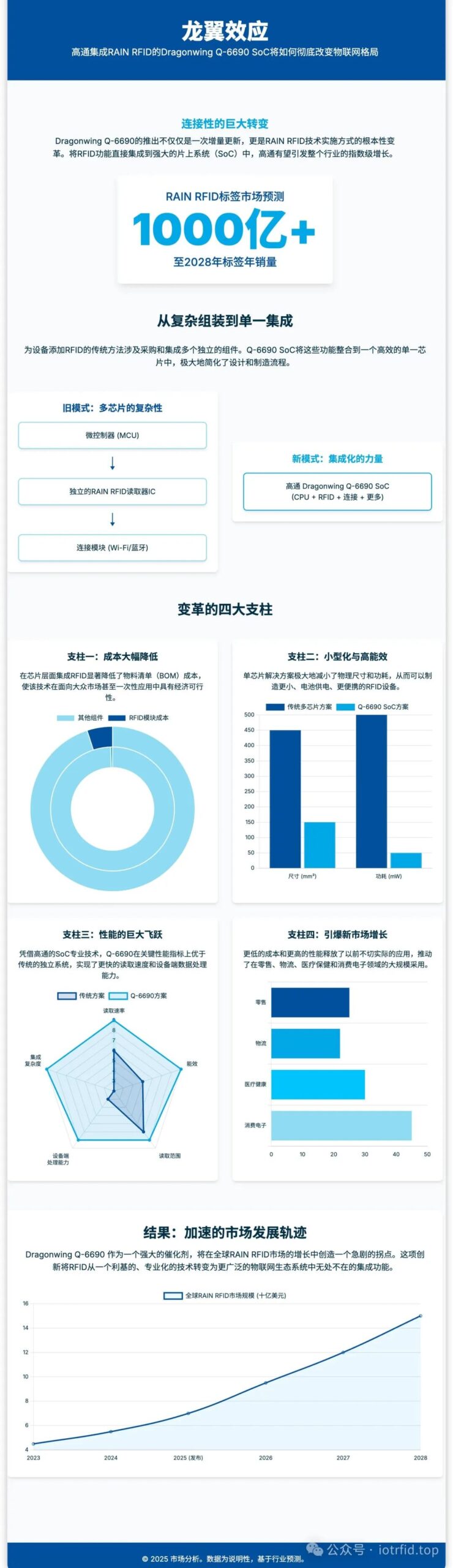
This report aims to deeply analyzeQualcomm‘s release of the🐉 Dragonwing Q-6690system-on-chip (SoC) and assess its profound impact on theRAIN RFID (Radio Frequency Identification)and the broaderInternet of Things (IoT)industry. The core argument is that the advent of the Q-6690 is not merely a simple product iteration, but a fundamental strategic disruption of the existing industry landscape. It marks a paradigm shift in RFID reader hardware architecture from traditional multi-component, discrete designs to a highly integrated SoC model.
Key insights from the report include:
-
💸 Transformation of Economic Models: This technological leap will profoundly change the economic model of enterprise-level devices by significantly reducing bill of materials (BOM) costs, thereby driving market adoption.
-
🚀 Accelerated Technology Adoption: The integrated solution greatly simplifies the R&D and certification processes for device manufacturers, promising to accelerate the widespread application of RFID technology.
-
🔄 Reshaping Market Dynamics: Existing industry leaders, such as Impinj, must strategically adjust to respond to the new competitive landscape.
-
📈 Significant Market Opportunities: This heralds unprecedented opportunities for tag chip manufacturers (such as NXP) and end-user industries like retail and logistics.
In summary, the Dragonwing Q-6690 is not just a chip, but a key catalyst for reshaping the industry value chain, fostering new business models, and accelerating the full realization of the IoT.
1️⃣ Chapter One: The Emergence of Dragonwing Q-6690: A New Architecture for Enterprise Edge Devices
This chapter aims to clarify the technical foundation ofDragonwing Q-6690, positioning it as a converged platform that redefines the capabilities of enterprise-level edge devices.
1.1 Deconstructing Q-6690: Beyond Traditional Processors
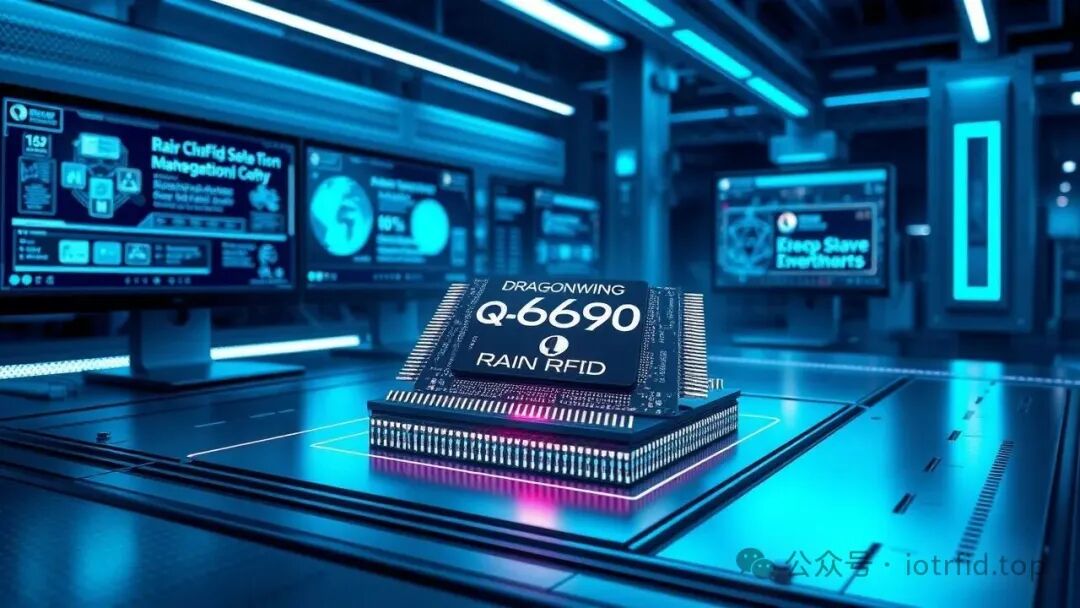
The Dragonwing Q-6690 is not merely a central processing unit (CPU), but a comprehensive system-on-chip (SoC) platform built on an advanced **4-nanometer (4 nm)** process node. This advanced process endows it with exceptional performance and energy efficiency, which is crucial for battery-sensitive enterprise mobile devices.
The platform integrates:
-
🧠 CPU: A powerful octa-core Qualcomm Kryo CPU (up to 2.9 GHz).
-
🎮 GPU: Next-generation Adreno 7 series graphics processing unit.
-
🤖 AI Engine: Third-generation AI engine capable of delivering up to 6 TOPS (trillions of operations per second).
-
📡 Connectivity Solutions: A top-tier connectivity solution including 5G (supporting dual SIM dual standby), Wi-Fi 7, Bluetooth 6.0, and ultra-wideband (UWB) technology.
The powerful computing capability is key to enabling data processing at the device level, making real-time analysis at data collection points possible. Comprehensive wireless protocol support ensures robust, high-speed, and precise location-aware communication, making the Q-6690 a hub for modern wireless communication.
1.2 “World’s First”: The Technical Significance of Integrating RAIN RFID
The most striking feature of the Q-6690 is its identity as the “world’s first enterprise-grade mobile processor with integrated ultra-high frequency (UHF) RAIN RFID functionality“. This marks a fundamental architectural transformation.
Historically, adding RAIN RFID functionality to rugged handheld devices required procuring a separate external reader module. This module typically includes a reader chip (e.g., from Impinj), a radio frequency front end, and other components, which need to be integrated into the device’s motherboard. This discrete solution incurs significant costs in design, expense, and power consumption. The Q-6690 eliminates this external module by directly integrating the RFID reader functionalityinto the main processor chip, constituting its core technological leap.
The integrated reader fully complies with the ISO/IEC 18000-63 RAIN protocol and supports the enhanced standard “Gen2X” pioneered by Impinj.
📊 Qualcomm Dragonwing Q-6690 Platform Technical Specifications
| Processor Technology | 4nm |
| CPU | Qualcomm Kryo, octa-core, 2.9 GHz |
| GPU | Adreno 7 series |
| AI Engine | Third generation, 6 TOPS |
| Cellular Network | 5G + 5G DSDA |
| Wi-Fi | Wi-Fi 7 |
| Bluetooth | 6.0 |
| Positioning | GPS |
| Other Radios | UWB |
| Integrated RAIN RFID Reader | Yes |
| RFID Standard Support | “ISO/IEC 18000-63, Gen2X-capable” |
| RFID Receiver Sensitivity (dBm) | Not publicly disclosed |
| RFID Maximum Read Rate (tags/second) | Not publicly disclosed |
| RFID Power Consumption | Not publicly disclosed |
1.3 Functional Integration: The Synergy of RFID, AI, 5G, and Wi-Fi 7
Integrating these cutting-edge technologies onto a single chip generates powerful synergies. This is not merely a simple addition of functionalities, but amultiplication of value.
Scenario Example: Retail Inventory 🏪
A store employee uses a handheld terminal equipped with the Q-6690 for inventory counting. The integrated RFID reader can collect inventory data at an extremely high speed (hundreds of tags per second). Subsequently, the AI engine on the device can immediately analyze this raw data, identifying anomalies (such as misplaced items, potential theft patterns, etc.) without needing to upload vast amounts of data to the cloud. Finally, through 5G or Wi-Fi 7 connectivity, the device only needs to upload processed, insightful results in real-time to the central inventory system.
This tight integration gives rise to a “smarter, proximity-aware” experience, where the device not only knows “who I am” but can also sense “what is around me” and intelligently compute and convey this contextual information. This architectural shift elevates mobile processors from mere computing and connectivity engines to “physical world perception engines.”
Moreover, the introduction of software-configurable feature packages creates new business models for enterprise hardware. Device manufacturers (OEMs) can sell base models of devices and then upsell more AI processing power or better camera support throughover-the-air (OTA) upgrades. This separates the value of hardware and software, creating the potential for ongoing revenue for OEMs, aligning the economic model of enterprise devices with modern software and cloud service models, thus extending the product lifecycle.
2️⃣ Chapter Two: The Inevitable Trend of Integration: Economic and Engineering Impacts on Device Manufacturers (OEMs)
This chapter will quantitatively analyze the value proposition brought by the Q-6690 to device manufacturers (OEMs) such as Zebra, Honeywell, and Urovo, who are direct customers of this SoC.
2.1 Reshaping Device Economics: In-Depth Analysis of BOM Costs and Total Cost of Ownership
The most direct advantage is the elimination of the external RFID reader module, which directly reduces the device’sbill of materials (BOM) costs. Analysts comment that this could reduce manufacturing costs by as much as30%.
The integrated design also gives rise to smaller, lighter, and more energy-efficient device forms. This is not only an aesthetic improvement; in enterprise environments, lightweight devices can reduce employee fatigue, while higher energy efficiency means longer battery life, directly enhancing work efficiency. Additionally, by simplifying manufacturing processes and reducing supply chain links, the device’s **total cost of ownership (TCO)** is also lowered.
2.2 Accelerating Innovation Cycles: Simplifying Design, Certification, and Time to Market
Integrating a discrete RFID module is a complex engineering task that involves precise RF circuit design, antenna tuning, and interference management. The Q-6690’s integrated solution significantly reduces engineering complexity and development investment. This simplification, combined with its software-ready platform characteristics, significantly shortens the time to market for new devices. At the same time, it also reduces the expenses related to regulatory and compliance certification testing for RF devices, which are often costly and time-consuming bottlenecks.
2.3 Solving Coexistence Challenges: The Inherent RF Advantages of SoC Solutions
A key technical challenge faced by modern mobile devices is ensuring that multiple radios (such as cellular networks, Wi-Fi, Bluetooth, and RFID) can operate simultaneously without interference, known asRF coexistence. When using discrete modules, managing this interference requires additional RF front-end components and complex shielding designs.
Qualcomm, leveraging its deep expertise in radio technology, has addressed this challenge internally within the Q-6690. Its integrated design allows RAIN RFID to operate concurrently with 5G, Wi-Fi 7, Bluetooth 6.0, and UWB without interference and without the need for additional components.
The deeper significance of Qualcomm’s move is that it effectively eliminates the decision-making risks for OEMs when adding RFID functionality to their products, turning RFID functionality into apre-integrated, pre-certified feature of their core processors. This is likely to lead to the rapid proliferation of RFID functionality in enterprise devices, transforming it from a high-end, specialized feature into a standard, ubiquitous configuration.
Furthermore, the energy efficiency gains from integration are key to unlocking new forms of RFID readers. The Q-6690’s high energy-efficient design makes it possible to embed RFID functionality into smaller devices (such as lightweight wearables or even consumer-grade enterprise smartphones) without sacrificing battery life. This aligns with the industry’s vision of “putting RAIN-enabled devices in the hands of every employee.”
3️⃣ Chapter Three: Reshaping the Competitive Landscape: Market Disruption and Strategic Repositioning
This chapter aims to analyze the chain reactions triggered by the Q-6690 throughout the RFID value chain, focusing on the strategic challenges and opportunities faced by existing industry participants.
3.1 The Predicament of Existing Leaders: Analyzing the Impact on Impinj’s Reader Chip Business Model
Impinj is the absolute leader in the RAIN RFID reader chip market. Qualcomm’s initial partners for the Q-6690, such as Zebra, Honeywell, and Urovo, are also major customers of Impinj’s reader chips.
Qualcomm’s entry directly threatens Impinj’s core business, especially in the mid-range and low-power markets. In response to the challenge, Impinj has adopted a “co-opetition” strategy. Its CEO Chris Diorio publicly welcomed the release of the Q-6690, emphasizing that the Q-6690 supports the Gen2X protocol and can fully leverage the advanced features of Impinj’s M700/M800 series tags.
Qualcomm’s move is likely to force the RFID reader market to undergosegmentation:
-
Mid-range market: Will be occupied by integrated SoC solutions.
-
High-performance market: Will still be dominated by specialized discrete chips.
Impinj will be forced to adjust its strategy, focusing its value proposition entirely on superior performance metrics (read rates, sensitivity, distance) to serve high-margin, specialized application markets where its E710/E910 chips can significantly outperform integrated solutions.
⚔️ RAIN RFID Reader Solutions Comparison: Integrated SoC vs. Discrete Chips
| Feature/Attribute | Qualcomm Q-6690 (Integrated Solution) | Impinj E Series (Discrete Solution, using E710/E510 as examples) |
| System Architecture | Single-chip SoC | Main Processor + Reader IC |
| BOM Cost Impact | Significantly reduced | Increased module costs |
| Design Complexity | Low, handled by SoC supplier | High, OEM responsible |
| Device Size | Minimized | Larger |
| Energy Efficiency | High, on-chip optimization | Medium, standalone components |
| RF Coexistence | Internally engineered solution | Requires external components/shielding |
| Performance – Sensitivity | Not publicly disclosed | E710: -88 dBm, E510: -82 dBm |
| Performance – Read Rate | Not publicly disclosed | E710: 950 tags/second, E510: 700 tags/second |
| Target Applications | Wide range of enterprise mobile devices | Performance-tiered specialized devices |
3.2 Opportunities for Tag Suppliers: NXP’s Role in the Qualcomm Ecosystem
Unlike Impinj, NXP is the leader in the RAIN RFID tag chip market. When designing the Q-6690, Qualcomm explicitly ensured compatibility with NXP’s UCODE series tags.
Therefore, the proliferation of low-cost, integrated RFID readers driven by Qualcomm will serve as ahuge catalyst for the tag market. As the number of deployed readers skyrockets, the demand for tags used for assets, inventory, and products will also grow exponentially. This is a significant boon for NXP’s business.
3.3 Strategic Shifts for OEMs: Navigating New Supplier Dynamics
OEMs like Zebra and Honeywell now have greater options and bargaining power. They can establish differentiated product lines:
-
High-performance devices: Can continue to use top discrete chips like Impinj E710 or E910.
-
Cost-sensitive devices: Can be built around the integrated Q-6690.
This dual-sourcing strategy will help lower component costs across the industry and promote richer product innovation. In the future, the evolution of the RAIN RFID protocol may become more closely tied to the development of mobile computing platforms (such as the Dragonwing series).
4️⃣ Chapter Four: From Professional to Ubiquitous: Catalyzing Large-Scale Applications in Key Vertical Industries
This chapter will explore the downstream market impacts brought about by the widespread adoption of RFID reader technology due to reduced costs and easier accessibility.
4.1 The Future of Retail: Real-Time Inventory, Contactless Payments, and Experiential Commerce
Strong market demand is indicated by enthusiastic support from retail giantsDecathlon andEssilorLuxottica, who have RFID tagged 100% of their products, calling the Q-6690 a “game changer.”
This technology will accelerate the deployment of the following solutions:
-
🛒 Automation/Contactless Payments
-
📊 Real-Time Inventory Analysis
-
🛡️ Loss Prevention
4.2 Transparent Supply Chains: Empowering Digital Product Passports and Circular Economies
The RAIN Alliance explicitly links the Q-6690 to the realization of “digital product passports and circular economies.”The EU’s “Digital Product Passport (DPP)” initiatives require products to have unique identifiers to track their lifecycle, material composition, and reparability. Making RFID readers ubiquitous and cost-effective is a key step in achieving this vision. This will bring unprecedented supply chain transparency, aiding in the global fight against counterfeiting, managing product recalls, and optimizing logistics.
4.3 Emerging Frontiers: Unlocking the Potential of Manufacturing, Healthcare, and Industrial IoT
The capabilities of the Q-6690 extend far beyond retail and logistics.
-
🏥 Healthcare: Applications include patient monitoring, medical supplies inventory management, and drug authenticity verification.
-
🏭 Manufacturing (Industry 4.0): Tracking assets, tools, and work-in-progress in factory workshops to achieve process automation and efficiency improvements.
-
🌐 Industrial IoT: The characteristics of its target devices (rugged handheld terminals, tablets) make them well-suited for applications in field services, utilities, and public safety.
The core impact of the Q-6690 is not to create entirely new application scenarios, but to make those already validated, mature RFID applications economically and logistically feasible for large-scale deployment for the first time. By integrating reader functionality into mobile computing devices that enterprises already need to equip their employees with, the incremental cost of RFID capability dramatically decreases. This fundamentally alters the ROI calculation model for large-scale deployments, truly achieving the “democratization of the IoT.”
5️⃣ Chapter Five: Strategic Outlook and Forward-Looking Recommendations
This chapter provides forward-looking analysis, exploring key uncertainties and offering actionable recommendations for stakeholders across industries.
5.1 The Performance Question: Assessing the Impact of Undisclosed RFID Benchmark Data
There exists a criticalinformation gap: Qualcomm has yet to publicly disclose detailed performance metrics for its integrated RFID reader, such as receiver sensitivity (in dBm), maximum read rate (in tags/second), or read distance. This is the most important variable determining the Q-6690’s short-term market impact.
-
If performance is comparable to Impinj E510: It will become a powerful solution for most handheld retail and mid-range applications.
-
If performance is lower: Its applications may be limited to near-field scenarios (such as point of sale, self-service terminals).
Given the inherent trade-offs of integration, its performance is unlikely to reach the levels of high-end chips like Impinj E710 or E910 in the short term.
5.2 The Path to IoT Democratization: Forecasting Long-Term Market Trajectories
The release of the Q-6690 is a strong validation of the RAIN RFID market, which is expected to grow from $12.61 billion in 2025 to $25.24 billion by 2033. Qualcomm’s entry may accelerate this growth curve. The longer-term vision is to eventually integrate RAIN RFID intoconsumer-grade smartphones.
5.3 Stakeholder Action Guide: Navigating the Landscape of the “Post-Dragonwing Era”
-
➡️ For Impinj: Increase investment in the high-performance market and continue to drive the development of software and protocol ecosystems.
-
➡️ For NXP and other tag chip suppliers: Align closely with Qualcomm’s product roadmap and prepare production capacity for the impending surge in demand.
-
➡️ For OEMs (Zebra, Honeywell, etc.): Initiate performance evaluations based on the Q-6690 immediately and develop a tiered product strategy leveraging both integrated and discrete solutions.
-
➡️ For end-users (retailers, logistics companies): Begin strategic planning for a future where RFID is ubiquitous, prioritizing pilot projects for digital product passports and circular economy tracking.
-
➡️ For investors: Reassess the competitive barriers of pure RFID reader hardware companies, viewing tag manufacturers and software/platform providers as primary beneficiaries.