Continuing from the previous article: Investment in Japanese Energy Storage Stations (13) – SOH (State of Health), this article discusses the State of Charge (SoC) of energy storage stations.
1. Basic Definition of SoC
SoC (State of Charge), which means荷电状态, refers to the ratio of thecurrent remaining charge to thecurrent maximum usable capacity, usually expressed as a percentage (%). The calculation formula is:
SoC = (Current Remaining Charge / Current Maximum Usable Capacity) × 100%
Where:
“Current Maximum Usable Capacity”: Here, it emphasizes “current”, not the factory capacity. Because batteries age, their maximum capacity will decline (this is the concept of SOH). Therefore, a battery with a health status (SOH) of 80% will only have 80% of the actual charge even if its SoC shows 100%.
It is an instantaneous state quantity: SoC is like a car’s fuel gauge or a phone’s battery percentage, a value that dynamically changes over time and with charge/discharge power, telling you “how much power is left at this moment”.
Analogy: If we compare energy storage/portable chargers to a bucket of water, SoC islooking into the bucket at this moment to see how much water is inside.
-
SoC 100%: The bucket is full and about to overflow. You feel secure, knowing you can water the flowers for a long time. But this puts a lot of pressure on the bucket itself (keeping the battery fully charged for a long time is not good).
-
SoC 50%: There is only half the water left in the bucket. You are wondering whether to water the flowers now or fill the bucket first.
-
SoC 20%: The bucket is almost empty. You start to feel anxious and must take immediate action, either to fill it with water (charge) or conserve it, or the flowers in the garden will wilt (the device will shut down). The low battery alert on your phone works on the same principle.
-
SoC 0%: The last few drops of water in the bottom of the bucket are used up. The pump (device) automatically stops working because forcing it to pump will suck in air, damaging the pump (over-discharging the battery can cause permanent damage).
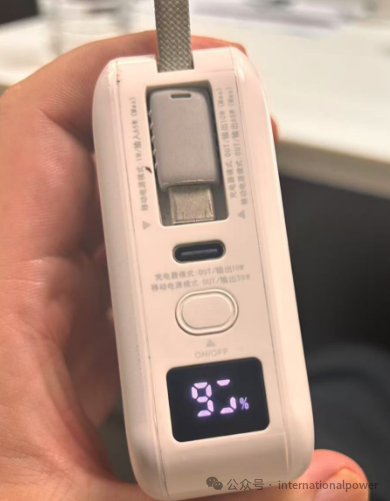
The following image shows a power bank with a display indicating 95% battery remaining. This number is the SoC.
 2. The Impact of SoC on the Revenue of Energy Storage Station Operations2.1 The Impact of SoC on Frequency Regulation
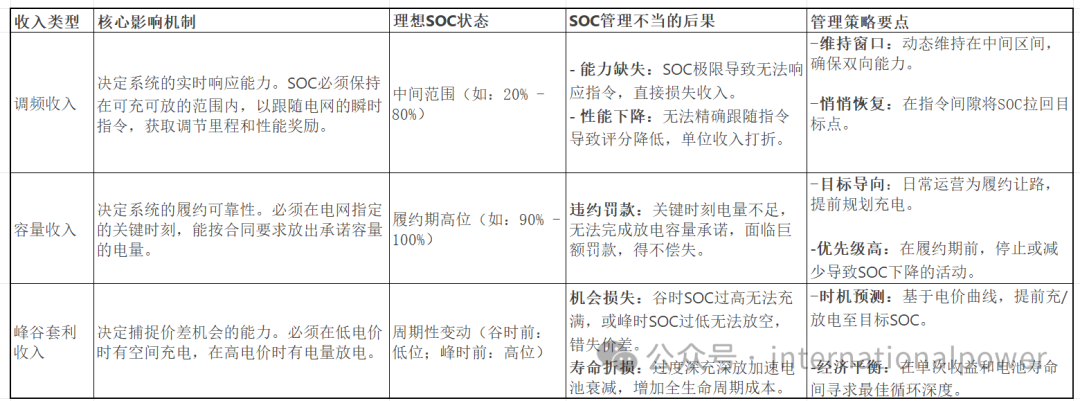
Frequency regulation is currently one of the most economically valuable applications of energy storage in Japan. The power grid requires rapid and precise power output to balance instantaneous load changes and maintain frequency stability. Energy storage, due to its millisecond response speed, has become an ideal choice.
The core impact of SoC: Maintaining frequency regulation capability (Ready Capacity)
a. Usable capacity and regulation mileage:
-
Frequency regulation revenue is usually linked tothe actual provided regulation power (megawatts) and regulation mileage (megawatts × time).
-
If the SoC is too high (e.g., 95%) or too low (e.g., 5%), the system cannot respond to the grid’s instructions to discharge or charge, which is equivalent to “having strength but unable to exert it”, resulting in a direct loss of regulation mileage revenue during that time period.
-
Ideal state: To maximize response capability, the SoC should be maintained within a middle range (usually recommended between20%-80%), ensuring that the energy storage system has enough capacity space to respond to charging or discharging instructions from the grid.
b. Regulation performance indicators:
-
Many electricity markets (such as the US PJM, and some pilot projects in China) adopt performance-based compensation mechanisms. The higher the regulation accuracy, response speed, and accuracy, the higher the revenue coefficient (Performance Score).
-
If the system cannot fully follow instructions due to SoC limits, it will lead to a decrease in performance scores, significantly reducing the revenue per unit of regulation mileage.
c. SoC recovery strategy:
-
After continuously providing frequency regulation services, the SoC will gradually deviate from the middle value. Therefore, aSoC recovery strategy must be in place.
-
Operators need to quietly pull the SoC back to the midpoint during the gaps in grid instructions, using low power that does not affect frequency regulation performance. The effectiveness of this strategy directly impacts long-term frequency regulation availability and revenue.
For frequency regulation, the goal of SoC management is to stabilize it within a middle window to maximize available capacity and regulation performance, thereby achieving the highest revenue.
2.2 The Impact of SoC on Capacity Revenue
Capacity revenue refers to the income obtained by the energy storage system by committing to provide a certain backup capacity when the grid needs it (such as during peak electricity demand), similar to capacity markets or capacity fees.
The core impact of SoC: Ensuring performance capability
a. Availability at performance moments:
-
The key to capacity revenue is being able to discharge at least a certain power for a specified time (e.g., 4 hours) during thecritical moments designated by the grid (such as certain peak periods in summer).
-
If the SoC is low during these critical times and cannot fulfill the promised discharge capacity, it faces significantpenalties. The penalties may far exceed the capacity revenue itself.
-
Ideal state: Before the performance period begins, the SoC must be charged to a sufficiently high level (e.g., 90%-100%) to ensure that the promised capacity can be fully released.
b. Coordination of daily management and performance periods:
-
This creates a contradiction: daily participation in frequency regulation or peak-valley arbitrage consumes energy, which may lead to insufficient SoC before the capacity performance period.
-
Operational strategies must be planned in advance. As the capacity performance period approaches,reduce or stop other energy-consuming activities (such as stopping discharge arbitrage, or even charging in advance) to prioritize the fulfillment of capacity contracts.
For capacity revenue, SoC management is goal-oriented. It can operate flexibly during non-critical periods, but during critical performance periods, it must ensure high SoC to meet discharge capacity requirements; otherwise, the risk is extremely high.
2.3 The Impact of SoC on Peak-Valley Arbitrage Revenue
Peak-valley arbitrage refers to charging energy storage during low electricity prices (valley times) and discharging to sell during high electricity prices (peak times) to earn the price difference.
The core impact of SoC: Capturing price difference opportunities
a. Timing of charging and discharging:
-
The logic of arbitrage is simple, but the key to success lies in having enough available capacity to charge duringlow-price periods and having enough energy to discharge duringhigh-price periods.
-
If the SoC is already high at the start of the valley price period (for example, due to previous frequency regulation services), it cannot charge sufficiently, losing the opportunity to buy low.
-
If the SoC is low at the start of the peak price period (for example, due to responding to frequency regulation discharge instructions), it cannot discharge sufficiently, losing the opportunity to sell high.
b. Cycle efficiency and degradation:
-
Deep charging and discharging (for example, using the SoC from 20% to 80% each time) has a greater impact on battery degradation than shallow charging and discharging (cycling between 40%-60%).
-
Although a single deep cycle may earn more price difference, accelerated battery degradation increases long-term life cycle costs (LCOS). The optimal strategy needs to balancesingle cycle revenue andbattery life.
-
Generally, avoiding keeping the SoC at extreme values (0% or 100%) for long periods and controlling the depth of discharge (DoD) helps extend battery life, thereby increasing total arbitrage revenue over the entire life cycle.
For peak-valley arbitrage, SoC management is timing-oriented. It is necessary to adjust the SoC to an appropriate level before the price difference cycle begins (lower SoC before valley times, raise SoC before peak times) to maximize capturing price differences while considering the economic impact of cycle depth on battery life.
3. How can energy storage station investors manage and transfer SoC risks?
Generally, the SoC risk of energy storage stations should be transferred to Aggregators. The specific ways to transfer SoC risk are as follows:
3.1 Signing Fixed Lease Payment Agreements
This is the most thorough way to transfer risk.
-
Model: Investors lease thecomplete operational rights of the energy storage station to Aggregators. Aggregators pay investors afixed rent annually (or monthly).
-
Risk transfer effect:
-
Investors: Completely transfer SoC and all market risks. Regardless of whether Aggregators use the station for frequency regulation, arbitrage, or capacity reserve, and regardless of how well they manage SoC, the investor’s income is fixed. This is similar to a landlord collecting rent without bearing the tenant’s business profits or losses.
-
Aggregators: Bear all operational risks (including poor SoC management leading to poor income, changes in market rules, accelerated battery degradation, etc.), but also enjoy all excess profits.
-
Applicable scenarios: Investors with a high aversion to risk who wish to obtain absolutely stable cash flow and are insensitive to potential excess profits.
3.2 Signing Base Revenue + Revenue Share Agreements
This is currently the most common and popular compromise model, balancing risk and reward.
-
Model: Aggregators promise investors aminimum annual base revenue. If the actual revenue of the station exceeds the base revenue, both parties share the excess according to an agreed ratio (e.g., 70% for investors, 30% for Aggregators).
-
Risk transfer effect:
-
Investors: Transfer most of the downside risk. Even if Aggregators perform poorly, investors can still receive the base revenue, ensuring the basic financial viability of the project. They can also share the upside revenue.
-
Aggregators: Bear the risk of not reaching the base revenue (need to make up the difference from their own pockets), but can earn a share as a reward for excellent operations (such as good SoC management).
-
SoC risk allocation: Aggregators have a strong incentive to optimize SoC management because any increase in revenue is directly related to them. Investors do not need to worry about specific SoC strategies, only the final revenue results.
3.3 Signing Availability-Based Agreements
This model focuses more on the reliability of the asset rather than the final revenue.
-
Model: Investors pay for theavailable capacity provided by Aggregators. Aggregators must ensure that the station is in good condition and that SoC management meets the requirements for responding to instructions at any time.
-
Risk transfer effect:
-
Investors: Pay a “service fee”, transferring the technical risk of ensuring system availability (including SoC health) to Aggregators. If the system becomes unavailable due to poor SoC management by Aggregators, investors can deduct payment.
-
Aggregators: Bear the responsibility for ensuring high-performance availability of the system, butdo not directly bear the risk of market revenue fluctuations. Their income comes from providing available assets, not market performance.
-
Applicable scenarios: Commonly seen in situations where Aggregators manage a large number of distributed assets simultaneously, providing virtual power plant (VPP) services.
3.4 How to Implement Risk Transfer through Contract Terms?
Regardless of the business model adopted, rigorous contracts must be used to clarify responsibility boundaries.
a. Clearly define operational responsibility boundaries:
-
Contract terms: Clearly define the full operational responsibilities of Aggregators, including but not limited to:market reporting, real-time scheduling response, SoC management strategy, battery health management (SOH), daily maintenance coordination, etc..
-
Investor’s role: Retreat to being the asset owner, only responsible for asset safety, site infrastructure maintenance, and receiving payments according to the contract.
b. Set performance indicators (KPI) and reward-punishment mechanisms:
-
Frequency regulation performance score: Require Aggregators to maintain an average score in the top XX% of the market.
-
Number of capacity performance failures: The number of capacity defaults due to SoC issues must not exceed X times/year.
-
Battery degradation guarantee: Require Aggregators to guarantee that the annual battery degradation rate does not exceed X%, incorporating the impact of their SoC management strategy on battery life into the assessment. If degradation is too fast, Aggregators must bear part of the replacement cost.
-
SoC-related KPIs: Although not directly intervening, investors can set some outcome-based KPIs to constrain Aggregators, such as:
c. Data transparency and supervision rights:
-
Contract terms: Investors should retainremote data access rights, allowing them to view key data such as SoC, power, revenue, etc., in real-time, but without operational authority.
-
Purpose: This is not to intervene in operations but tosupervise whether Aggregators fulfill their contractual responsibilities, ensuring that assets are well-managed and providing data evidence in case of disputes.
d. Termination clauses:
-
Contract terms: If Aggregators continuously fail to meet the performance or revenue requirements stipulated in the contract due to poor management (e.g., multiple significant defaults or penalties due to SoC management errors), investors have the right to terminate the contract and replace Aggregators.
-
Purpose: This is the ultimate bottom line to protect investors’ interests.
Previous articles:Investment in Japanese Energy Storage Stations (13) – SOH (State of Health)Investment in Japanese Energy Storage Stations (12) – Milliampere and Watt-hourInvestment in Japanese Energy Storage Stations (11) – “Capacity” and “Capacity”Energy Storage Notes (4) – Understanding Primary, Secondary, and Tertiary Frequency RegulationInvestment in Japanese Energy Storage Stations (10) – Total Investment CAPEX CompositionInvestment in Japanese Energy Storage Stations (9) – Operating Expenses OPEX CompositionUnderstanding the Levelized Cost of Electricity (LCOE) (Discussion Draft)Investment in Japanese Energy Storage Stations (2) – InputsInvestment in Japanese Energy Storage Stations (4): Simple Instruction SystemInvestment in Japanese Energy Storage (8) – Why does energy storage only pay the capacity part?Investment in Japanese Energy Storage Stations (7) – Entrustment FeesInvestment in Japanese Energy Storage Stations (6) – What is Renewable Energy Assignment Fee?Overseas Energy Storage Station Discussion:September 8, 2025, Monday evening 19:00-23:00, Japanese Energy Storage Station Investment Discussion Meeting.Meeting Theme: “Building Overseas Energy Storage Station Assets: Japan’s Load Aggregators, EMS, and PCS, Upstream and Downstream Connections”Registration WeChat: internationalpower
Previous online discussion meeting minutes:
20250829 – “Building Overseas Energy Storage Station Assets – Revenue Models of Japanese Energy Storage”, meeting minutes.
Recommended Energy Storage Books:
“Monetizing Energy Storage”, PDF version.
Friends engaged in Japanese energy storage station investment business can add WeChat: internationalpower to request.