In recent years, the toy industry has seen a surge in attention, with Labubu’s trendy attributes and Jellycat’s soothing qualities capturing the favor of consumers across all age groups. The deep integration of IP and toys not only injects emotional value into the industry but also precisely meets the dual demands of young people for “self-satisfying consumption” and “emotional companionship” with families.However, beyond this IP craze, a more disruptive industrial transformation has quietly taken shape— the deep penetration of AI technology is evolving toys from “static entertainment carriers” to “intelligent interactive partners,” breaking new ground primarily among children and the elderly.
01
From “Pseudo-Intelligence” to True InteractionWhen it comes to AI toys, the public’s perception often remains stuck in the early stages of “fixed dialogue responses” and “single-function triggers” that characterize “pseudo-intelligence,” or they think of niche products with a high price tag. This situation has been fundamentally reversed thanks to breakthroughs in domestic AI large model technology: lightweight iterations of large models like DeepSeek and Volcano have not only endowed toys with core capabilities such as real-time semantic understanding, online translation, and emotional recognition but have also reduced the cost of edge hardware modules to a range suitable for scalable applications, clearing key obstacles for the popularization of AI toys.
02
Intelligent Interaction and Precise Scene Implementation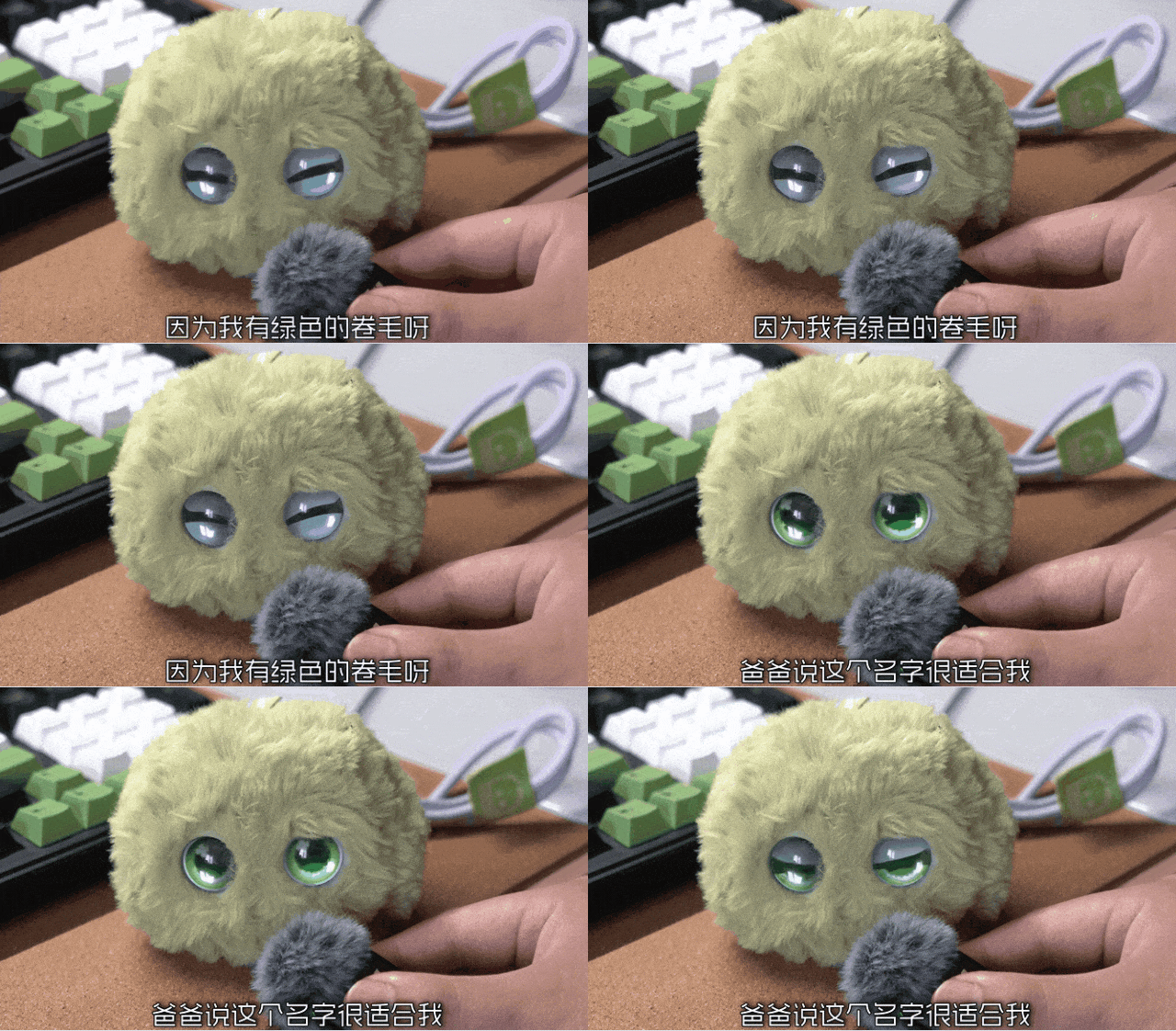
Some specific functions are showing a trend towards precision: for children, certain products can analyze voice to recognize emotional fluctuations, automatically switching to soothing mode when a child is crying, or guiding good habits like tidying up toys and brushing teeth on time through contextual dialogue; for language learning needs, a bilingual interaction system can achieve real-time translation and pronunciation correction, acting as a “personal little foreign teacher”; some products even integrate with educational institutions’ curricula to provide synchronized tutoring on knowledge points and feedback on learning outcomes, creating a closed loop between entertainment and education.
03
From Child Consumption to Family-Wide CoverageIt is noteworthy that the scene boundaries of AI toys are continuously breaking through traditional parent-child domains, forming a new ecosystem that covers multiple demographics.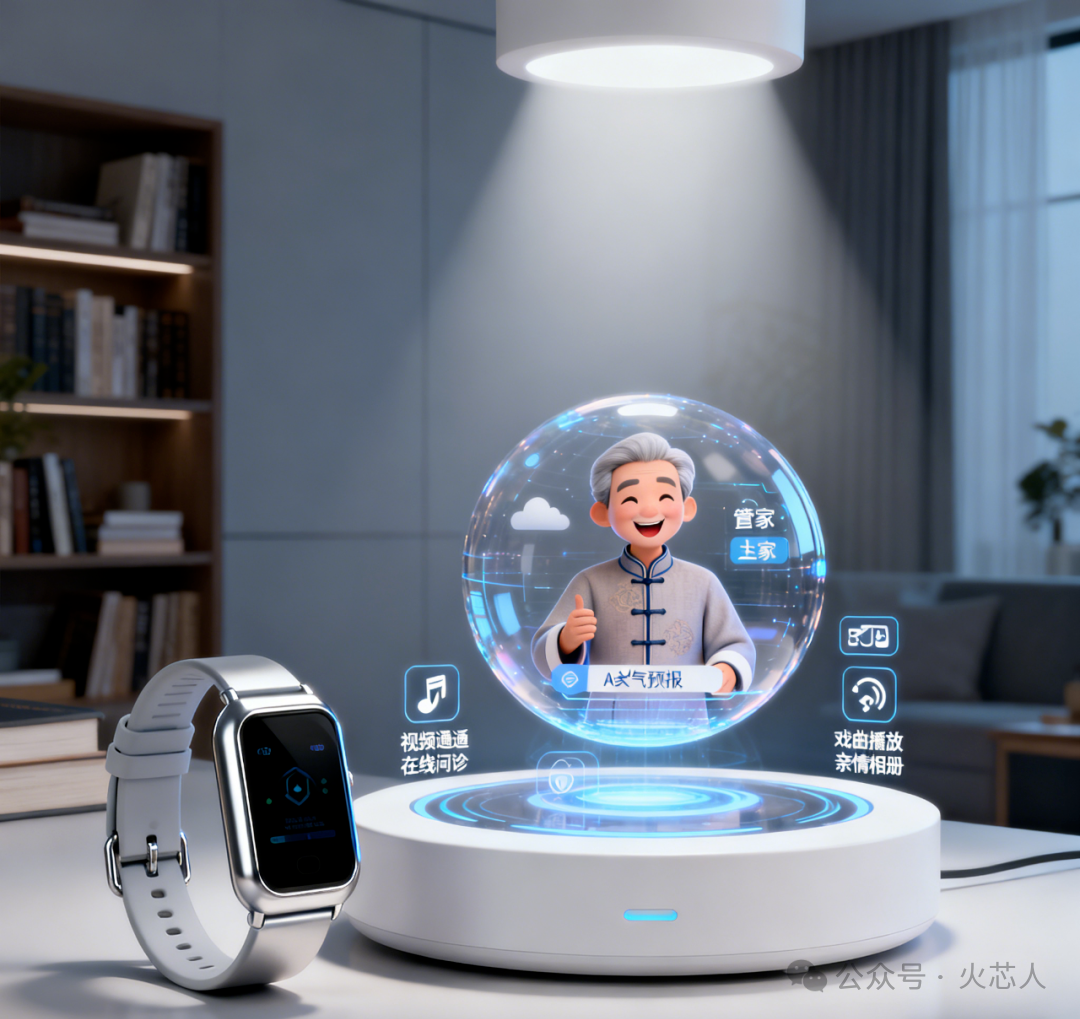
In the silver economy, AI companionship toys designed specifically for the elderly have emerged: smart toys shaped like traditional ornaments can monitor health data, remind about medication, and facilitate remote video calls with children, adapting to the operational logic suited for the elderly, thus filling the emotional companionship gap for empty-nesters;

In the pet economy sector, AI interactive toys can automatically trigger actions like teasing cats or feeding based on pet behavior patterns, combined with real-time monitoring via mobile devices, becoming the “smart housekeeper” for urban pet owners.This cross-demographic and multi-scenario extension allows AI toys to upgrade from children’s consumer products to family-level smart products.
04
Public Popularization Potential Supported by the Industry ChainIn terms of pricing, the current mainstream price range of 200-300 yuan is higher than traditional toys but has sufficient penetration for mass consumption. According to industry supply chain data, the incremental cost of edge AI modules can now be controlled within 20-30 yuan. With rising sales and released production capacity, it is entirely feasible for the retail price of AI toys to drop to the 100-150 yuan range within the next 1-2 years.More critically, China’s well-established industrial chain system provides solid support for cost optimization—from hardware motherboard manufacturing in Shenzhen, precision injection molding in the Yangtze River Delta, to customized development of AI algorithms, cloud deployment of SaaS services, and even the full-chain domestic specialized chips, enabling Chinese AI toy companies to possess global competitive advantages such as “fast technology iteration, strong cost control, and high autonomy.”
05
From Product Thinking to Ecological Thinking TransformationFor industry players, this transformation is both an opportunity and a challenge. Traditional toy companies that cling to the old model of “OEM production + hardware sales” are likely to be eliminated in the AI wave; while new entrants focusing solely on functional replication will also struggle to escape the red ocean of homogenized competition. The key to breaking through lies in shifting from “product thinking” to “ecological thinking”—currently, less than 30% of the potential of AI toy functions has been developed, and content customization and service value-added are the core profit points.
06
The Business Model of “Hardware + Content + Ecology” The future business model will present a three-dimensional structure of “hardware-driven traffic + content monetization + ecological value addition”: the hardware side will capture the market with cost-effective products, establishing a user base; the content side can develop paid courses, themed story packs, virtual character skins, and other value-added services to achieve continuous revenue; the ecological side can integrate third-party resources through an open platform, such as collaborating with educational institutions to develop customized courses and linking with maternal and infant brands to create contextual services, forming a closed-loop ecosystem of “toys + content + services.” Some companies have already begun exploring a “rental model,” reducing user barriers and enhancing user stickiness through toy rentals and regular content updates.Technological iteration will not stop; the next stop for AI toys will be “full-domain intelligent integration”—with the development of IoT technology, toys will become important nodes in smart home scenarios, achieving coordinated control with smart speakers and smart home devices; the integration of AR/VR technology will create interactive scenarios that combine virtual and real elements, upgrading toys from “tangible” to “immersive experiences.” Whoever can first break through technological bottlenecks, establish a content ecosystem, and address safety concerns will dominate this industrial reconstruction and become the next generation leader in the toy industry.What do you think about this? Feel free to leave a comment below.More historical articles about AI toysLearn about an AI product— the best-selling AIBI pocket pet with 850,000 units soldNot just competing on parameters but on “warmth”: Ropet validates the commercial value of emotional AIFollow me,and let’s touch the future of AI together!*Some images in this article are sourced from AI and are not for commercial use.