Not just a database, but a new generation of data foundation
——DolphinDB connects the entire data governance chain in the power industry!
At the 6th Power Artificial Intelligence Conference and the 4th Power Industry Digital Transformation Conference, Zhejiang Zhiyu Technology Co., Ltd. (hereinafter referred to as “DolphinDB”) won the “Power IoT Technology Innovation Award” for its outstanding technical strength and innovative applications in the field of power IoT.
01
Company Introduction
DolphinDB is a real-time computing platform based on a high-performance distributed time-series database that supports complex analysis and stream processing. Users can perform various operations such as storage, querying, analysis, and computation on the same platform. With its powerful distributed capabilities, convenient cloud-edge collaborative architecture, rich operator library, and ecosystem of external data sources, DolphinDB is releasing tremendous value in IoT scenarios such as smart grids, industrial manufacturing, and smart cities, gaining recognition from heavyweight clients such as Southern Power Grid, Yangtze Power, China General Nuclear Power Group, and BYD.
At this conference, DolphinDB showcased a one-stop data solution covering all scenarios in the power sector, presenting leading application results and successful practices in key areas such as hydropower industrial internet, power grid vibration monitoring, and nuclear reactor industrial configuration monitoring.
02
Structural Challenges in the Power Industry
The power industry has long faced issues of system complexity and fragmentation. Production, scheduling, and equipment monitoring systems are isolated from each other, presenting a typical “silo” architecture that makes it difficult to form a comprehensive data governance system. In the past, the limited data scale allowed this architecture to function. However, in the current context of exponential data growth, its drawbacks are becoming increasingly apparent: a large amount of data is isolated within their respective systems, unable to circulate efficiently—this not only restricts real-time analysis and decision-making capabilities but also makes it difficult to consolidate valuable experiences and patterns into reusable knowledge assets.
03
Not just a database,
but a new generation of data foundation
To truly unlock the value of data, software vendors must focus not only on stacking functions or single-point applications but also on building a data foundation that can support the long-term development of power enterprises.
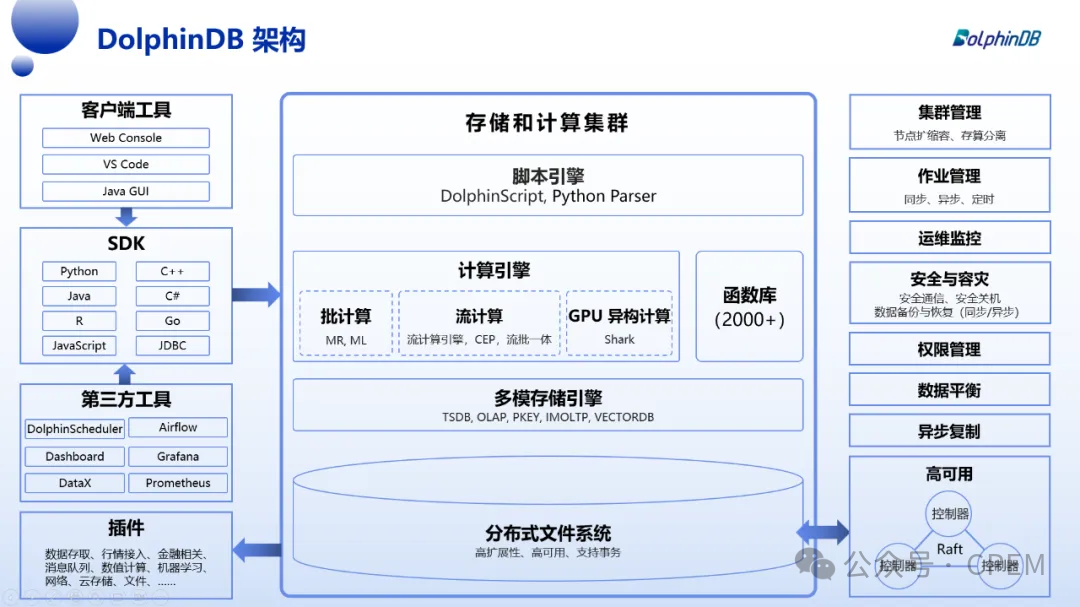
In this context, DolphinDB focuses on providing modular and reusable business components for power enterprises, with a core of high-performance distributed time-series database, built-in 2000+ professional functions (covering statistical analysis, aggregation computation, linear programming, etc.), 20+ stream computing engines (supporting window aggregation, anomaly detection, multi-stream correlation, etc.), and a rich set of professional plugins (including data access, message queues, machine learning, and nearly a hundred other plugins), flexibly covering data collection, storage, computation, and analysis needs, widely applicable to various business scenarios such as smart grids, grid scheduling, power marketing, and real-time monitoring.
At the same time, DolphinDB has also conducted multiple explorations in AI applications: through AI Agent, users can perform complex data retrieval and analysis using natural language; relying on RAG technology, the system can efficiently conduct similarity searches in knowledge bases such as power equipment archives and operation and maintenance procedures, helping engineers quickly find corresponding solutions under complex working conditions; in machine learning, DolphinDB has built-in various commonly used algorithms and provides plugins such as xgboost and libtorch, which can be used for tasks like power load forecasting, equipment health assessment, and fault diagnosis; the CPU-GPU heterogeneous computing platform Shark launched by DolphinDB can fully utilize the extreme computing power of GPUs in scenarios requiring massive calculations, such as grid simulation and parameter optimization.
04
Typical Cases of DolphinDB
01
Hydropower Industrial Internet Platform
Background and Challenges:
A hydropower generation group with six national-level large hydropower stations aims to build a unified industrial internet platform. Its measurement point scale exceeds 2 million, generating hundreds of billions of rows of data daily. The original architecture could not support such a large-scale data storage and efficient querying, and the cloud-edge collaboration capability was insufficient.
Solution and Results:
The group built a unified data foundation based on DolphinDB, leveraging its distributed architecture to not only handle massive data but also maintain stable performance under increasing business pressure. Additionally, lightweight DolphinDB nodes were deployed on the edge side of the six hydropower stations to directly complete data collection, feature extraction, millisecond-level real-time computation, and early warning judgments, significantly reducing the pressure of data uploading to the cloud. The processed data from the edge side is synchronized to the cloud for long-term storage and historical analysis, achieving efficient cloud-edge collaboration.
02
Power Grid Main Transformer Vibration Collection Monitoring System
Background and Challenges:
A listed company, as a manufacturer of power monitoring equipment, provides vibration monitoring and fault diagnosis services for main transformer equipment to power enterprises such as Southern Power Grid. To achieve online monitoring of the main transformer’s operating status, it is necessary to deploy industrial control computers on-site at each main transformer station to collect raw data such as vibration. However, the on-site industrial control computers have limited computing power and storage, requiring strict control of hardware costs while performing real-time computation and long-term storage of all monitoring data, leading to a conflict between hardware cost control and the computation and storage of all data.
Solution and Results:
A real-time collection monitoring system for main transformer station equipment was built on the limited hardware resources of the industrial control computer, solving challenges such as vibration data feature value computation and storage, and cloud-edge collaboration, while achieving low-latency complex real-time computation functions (such as real-time down-sampling, Fourier transform, anomaly recording), significantly reducing data storage costs and effectively improving production efficiency.
03
Nuclear Reactor Industrial Configuration Monitoring
Background and Challenges:
A research institute’s original instrumentation control system was built on a hybrid architecture of Flink+Hadoop+Kafka+MySQL, involving multiple languages and technology stacks such as Impala, Python, and Java, resulting in a bloated architecture. With a significant increase in measurement points and sampling frequency, the system could no longer meet the demands for concurrent writing of large amounts of data, real-time querying, and aggregation computation.
Solution and Results:
The institute built a new generation configuration monitoring platform based on DolphinDB, which can complete the writing of data from ten thousand measurement points within 100 milliseconds, even with lower hardware configurations. In terms of computation, using DolphinDB’s built-in 10+ efficient stream computing engines, real-time monitoring and analysis logic can be completed directly at the data storage layer, reducing alarm and computation delays from minutes to milliseconds. DolphinDB also encapsulated complex algorithms such as Fourier transform and wavelet transform into library functions for direct invocation by the institute, ensuring high performance and stability of computations while meeting professional and accuracy requirements.
04
Real-time Data Warehouse for Power Data Middle Platform
Background and Challenges:
A large power enterprise built its data middle platform using MySQL, Oracle, MongoDB, etc., leading to a complex architecture and lengthy data processing chain. As business expanded, the data volume exceeded hundreds of billions, and the fragmented system and Java-based processing methods could not support high concurrency and real-time demands, making it difficult to integrate data, with increasing time for writing and querying, severely affecting normal business operations.
Solution and Results:
A real-time data warehouse was built based on DolphinDB, leveraging its rich ecosystem of external data sources, powerful distributed capabilities, and convenient stream computing framework to achieve the integration of data from multiple business systems, greatly simplifying the data processing chain while ensuring stable operation of the data analysis platform, reducing personnel input and operational costs.
If you want to learn more about detailed power scenario solutions,
please follow the DolphinDB IoT public account!
DolphinDB’s winning of the “Power IoT Technology Innovation Award” is not only a recognition of its technical strength but also an important affirmation of its innovative practices in promoting the digital transformation of the power industry. In the future, DolphinDB will continue to enhance data governance and intelligent analysis capabilities, building a more reliable and user-friendly data foundation for the power industry, helping enterprises construct intelligent systems covering generation, transmission, transformation, distribution, and consumption.
☆ END ☆
(This article is fromZhejiang Zhiyu Technology Co., Ltd., the articles published by this account are for learning and communication purposes only, with no commercial use, paying tribute to the original author. We apologize for not being able to find the original author due to multiple reprints of some articles. If there is any infringement, please inform us, and we will delete it in a timely manner. This article is for learning and communication only; we emphasize sharing, and it should not be used for commercial purposes; the copyright belongs to the original author.)
Media reproduction must indicate ID and WeChat QR code