When we talk about AI, robots, and productivity, public opinion often falls into two extremes:
“AI will cause everyone to lose their jobs”
“AI will usher in a second industrial revolution for humanity”
But what does academic research say?
At the end of 2023, the journal Research Policy published a recent paper from the Lyon Business School in Finland and France, titled: The Kaldor–Verdoorn Law in the Age of Robots and AI (机器人与 AI 时代的 Kaldor–Verdoorn 法则).
This paper provides a key perspective: robots and AI are not simply “replacing humans,” but rather enhancing the internal mechanisms of productivity acceleration in economic growth.
The Kaldor–Verdoorn Law: An Economic Principle Explained in One Sentence
Kaldor and Verdoorn proposed an economic law in the 20th century that has been repeatedly validated by numerous countries, industries, and historical data: The faster the output growth, the faster the labor productivity increases. This is because, as the scale of output expands, there often occurs simultaneouslyincreasing returns to scale, capital deepening, and technology diffusion, which together form a “cumulative cycle” of growth—output growth leads to productivity improvement, productivity improvement enhances competitiveness, which in turn drives faster output growth.
This mechanism is a foundational logic of growth recognized by industrial economics, post-Keynesianism, and evolutionary economics.
How Has This Law Changed with the Arrival of Robots and AI?
The paper presents a very important point:Robots and AI have not rewritten the logic of economic growth, but have strengthened two key channels of existing productivity enhancement.
The first channel is the “mechanization effect”— enterprises would originally invest in new machinery and equipment as output increases, but now it has become “the higher the robot density, the stronger the level of automation, the more significant the productivity improvement.” In other words, robots do not parallelly replace labor but further amplify the existing path of capital deepening.
The second channel is the “technology-demand co-evolution mechanism.” Technological progress and market expansion would originally form a virtuous cycle, and the addition of AI has accelerated the speed of technological innovation, reduced costs more significantly, and created new products, new demands, and new business models, making the “output—productivity” cycle turn faster.
In other words, AI is the “turbocharger” of the economic growth mechanism.
Latest Evidence from 25 Countries, 17 Industries, and 28 Years of Panel Data
To validate this viewpoint, the authors constructed a dataset covering 25 OECD countries, 17 manufacturing and service industries, and long-term panel data from 1990 to 2018, using the GMM (Generalized Method of Moments) model to address endogeneity issues. Under rigorous model controls and multiple robustness checks, the study reached several very clear conclusions:
The research found that countries and industries with higher robot density experience significantly faster labor productivity growth, indicating that robot investment is not merely a “promotional effect,” but is genuinely driving efficiency improvements. More importantly, robots have strengthened the mechanization channel and the technology-demand co-evolution channel, making the existing growth structure respond more agilely and quickly. Additionally, the research also presents industry differences: high-skill industries (such as pharmaceuticals, equipment manufacturing, and electronics) have the conditions to absorb the efficiency improvements brought by robots, while low-skill industries are more likely to face labor replacement risks.
This means:AI and robots bring about “efficiency polarization”—efficiency improvements are faster, but the differentiation between industries also intensifies.
Why Is This Research Worth Noting?
The value of this paper lies not in simply repeating “robots improve efficiency,” but in precisely revealing how robots and AI are embedded in the internal structure of economic growth. It not only provides a theoretical explanatory framework but also validates the enhancement effects of the two mechanism paths with a large cross-national sample. At the same time, it candidly points out the structural challenges: efficiency improvements are faster, but industry gaps and skill gaps are also widening.
For policymakers, it reminds us of the need for more refined industrial policies and improved retraining systems; for business managers, it explains why AI projects must truly enter production systems rather than remain at the PPT level; for researchers, it provides a starting point for discussing AI within the framework of macroeconomic growth theory.
Three Insights in the Context of China’s “New Quality Productivity”
Placing this research in the context of China’s current “new quality productivity,” there are three points particularly worth noting (as shown in the figure).
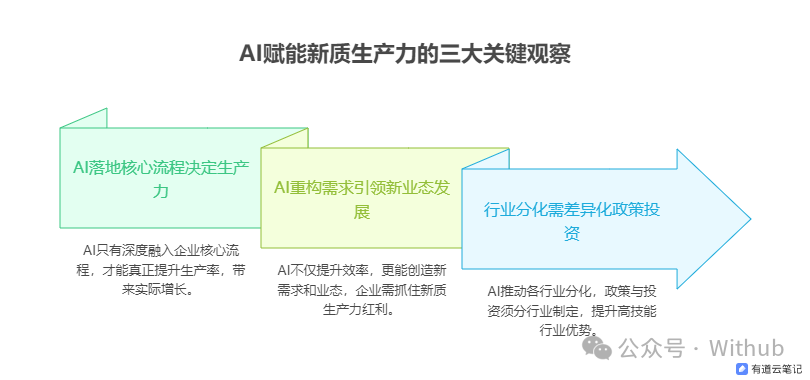
This research published in Research Policy shows us a deeper logic: robots and AI are not substitutes for labor, but amplifiers of the economic growth structure. They accelerate productivity growth, strengthen technology diffusion, create more active demand, and make industry differentiation more pronounced. Understanding the industrial logic of AI requires not only a technological perspective but also a macroeconomic perspective. AI is not just a tool, but a technology that will change the “growth structure.” If you are focusing on AI and innovation, new quality productivity, digital transformation, or industrial policy design, this research is worth your serious reading.