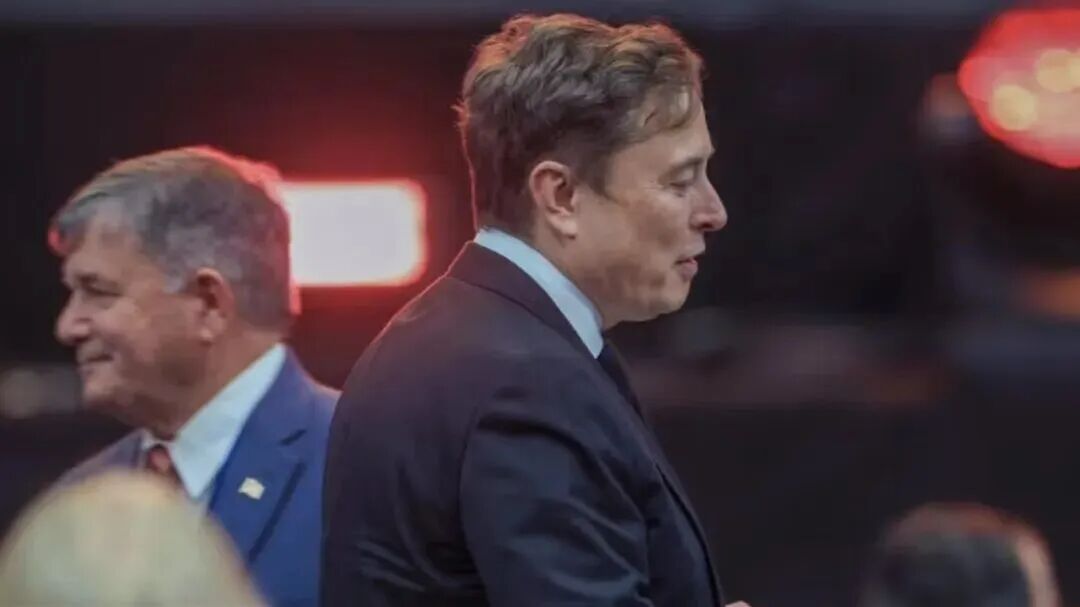
 When Musk talks about the future, he is discussing the survival of civilization.
At this year’s exclusive dialogue hosted by Barron Capital, Elon Musk once again proved that he never adheres to conventional business narratives with an in-depth sharing that spanned AI, robotics, and manufacturing.
This tech leader, who holds Tesla, SpaceX, xAI, Neuralink, did not list revenue figures or elaborate on market strategies. Instead, this multi-hour deep exchange revolved around a core proposition—how to reconstruct technology to ensure the continuation and expansion of human civilization.
While the industry is still entangled in the commercialization pace of humanoid robots, he threw out a scale prediction of “40 billion units”; when car manufacturers are focused on improving production line efficiency, he bluntly stated, “5 seconds to build a car”; and when the AI field avoids discussing specific probabilities regarding general artificial intelligence (AGI), he boldly asserted that “Grok 5 has a 10% chance of achieving AGI.”
These seemingly disruptive statements are, in fact, Musk’s consistent logic: the ultimate value of technology is not commercial profit, but building “risk resilience” for civilization. He repeatedly emphasized in the dialogue that all his ventures are not isolated risks, “but rather a grand blueprint interconnected with each other.”
The most intriguing counterintuitive insight is his redefinition of “abundance.”
The original mission of Tesla was to “accelerate the development of sustainable energy,” which has now been upgraded to “sustainable abundance.” The core logic is clear: to completely dismantle the economic foundation of labor and scarcity with robots, making material production no longer reliant on human labor.
The logic behind acquiring Twitter (now X) also transcends commercial inertia. While the outside world generally interprets it as an expansion of the social landscape, Musk candidly stated that the original intention was to “maintain freedom of speech.” “It was controlled by a group of people with a political ideology typical of San Francisco, becoming a tool against civilization,” he said, emphasizing that freedom of speech, as “the cornerstone of democracy,” is a crucial premise for the survival of civilization. As for X providing the best real-time global data, it is more like an unexpected gain from this civilizational protection action, becoming the exclusive fuel for xAI to break through AGI.
The value of this dialogue lies not in how many sci-fi concepts were proposed, but in Musk’s use of the first principles of physics to deconstruct these concepts into actionable technical paths and data metrics.
Next, we will decode Musk’s underlying logic in the three fields of AI, robotics, and manufacturing based on the core facts from the dialogue, to see the deep reflections on the survival of civilization behind this technological revolution.
01
How does Musk view robotics and AI?
In Musk’s technological blueprint, robotics and AI are the core dual engines driving “sustainable abundance.” One reconstructs the productivity boundaries of the physical world, while the other breaks through the intelligence limits of the digital world. Together, they synergistically aim for a systematic upgrade of civilization’s capabilities.
Regarding the Optimus humanoid robot, Musk provided clear technical specifications and scale predictions without any ambiguity. He stated that the core breakthrough of this robot lies in its “dexterity”—with 50 actuators integrated into its hands and forearms, totaling 100 throughout its body, covering motors, gearboxes, and power electronics, aiming to “possess the sensitivity, precision, and freedom of human hands.”
This extreme pursuit of detail stems from his judgment on the application boundaries of robots. Only with human-like dexterity can they break free from the fixed scene limitations of traditional industrial robots and enter unstructured environments such as homes and healthcare, completing diverse tasks from picking up a screwdriver to performing complex surgeries.
Scale and cost are key to the realization of Optimus. Musk mentioned, “After reaching a stable state of 1 million units per year, labor and material costs will drop to $20,000 to $30,000.” This cost control target seems aggressive but is based on Tesla’s mature experience in large-scale production—by vertically integrating the supply chain and optimizing production processes, the costs of complex products can be brought within reach of the masses. His prediction for the final scale is even more astonishing: “The total number of robots could be around 40 billion, which corresponds to 3-4 units per human.”
Even more groundbreaking is the synergistic effect between Optimus and Neuralink.
Musk clearly stated that the integration of the two companies’ technologies will give rise to “superhuman cyborg capabilities”—by extracting signals from the motor cortex of the brain through Neuralink‘s brain-machine interface, directly controlling the mechanical limbs of Optimus. “We can give legs to people who have lost their legs, allowing them to dance and run, with costs possibly only around $60,000.”
This technological realization not only empowers people with disabilities but also reconstructs the boundaries of human capabilities. Moreover, Optimus’s “superhuman precision” will fundamentally change the landscape of medical services—”Great doctors are not grown on trees, but robots can be mass-produced in factories,” bringing complex medical procedures into the lives of ordinary people.
If Optimus represents a revolution in the physical world, Grok 5 is the key breakthrough of xAI in the digital world. Musk clarified for the first time in the dialogue the probability of achieving AGI: “Grok 5 has a 10% chance of achieving general artificial intelligence.”
This judgment is supported by three core advantages of Grok 5.
First, a dual breakthrough in model scale and efficiency. Musk revealed that Grok 5 will be a “60 trillion parameter model,” far exceeding Grok 3 and 4‘s 30 trillion parameters, and that “the intelligence density per trillion operations is higher.” The increase in parameter scale is not merely a stacking exercise but is based on a profound understanding of model efficiency, ensuring an optimal ratio of intelligent output to computational cost.
Second, comprehensive coverage of multimodal data. Unlike existing AI models, Grok 5 is essentially multimodal, encompassing text, images, video, and audio, with the core breakthrough being “the ability to understand real-time video.” Musk emphasized, “If AI cannot understand real-time video, it cannot truly achieve AGI,” because human perception of the world is fundamentally about dynamic scenes, which hits at the current shortcomings of AI technology.
Third, the support of exclusive data advantages. The X system (formerly Twitter) serves as “the best real-time data source in the world,” providing Grok 5 with unique training fuel—real-time conversations from 600 million users, containing dynamic feedback from human society, which is a core asset that other AI companies cannot replicate.
In addition, Musk also revealed another important plan for Grok 5: to create an open-source “galactic encyclopedia” covering all human knowledge and distribute copies to Earth, the Moon, Mars, and even deep space.
In Musk’s view, the ultimate value of AI and robotics is to “expand the boundaries of human consciousness.” The perceptual capabilities of Grok 5 will reach a level that “makes it feel sentient,” and this exponential growth of intelligence will provide humanity with new tools to understand the world; while the large-scale application of Optimus will liberate humanity from material production, allowing a focus on higher-level needs such as creativity and exploration. The synergy of the two ultimately injects the power of “sustainable development” into civilization.
02
The limits of manufacturing have not yet been reached
“I certainly see a way to achieve about 5 seconds to build a car,” Musk’s goal thrown out in the dialogue is not a fantasy, but is based on Tesla’s core philosophy of “reconstructing manufacturing with the first principles of physics.”
The core of Tesla’s manufacturing philosophy is to “design the factory as a chip.”
Musk’s logic is clear: “How do you make a chip faster? Bring the circuits closer together and increase the clock speed. The same goes for factories: improve volume efficiency and movement speed.” He bluntly stated that the biggest problem in current manufacturing is “extremely low volume efficiency”—if factories are divided into cubic meters, “the proportion of useful work is astonishingly small,” with a lot of space wasted by idle equipment and overly long material transport paths.
In contrast, traditional car manufacturers’ “incremental improvement” thinking is satisfied with “5% better than last year,” never considering reconstructing the physical logic of production.
It is important to note that the goal of building a car in 5 seconds is not a castle in the air; it actually has clear technical paths supporting it.
First, optimizing factory layout by changing linear production lines to circular layouts, shortening material movement distances, allowing parts to be assembled along the shortest paths; second, simplifying processes through “integrated casting” technology, consolidating hundreds of car parts into a few components, significantly reducing assembly steps; finally, the deep application of AI, using Grok 5 to optimize production processes in real-time, predict equipment failures, and adjust robot action precision, achieving “full-link intelligent scheduling.”
Musk explained, “These cars will roll off the production line at walking speed,” and while this speed seems incredible, it is actually the result of extreme optimization of every physical link in the production process.
The core supporting this manufacturing revolution is Tesla’s self-developed chip strategy.
Musk revealed that he spends a lot of his weekends studying AI5 chips because “everything at Tesla depends on this chip”—it will not only be used for the next generation of autonomous vehicles but also serves as the core computational support for Optimus. The core advantage of this chip is “performance per watt,” and Musk clearly stated, “at least 2 to 3 times better than Nvidia’s chips, with costs only about 10% of theirs.” Low-power, low-cost computing power is the foundation for achieving large-scale and efficient manufacturing, as large-scale robots and automated production lines require massive computational support, and the cost of computing power directly determines the feasibility of manufacturing.
However, Musk also candidly admitted to facing supply chain challenges.
Taiwan Semiconductor Manufacturing Company and Samsung, as Tesla’s chip foundries, have mature technologies, but building new wafer fabs takes five years to fully ramp up, which does not align with Tesla’s rapid iteration pace. “We need 100 billion to 200 billion AI chips every year,” Musk stated, emphasizing that the delivery speed of the existing supply chain is a limiting factor.
Therefore, he does not rule out the possibility of building a giant wafer fab himself—”If the foundry speed cannot keep up, we will do it ourselves,” this vertical integration thinking aligns with Tesla’s logic of building battery factories and Gigafactories, all aimed at mastering core links and avoiding being constrained by the supply chain.
Tesla’s manufacturing revolution is essentially about “bringing the iteration speed of the digital world into the physical world.” The iteration cycle of traditional manufacturing is measured in years, while Tesla has shortened it to months by deconstructing the essence of manufacturing.
Musk cited the current production speed as an example: “Now a car rolls off the line every 35 seconds,” while the goal of 5 seconds is a triple upgrade on “volume efficiency, movement speed, and intelligent scheduling” based on the existing foundation. He emphasized, “The limits of manufacturing have never been reached; we are just constrained by the imagination of past experiences.”
03
Musk’s Ultimate Vision: The Survival of Civilization and the Expansion of Consciousness
Behind every technological breakthrough lies Musk’s consistent ultimate goal—”to expand consciousness in order to better understand the universe and ensure the continuation and expansion of human civilization.” From fully autonomous driving to interstellar exploration, from brain-machine interfaces to AI safety, it can be said that every one of his layouts is building “risk resilience” and “exploration capability” for human civilization.
Fully autonomous driving (FSD) is the “sci-fi close to reality” in Musk’s technological blueprint and is key to reconstructing human mobility and supporting the efficiency of civilization. In the dialogue, Musk provided clear safety data and technical paths: “FSD has accumulated over 10 billion miles, four times safer than non-autonomous driving.” This data is based on the training results from massive real-world scenarios—every Tesla serves as a data collection terminal, providing real-time feedback on road conditions, weather, and emergencies, continuously optimizing the AI model.
Unlike the industry’s mainstream reliance on “high-precision maps,” Tesla’s autonomous driving path adopts a “pure vision solution”—using cameras, radar, and AI algorithms to allow cars to “observe and judge road conditions” like humans, rather than relying on pre-stored map data.
Musk’s logic is clear: “The real world is full of uncertainties; high-precision maps cannot cover all scenarios. Only by allowing AI to learn to make autonomous judgments can true safety be achieved.” He revealed that the current AI4 hardware can achieve “at least two to three times the safety level of an average driver,” while the upcoming AI5 chip will elevate safety to 10 times, “supporting users to sleep in the car during unsupervised driving.”
More importantly, the technological accumulation of FSD will directly empower Optimus robots.
Musk explained, “If AI can control high-speed moving cars, it can better command robots to act in complex environments”—the environmental perception and dynamic decision-making capabilities required for autonomous driving are highly consistent with the operational needs of robots in unstructured scenarios. Therefore, every iteration of FSD is accumulating technology for the large-scale application of robots, and the two together constitute the core capability of “mobile intelligence,” reconstructing human mobility and production methods.
Musk’s ultimate vision extends far beyond technological revolutions on Earth; it is about expanding the boundaries of civilization into the universe. He recalled a debate with Google co-founder Larry Page during the dialogue. Page called him a “speciesist” because he “favored humans over computers.” This debate awakened him and prompted him to establish OpenAI as a counterbalance to the risks of Google’s AI. Today, the development of xAI also adheres to the principle of “human priority,” incorporating a “human values alignment” module into the training of Grok 5 to prevent AI from posing a threat to civilization.
In stark contrast to his trillion-dollar wealth, Musk lives a very simple life: “In Austin, I only have a medium-sized house, and I bought a small house for $8,000 at the starbase, with no vacation villa.” He stated that wealth is merely a tool to achieve goals, “I mainly need enough control over the company to continue guiding its activities, ensuring these projects serve the goal of civilization’s continuation.”
At the end of the dialogue, Musk returned all technological blueprints to a philosophical level: “My motivation is to expand consciousness to better understand the universe, to find out if there are extraterrestrial civilizations, and to clarify what is happening in the universe.” For him, technology is a means, exploration is the goal, and the continuation of civilization is the premise of all exploration.
* Image source from the internet, please contact for removal if infringing


Previous Issues
|
01|Emotional Value, Sky-High Bills, Can First-Form Technology Sell “Emotions”? |
|
02|From “Capital Story” to “Delivery Test,” What Will Domestic Humanoid Robots Compete Next? |
|
03|Ripping Open the Iron Curtain: The Billion-Dollar Comeback of Domestic Surgical Robots |
|
04|Involution, Going Abroad, Layoffs, Where Will the Next Batch of Users for Floor Cleaning Robots Be? |
|
05|Chatbots: A Cure or a Poison? |
|
06|Hundreds of Billions in Foreign Capital Competing for China’s Robot “Golden Triangle” |
|
07|3 Trillion Silver-Haired Market, The Strongest CP for Humanoid Robots |
|
08|Internet Giants’ Layout in Robotics, It’s Intense! |