|
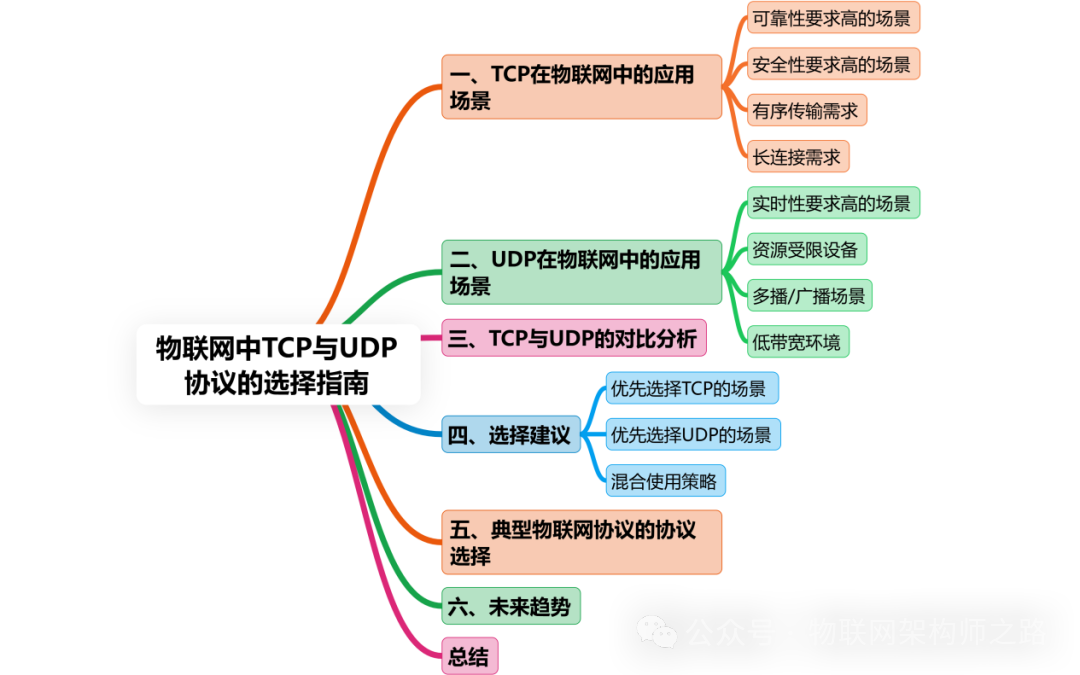
In the context of the Internet of Things (IoT), the choice between TCP and UDP depends on the specific application requirements for reliability, latency, bandwidth, and device resources. Below is a detailed analysis of typical application scenarios, advantages and disadvantages, and selection recommendations for both protocols in IoT: |
1. Application Scenarios of TCP in IoT
1. Scenarios with High Reliability Requirements
•Transmission of sensor data to cloud platforms:
○Scenario: Industrial sensors and environmental monitoring devices (such as temperature, humidity, and air quality sensors) need to reliably upload data to the cloud.
○Reason: Data loss can lead to biased analysis results, and TCP’s retransmission mechanism and ordered delivery ensure data integrity.
○Example Protocol: MQTT (based on TCP) is commonly used in such scenarios, such as device monitoring in industrial IoT.
•Firmware updates and remote configuration:
○Scenario: Remote upgrading of device firmware or configuration parameters (such as cameras, smart meters).
○Reason: Firmware updates must ensure data accuracy to avoid device failures due to transmission errors.
○Example: Transmitting binary files via TCP to ensure integrity and order.
2. Scenarios with High Security Requirements
•Encrypted communication:
○Scenario: Communication between smart home devices (such as smart locks, cameras) and the cloud.
○Reason: TCP can be combined with TLS/SSL (such as HTTPS, MQTT+TLS) to provide end-to-end encryption, ensuring data security.
○Example: Smart home devices transmit encrypted commands via TCP to prevent man-in-the-middle attacks.
3. Ordered Transmission Requirements
•Video surveillance and control commands:
○Scenario: In intelligent transportation systems, vehicle location data must be transmitted in order to avoid scheduling confusion.
○Reason: TCP ensures that data packets arrive in order, preventing errors caused by out-of-order control commands.
○Example Protocol: GB/T 28181 (National Standard Protocol for Video Surveillance) transmits control commands based on TCP.
4. Long Connection Requirements
•Real-time device status monitoring:
○Scenario: Industrial equipment (such as production line sensors) continuously sends status data to the cloud.
○Reason: TCP’s persistent connection reduces the overhead of frequent handshakes, suitable for high-frequency data transmission.
○Example: MQTT maintains real-time communication between devices and cloud platforms through TCP’s long connection.
2. Application Scenarios of UDP in IoT
1. Scenarios with High Real-time Requirements
•Real-time video/audio transmission:
○Scenario: Real-time video streaming from smart home cameras and industrial AR/VR devices.
○Reason: UDP’s low latency characteristics prevent frame freezing and can tolerate a small amount of packet loss (e.g., losing video frames does not affect overall viewing).
○Example: IP cameras transmit video streams via UDP, combined with H.264 encoding to optimize bandwidth.
•Online gaming and remote control:
○Scenario: Remote operation of industrial robots or drone control.
○Reason: Low latency is critical, and UDP can quickly respond to user actions.
○Example: Game controllers send control commands via UDP to ensure real-time feedback.
2. Resource-constrained Devices
•Low-power device communication:
○Scenario: Battery-powered sensors (such as temperature and humidity sensors, smart meters).
○Reason: UDP’s connectionless and acknowledgment-free nature reduces device processing overhead and power consumption.
○Example: Sensors in LoRaWAN networks transmit short packets via UDP.
3. Multicast/Broadcast Scenarios
•Multicast notifications and broadcast control:
○Scenario: In smart agriculture, sending the same command (such as irrigation control) to multiple field sensors.
○Reason: UDP supports multicast, allowing a single send to reach multiple devices.
○Example: Broadcasting notifications to all devices to synchronize time via UDP (NTP protocol).
4. Low Bandwidth Environments
•Narrowband IoT (NB-IoT):
○Scenario: Environmental monitoring devices (such as forest fire sensors) in remote areas.
○Reason: UDP’s lightweight header (8 bytes) saves bandwidth, suitable for low-rate networks.
○Example: CoAP protocol is based on UDP, suitable for resource-constrained NB-IoT devices.
3. Comparative Analysis of TCP and UDP
|
Feature |
TCP |
UDP |
|
Reliability |
No data loss, no out-of-order delivery, suitable for critical tasks. |
Data may be lost or out of order, suitable for scenarios that can tolerate some packet loss. |
|
Latency |
Higher (handshake, retransmission, congestion control). |
Extremely low (no connection establishment/maintenance overhead). |
|
Bandwidth and Resources |
Large header overhead (20 bytes), requires maintaining connection state. |
Small header overhead (8 bytes), no connection maintenance required. |
|
Applicable Scenarios |
Sensor data upload, firmware updates, secure communication. |
Real-time video, low-power devices, multicast control, narrowband environments. |
4. Selection Recommendations
1. Scenarios where TCP is preferred
•Data integrity is crucial: such as medical device data, financial transaction instructions.
•Ordered transmission is required: such as control commands for video surveillance, industrial automation processes.
•High encryption requirements: such as communication between smart home devices and the cloud.
2. Scenarios where UDP is preferred
•Real-time performance is prioritized: such as online gaming, video calls, drone control.
•Device resources are constrained: such as battery-powered sensors, low-power microcontrollers.
•Multicast/broadcast needs: such as centralized control of smart streetlights, synchronization of environmental monitoring networks.
3. Hybrid Usage Strategy
•Critical data using TCP: such as device firmware updates, security authentication information.
•Real-time data using UDP: such as video streams, raw sensor data.
•Protocol combinations: such as MQTT (TCP) for device management, CoAP (UDP) for status reporting.
5. Typical IoT Protocol Selection
|
Protocol |
Underlying Protocol |
Typical Applications |
|
MQTT |
TCP |
Reliable communication between cloud platforms and devices (such as industrial IoT). |
|
CoAP |
UDP |
Lightweight communication for resource-constrained devices (such as smart meters). |
|
AMQP |
TCP |
Enterprise-level message queuing, ensuring financial-grade reliability. |
|
DNST |
UDP |
Fast resolution of IoT device domain names. |
6. Future Trends
•QUIC protocol: Achieves TCP-level reliability based on UDP, reducing latency (such as HTTP/3).
•Edge computing: Optimizes communication for edge devices by combining TCP’s reliability and UDP’s low latency.
•Protocol adaptability: Dynamically switching between TCP/UDP based on network conditions (such as dynamic QoS control).
Conclusion
•TCP is the cornerstone of reliability and security in IoT, suitable for critical tasks and complex scenarios.
•UDP is the best choice for real-time and resource-constrained scenarios due to its low latency and overhead.
•Hybrid architectures (such as MQTT+CoAP) can balance the advantages of both, meeting the diverse needs of IoT.