Current Formula of MOS
As shown in the figure, for an NMOS, we first make a one-dimensional assumption, equivalently treating it as an NPN semiconductor junction, considering only the variation of current along the channel in the x-direction.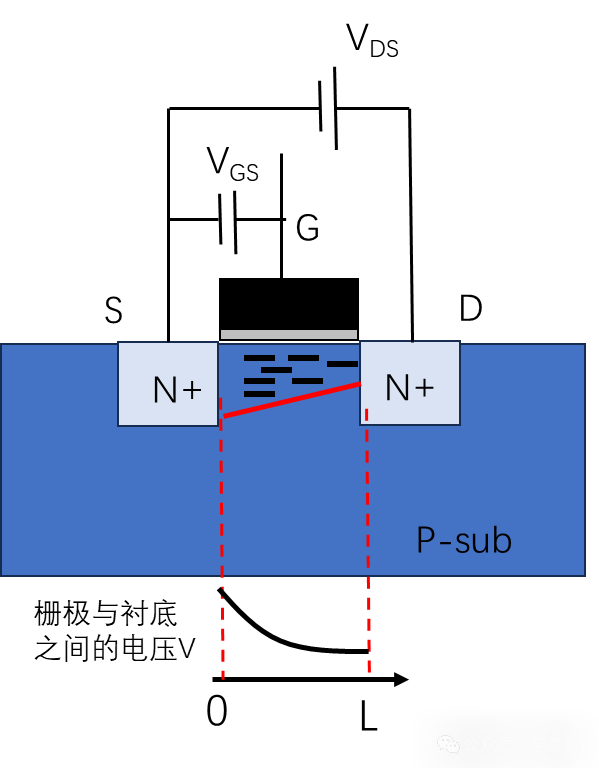
For this model, the current through can be calculated as:
After applying voltage, the voltage difference at any point in the channel varies continuously, thus the corresponding charge density:
Substituting into the current formula, while also substituting:
Integrating gives:
Therefore, from the above equation, it can be seen that the DC current of the MOSFET exhibits a parabolic shape, with the maximum current being:
Corresponding voltage, this voltage is one of the important parameters of the MOSFET, known as the saturation voltage, and the corresponding current is referred to as the saturation current.
Additionally, from the current formula, it should be noted thatthis parameter is closely related to the specific process, corresponding to the length of AA and the width of Poly, directly indicating that the poly AEI CD is closely related to electrical parameters.
I-V Characteristics of MOS
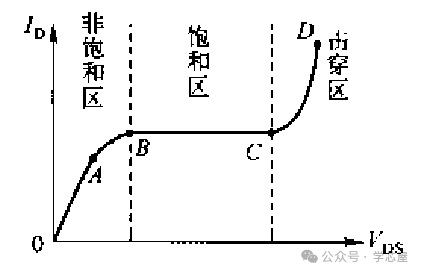 1. It can be approximated that it operates in the linear region of the non-saturation zone (OA segment), where the channel can be equivalent to a constant resistance;2. Ascontinues to increase, the channel resistance will increase, causing the current to increase more slowly until it reaches the maximum value (AB segment);3. Entering the saturation region (BC segment), at this point the current no longer increases (in fact, due to the channel modulation effect, the effective channel will continue to shorten, and the actual current slightly increases);4. In the breakdown region (CD segment),ifis too large, it will directly break down the reverse-biased PN junction, leading to a rapid increase in current.