
IGBT with Built-in Fast Recovery Diode (FRD)
IGBT product lineup includes types with built-in fast recovery diodes (hereinafter referred to as “FRD”). In inverter and motor drive applications using IGBT, the diode is also used as a path for the reverse current generated during switching. This diode is known as a “freewheeling diode,” and is typically an “FRD.” For applications that pair IGBT with FRD, there are IGBTs available with built-in FRDs.
The IGBT with built-in FRD will indicate the built-in FRD in its technical specifications, and typically, as shown in the figure below, its pin configuration diagram will show that the FRD is built-in. Additionally, besides the specifications of the IGBT, the technical specifications will also provide the specifications of the built-in FRD.


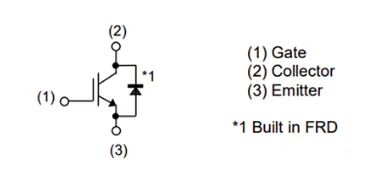
Since there is no need for an external FRD, the advantages of built-in FRD include a reduction in the number of components and installation area, as well as improved reliability.
Reverse Recovery Characteristics and Ringing of FRD Built into IGBT
One of the important characteristics that the freewheeling diode must possess in inverter and motor drive applications is high speed, specifically a short reverse recovery time trr. The switching losses are greatly influenced by the reverse recovery current, so it is necessary to use an FRD with high-speed trr characteristics to reduce losses. In other words, the FRD built into the IGBT also needs to have high-speed trr characteristics.

Another key point is the ringing of the built-in FRD. For FRD, a fast trr means that the reverse recovery current converges sharply, which can cause ringing (noise), and this becomes a problem from the perspective of EMC. Therefore, the reverse recovery characteristics of the FRD need to have a short trr and converge gently. Products designed with this consideration are referred to as “soft recovery types.”
As an example, below is a comparison chart of the reverse recovery characteristics of the built-in soft recovery type FRD in the RGS series and RGT series IGBTs versus those with built-in standard FRDs.
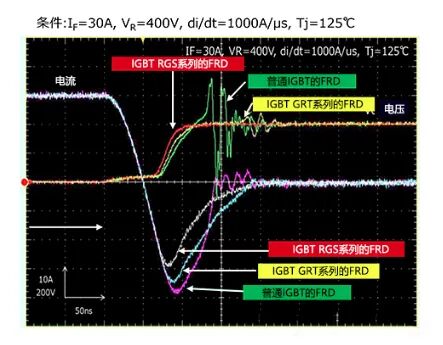
Built-in FRD in the RGS series and RGT series can achieve soft recovery even under high-speed switching conditions of di/dt=1000A/μs, despite the rapid convergence of the reverse recovery current, and there is no ringing even at high temperatures of Tj=125℃. In contrast, standard products show significant ringing. Although the built-in FRD in the IGBT is very convenient to use, it is still crucial to carefully verify the reverse recovery characteristics of the built-in FRD, as this is a very critical point, because ringing and surges that occur in high voltage and high current systems can have a significant impact on EMC.
·