 (Can be interpreted on behalf of the author, published after proofreading) Submission Channel ↑

With the global energy transition and increasing reliance on renewable energy, efficient and high energy density energy storage systems have become crucial. Lithium-ion batteries (LIBs), as the most mainstream energy storage technology, have commercial products whose energy density is approaching theoretical limits, making it difficult to meet future demands for higher energy density, especially in fields such as electric vehicles, aerospace, and smart grids. Therefore, the development of new high energy density lithium metal batteries (LMBs) has become a research hotspot. These battery systems can theoretically significantly increase energy density by using lithium metal as the anode. However, achieving this goal requires not only high-performance cathode materials but also innovations in battery design and packaging.
Recently, Professor Zhou Haoshen’s team from Nanjing University systematically explored pathways to achieve high energy and durable lithium metal batteries from key cathode materials to pouch cell structural design. They discussed the basic characteristics and key challenges of five promising cathode materials (lithium cobalt oxide, high nickel oxide, lithium-rich oxide, sulfur, and oxygen) and summarized feasible solutions and recent progress to overcome critical bottlenecks. Additionally, using pouch cell structure as a typical model, they precisely summarized the impact of each component in pouch cells on energy density and elaborated on the detailed routes to achieve maximum practical energy density using different cathode materials in pouch cells.
This work, titled “High energy density lithium battery systems: from key cathode materials to pouch cell design,” was published in the journal “Chem Soc Rev,” with Xu Chengrong and Peng Bo as the first authors.
(Electrochemical Energy Compilation, not to be reproduced without permission)
【Key Points】
This article delves into the core mechanisms of high energy density lithium-ion battery systems, focusing on the characteristics and improvement strategies of cathode materials. Lithium cobalt oxide (LiCoO₂), as a classic cathode material, has been widely studied due to its high energy density and good cycling stability, but it faces issues with structural stability at high voltages. Techniques such as element doping and surface coating can effectively suppress harmful phase transitions and oxygen loss, thereby enhancing its high voltage performance.
1. Key Cathode Materials for High Energy Density Lithium Metal Batteries (LMB)
LiCoO₂ cathode (Lithium Cobalt Oxide)
Characteristics: High volumetric energy density, but capacity is limited (~140 mAh/g @ 4.2V).
Challenges: Irreversible phase transitions at high voltages (>4.5V) (O3 → H1-3 → O1), lattice oxygen loss, and surface side reactions.
Strategies: Bulk doping (e.g., Mg, Ni, P) to stabilize structure; surface coating (e.g., LiCoPO₄, La/Ca doping) to suppress oxygen loss; morphology control (e.g., polyhedral prism structure) to reduce stress concentration; high spin state Co design to suppress phase transitions.
Ni-rich cathodes(High Nickel Cathodes)
Characteristics: High capacity (>200 mAh/g), but Ni⁴⁺ is unstable, prone to cation mixing, micro-cracking, and surface reconstruction.
Challenges: Cation mixing (Li⁺/Ni²⁺) hinders Li⁺ diffusion; structural phase transitions (H2 → H3) lead to lattice contraction and cracking; surface side reactions: residual alkali, oxygen loss, transition metal dissolution.
Strategies: Doping (e.g., Al, Zr, B) to stabilize lattice; surface coating (e.g., LiNbO₃, LMO) to suppress side reactions; single crystal/multicrystal morphology design to reduce cracking; electrolyte/binder synergistic optimization of CEI layer.
Li-rich cathodes(Lithium-rich Cathodes)
Characteristics: Extremely high capacity (>250 mAh/g), but issues with voltage decay, voltage hysteresis, oxygen loss, and cation migration.
Challenges: Oxygen loss: lattice oxygen oxidizes to O₂, forming oxygen vacancies; cation migration: TM ions irreversibly migrate to Li layers; irreversible phase transitions: layered → spinel → rock salt phase; voltage decay and hysteresis: continuous decline in voltage plateau during cycling.
Strategies: Constructing oxygen vacancies or spinel phases on the surface to suppress oxygen loss; doping (e.g., Zr, Cr) to regulate cation migration pathways; concentration gradient design (e.g., reducing Mn, increasing Ni/Co) to alleviate voltage decay; local structural control (e.g., honeycomb ordered structure) to enhance stability.
Li–S batteries
Characteristics: Theoretical energy density up to 2600 Wh/kg.
Challenges: Polysulfide shuttling effect; poor conductivity of sulfur and Li₂S; significant volume expansion.
Strategies: Host materials such as porous carbon, metal compounds, MOF/COF; catalysts (e.g., Fe-Co bimetal) to accelerate polysulfide conversion; gel electrolytes/functioning binders to suppress shuttling.
Li–O₂ batteriesCharacteristics: Theoretical energy density up to 3500 Wh/kg.
Challenges: Slow ORR/OER kinetics; Li₂O₂ deposition blocking pores; numerous side reactions (e.g., electrolyte decomposition).
Strategies: Porous carbon, single-atom catalysts (e.g., PtAu, NiRu-HTP); constructing heterostructures (e.g., GeS₂-NiS₂) to promote LiO₂ adsorption and decomposition; high-entropy oxides (HEO) to enhance catalytic activity.
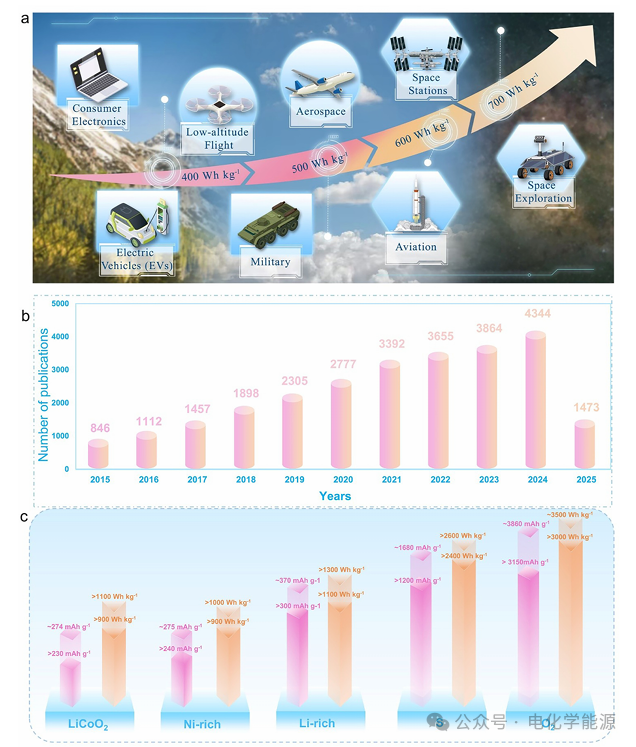
Figure 1: (a) Demand for high energy density lithium-ion battery systems and their application fields. (b) Number of publications related to high energy density lithium-ion batteries based on Web of Science statistics (as of April 2025, search keywords “lithium-ion battery” and “high energy density”). (c) Highest specific capacity and energy density based on the materials themselves, as well as achieved specific capacity and energy density.
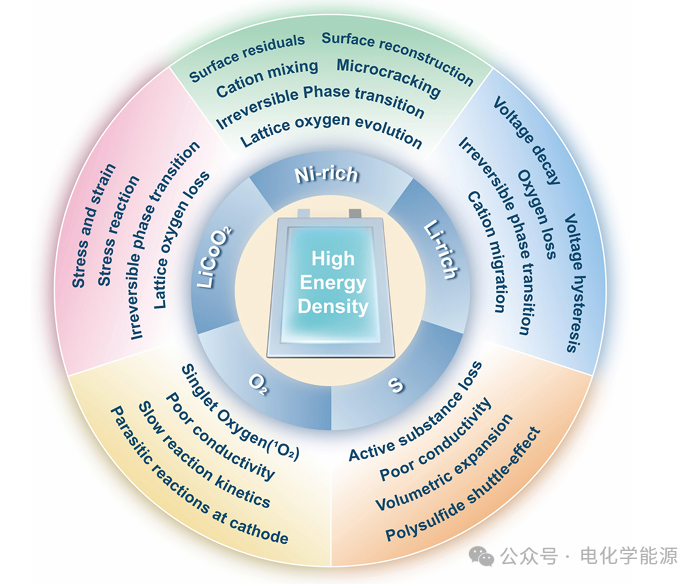
Figure 2: Schematic diagram of challenges faced by high energy density lithium-ion battery systems.
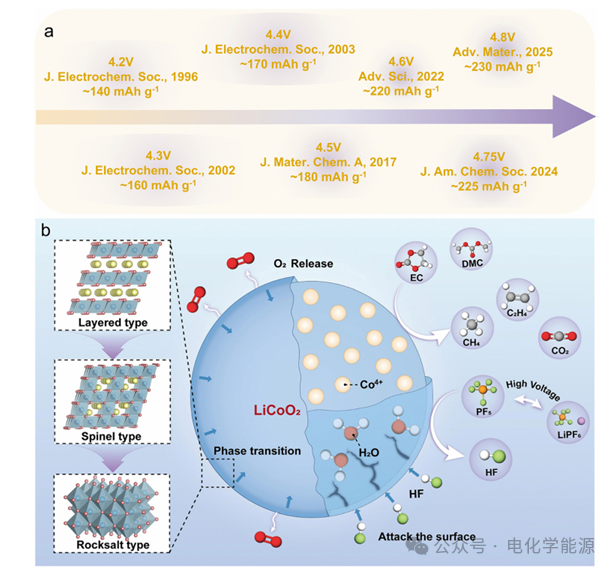
Figure 3: (a) History of developing high voltage LCO and (a) schematic diagram of high voltage LCO operation. (b) Charge-discharge curves of high voltage LCO at a cutoff voltage of 4.8V.
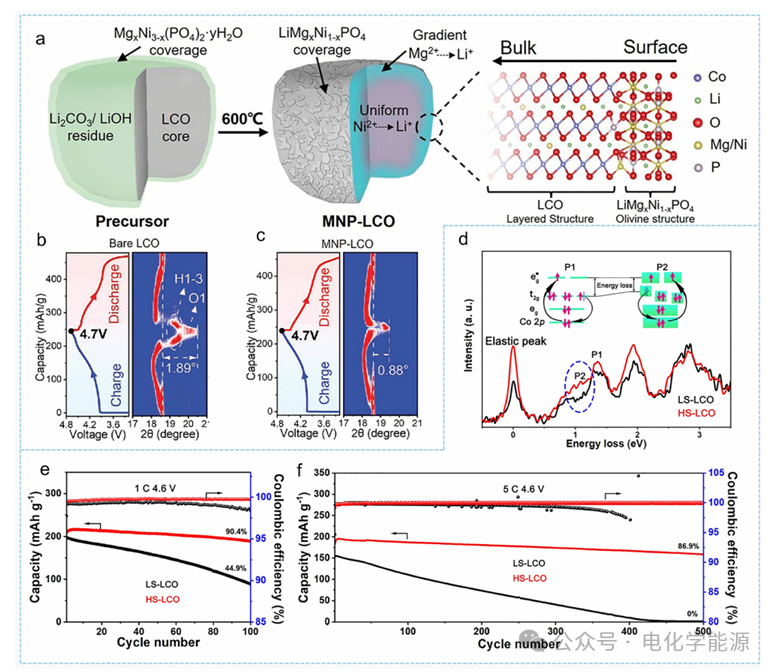
Figure 4: (a) Schematic diagram of MNP-LCO synthesis method. (b) and (c) In situ XRD tests of the first charge-discharge process of MNP-LCO and bare LCO within a voltage window of 3.0–4.7V. (d) RIXS spectrum of Co L-edge. (e) and (f) Cycling performance of HS-LCO and LS-LCO at 1C and 5C current densities.
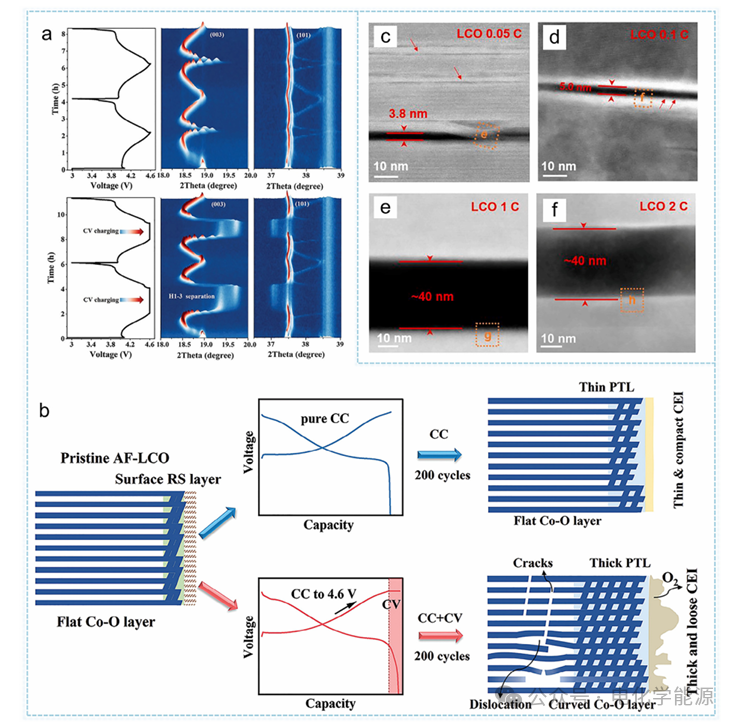
Figure 5: (a) In situ XRD tests of the first two cycles of AF-LCO in CC and CC–CV modes, and (b) schematic diagram of structural changes after cycling of AF-LCO in CC and CC + CV modes.
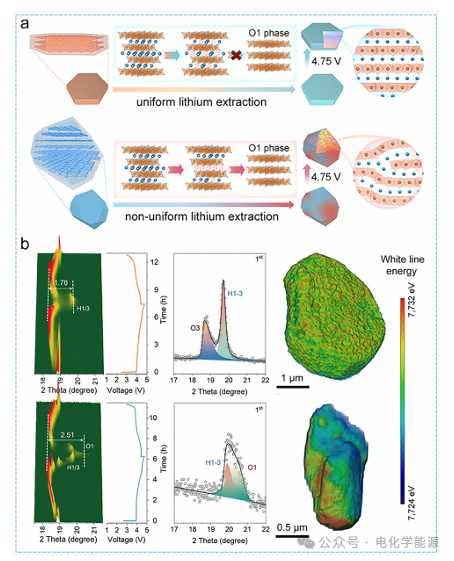
Figure 6: (a) Schematic diagram of uniform and non-uniform lithium extraction and structural evolution, stress accumulation, and decay mechanisms of P-LCO and LCO during the 4.75V charge-discharge process. (b) In situ XRD tests of P-LCO and LCO during the first charge-discharge process, and TXM-XANES imaging technology showing the three-dimensional distribution of Co valence states in single particles.
2. Design of High Energy Density Battery Systems
Achieving high energy density requires not only high-performance cathode materials but also optimizing the overall design of the battery, including packaging forms, weight, and volume of battery components.
Battery Packaging Forms
-
Pouch Cell: Uses aluminum-plastic composite film as the outer packaging, assembled by alternately stacking cathode sheets, separators, anode sheets, and separators. It has good flexibility and customization capabilities. Advantages: No heavy metal shell, compact stacking process, high energy density, and better internal pressure release under the same conditions. Challenges: Requires strict control of the environment and thermal sealing equipment to ensure battery performance and safety.
-
Prismatic Cell: Initially used steel shells, now mainly adopts aluminum-based packaging methods, assembled by winding or stacking techniques. Advantages: High overall strength and stability.
-
Cylindrical Cell: Cylindrical structure, usually assembled by winding process, with standardized sizes (e.g., 18650 and 21700). Advantages: Provides efficient thermal management pathways.
Impact of Battery Components on Energy Density
-
Cathode Materials:
-
Increase specific capacity and average discharge voltage.
-
Increase the loading amount of cathode materials.
-
Optimize the particle size distribution and morphology of cathode materials to improve packing density.
-
Impact: The specific capacity, average discharge voltage, and mass loading of cathode materials have the greatest impact on energy density.
-
Anode Materials:
-
Use high specific capacity lithium metal anodes.
-
Optimize the thickness and mass of the anode.
-
Electrolyte:
-
Reduce the amount of electrolyte (E/C ratio).
-
Use electrolytes with high ionic conductivity and thermal stability.
-
Separator:
-
Use lightweight, high mechanical strength separators.
-
Optimize the porosity and thickness of the separator.
-
Current Collectors:
-
Use ultra-thin or composite current collector materials.
-
Optimize the thickness and weight of the current collector.
Packaging Materials:
-
Use lightweight, high mechanical strength, and chemically stable aluminum-plastic composite films.
-
Optimize the thickness and weight of packaging materials.
Achieving Practical Energy Density
-
Case Studies:
-
By optimizing the catalytic activity and stability of the air electrode, an energy density of 860 Wh/kg was achieved.
-
Specific parameters: Air electrode specific capacity 1200 mAh/g, average discharge voltage 2.1V.
-
By optimizing the loading amount of sulfur and the amount of electrolyte, an energy density of 889 Wh/kg was achieved.
-
Specific parameters: Sulfur loading 10 mg/cm², electrolyte amount 1.5 g/Ah.
-
By optimizing the specific capacity and average discharge voltage of cathode materials, an energy density of 700 Wh/kg was achieved.
-
Specific parameters: Cathode specific capacity 300 mAh/g, average discharge voltage 3.5V.
-
By optimizing the loading amount of cathode materials, electrolyte amount, and current collector weight, an energy density of 510 Wh/kg was achieved.
-
Specific parameters: Cathode loading 35 mg/cm², electrolyte amount 1.5 g/Ah, current collector thickness 3 mg/cm².
Future Development Directions
-
Material Optimization:
-
Develop cathode materials with higher specific capacity, such as lithium-rich materials and high nickel materials.
-
Optimize anode materials to improve the stability and cycle life of lithium metal anodes.
-
Develop high-performance electrolytes and separators to improve ionic conductivity and thermal stability.
-
Battery Design:
-
Optimize battery packaging design to reduce the weight and volume of inactive materials.
-
Use lightweight current collectors and packaging materials to improve overall energy density.
-
System Integration:
-
Optimize battery management systems to enhance battery safety and reliability.
-
Promote the application of batteries from laboratory to industrialization, ensuring feasibility and economy for large-scale production.
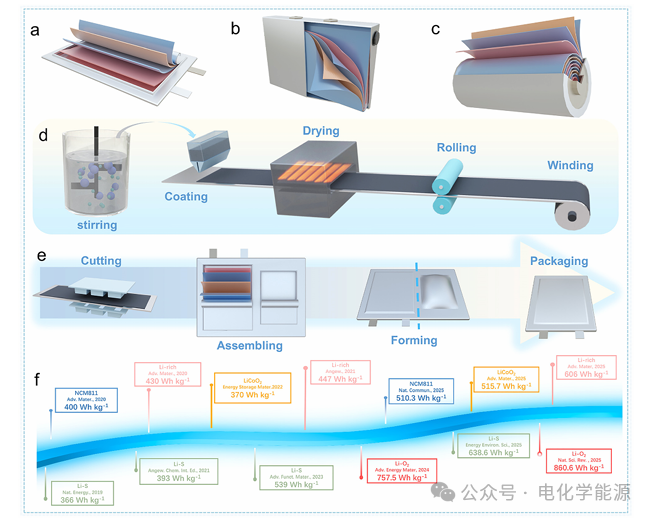
Figure: (a)–(c) Schematic diagrams of pouch cell, prismatic cell, and cylindrical cell models. (d) and (e) Schematic diagrams of the preparation of pouch cell cathode sheets and the assembly process of pouch cells. (f) Practical energy density calculated based on the total mass of pouch cells, achieved since 2019 with different cathode material systems.
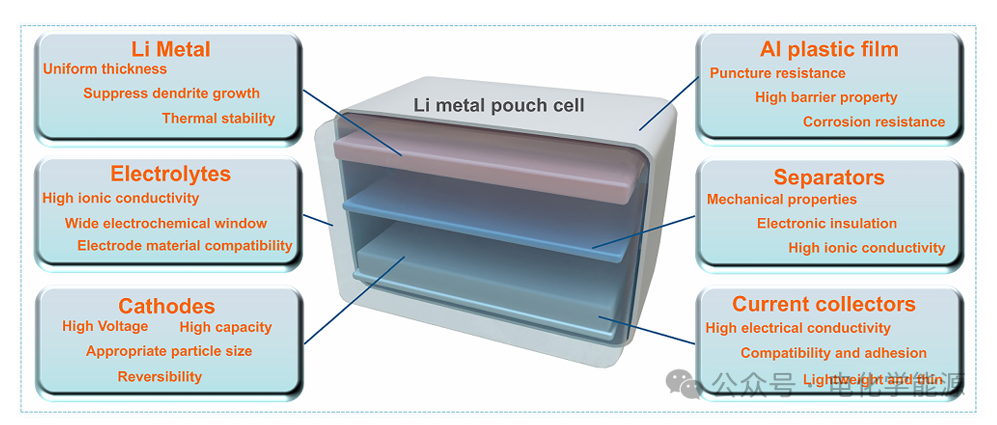
Figure: Main development directions of each component in high energy density LMB devices.
【Conclusion】
High energy density lithium metal battery systems, as a key part of energy storage, not only significantly enhance the range of electric vehicles, meeting consumer demands for long-distance travel, but also play an important role in consumer electronics and smart grid storage. The synergistic progress of materials science and equipment engineering drives the development of high specific energy lithium batteries. Materials are the foundation of battery performance, while equipment is the practical application tool for material performance. From the perspective of material development, in the past few decades, lithium-rich and high nickel cathode materials have shown great potential in the field of high energy density lithium-ion batteries due to their high voltage and high specific capacity characteristics, expected to elevate lithium battery energy density to over 600 Wh kg⁻¹, becoming a strong competitor in next-generation energy storage technology. From the perspective of equipment research, battery packaging, component composition, and types are also crucial to battery performance and application outcomes.
This article mainly focuses on the issues faced by LCO, high nickel cathode materials, lithium-rich cathode materials, as well as sulfur and O₂ battery cathodes, and discusses current modification strategies in detail. In layered cathodes, LCO, as one of the earliest discovered and commercialized lithium-ion battery cathode materials, is known for its high energy density and good cycling stability. High nickel cathode materials (e.g., NCM811 and NCA) have become important choices for current high energy density lithium-ion batteries due to their high specific capacity and high voltage characteristics. Lithium-rich materials, with their high theoretical specific capacity and low cobalt content, are considered strong candidates for the next generation of high energy density lithium-ion batteries. However, due to their similar layered structures, these materials all face poor cycling stability issues caused by volume phase transitions and surface side reactions. Typically, LCO needs to increase the cutoff voltage to achieve higher specific capacity and average discharge voltage but suffers from severe structural collapse. High nickel cathodes require appropriate adjustment of cation mixing and particle morphology to enhance particle stability. Lithium-rich materials need to focus on irreversible oxygen loss and poor kinetic behavior. Several modification strategies have been proposed to address these typical defects in these materials. Overall, there are three main aspects:
(1) Bulk Element Doping: By incorporating metal or non-metal elements into the cathode materials, the electronic structure and crystal structure of the materials can be adjusted, thereby improving their electrochemical performance. Doping elements can occupy lithium or transition metal sites, stabilizing the structure, suppressing harmful phase transitions, and enhancing ionic diffusion rates.
(2) Surface and Interface Protection: By constructing protective layers on the surface of cathode materials, direct contact between the materials and the electrolyte can be reduced, thereby suppressing side reactions. Additionally, the protective layer can serve as an extra barrier to alleviate stress and strain, enhancing material stability.
(3) Structural Optimization: By optimizing the crystal structure, particle size, and morphology of cathode materials, ionic diffusion pathways can be improved, stress accumulation can be reduced, and the cycling stability and rate performance of materials can be enhanced.
In conversion-type systems, lithium-sulfur (Li–S) batteries use sulfur as the active element in the cathode, experiencing the polysulfide “shuttling effect” and volume expansion during charge and discharge. Lithium-oxygen (Li–O₂) batteries, using oxygen as the cathode reactant, have significant advantages in energy density. However, the catalytic activity and stability on the air electrode side face challenges, and the slow kinetics of the oxygen redox reaction severely affect battery life. Corresponding strategies mainly focus on host materials and advanced catalysts:
(1) Cathode Structure Design: Both sulfur and oxygen require cathodes with porous structures, as they must allow oxygen to pass through the device and provide more active sites for anchoring sulfur. The specific surface area of the cathode material and the size/volume of the pores are directly related to the specific capacity.
(2) Development of Advanced Catalysts: Both sulfur and oxygen conversion-type cathodes suffer from slow reaction kinetics, such as the oxygen reduction reaction (ORR) and oxygen evolution reaction (OER) in air electrodes, as well as the polysulfide conversion reaction in sulfur cathodes. Developing advanced catalysts can accelerate reaction kinetics, improving discharge capacity, rate performance, and lifespan.
It is noteworthy that layered and conversion-type cathodes have fundamentally different reaction mechanisms, especially in terms of reaction kinetics. Layered oxides like LCO and high nickel cathodes operate through reversible (de)intercalation of alkali metal ions and redox reactions of transition metals, ensuring the convenience of electron transfer. Lithium-rich layered oxides further utilize the redox reaction of oxygen above 4.4V (relative to Li/Li⁺) by extracting an electron from the O 2p band, providing additional capacity beyond the contribution of transition metals. In contrast, conversion-type cathodes represented by sulfur undergo multi-step, two-electron redox reactions at each active center, accompanied by significant structural reorganization and energy barriers. Their inherent low electronic and ionic conductivity further exacerbates kinetic limitations. Therefore, layered cathodes provide superior power density, making them more suitable for power batteries, while conversion-type cathodes, with higher theoretical specific energy (41000 Wh kg⁻¹), sacrifice power capability, making them more suitable for volume-constrained aerospace and outer space applications.
Secondly, from the perspective of equipment design, achieving high energy density requires comprehensive consideration of multiple aspects, including cathode materials, anode materials, electrolytes, separators, and packaging design. Taking pouch cells as an example, a detailed analysis of the impact of each component in pouch cells on energy density calculated based on the total mass of pouch cells was conducted. It was found that the comprehensive performance of cathode materials is the most important influencing factor. However, it is also necessary to combine reasonable structures of other components to most effectively and maximally utilize energy density. Additionally, in several promising material systems, it was found that all materials have the potential to meet the current demand for 500 Wh kg⁻¹ energy density. However, with the increasing demand for energy density in various application fields, achieving ultra-high energy density exceeding 700 Wh kg⁻¹ may require the performance of all battery components to reach their limits. For example, as researchers compiled in Table 4, perhaps only lithium-rich materials and higher specific capacity sulfur cathodes or even O₂ can meet the requirements. This poses higher demands for the preparation of future materials and the assembly and processing technology of pouch cells.
Despite significant research achievements in the field of high energy density lithium-ion battery systems in recent years, there are still many challenges in achieving ultra-high energy density and large-scale practical applications. To further promote the development of high energy density lithium-ion batteries, future research can be conducted in the following directions.
First, as the most critical components of lithium-ion batteries, cathodes, anodes, separators, and electrolytes should prioritize enhancing their electrochemical performance, as shown in Figure 26:
(1) Development of Advanced Cathode Materials: Cathode materials are one of the key factors determining the energy density of lithium-ion batteries. Currently, lithium-rich cathode materials and high nickel materials are considered important choices for achieving high energy density due to their high specific capacity and high discharge voltage characteristics. However, these materials still face issues such as poor cycling stability and voltage decay. Future work should focus on developing cathode materials with higher specific capacity and more stable structures.
(2) Design and Protection of Lithium Metal Anodes: Lithium metal anodes are regarded as ideal anode materials for achieving ultra-high energy density due to their high theoretical specific capacity and low electrode potential. However, lithium metal anodes face challenges such as lithium dendrite growth, volume expansion, and interface stability in practical applications. Interface engineering can be used to optimize the contact between lithium metal anodes and electrolytes, enhancing interface stability.
(3) Optimization and Innovation of Electrolytes: Electrolytes play a crucial role in lithium-ion batteries, affecting the transport efficiency of lithium ions and determining the safety and cycle life of the battery. The performance of electrolytes can be optimized by introducing functional additives. Additionally, designing new electrolyte systems can improve the ionic conductivity and thermal stability of electrolytes.
(4) Design and Optimization of Separators: Separators in lithium-ion batteries are used to isolate the anode and cathode, preventing short circuits and regulating ion transport. Developing high-performance separator materials, such as ceramic-coated separators and composite separators, can enhance the thermal stability and mechanical strength of separators. Functional separators can be designed to optimize separator performance. For example, developing separators with good ionic permeability can improve the rate performance and cycling performance of batteries.
Secondly, as important components of lithium-ion battery systems, lightweight requirements must be met to achieve higher energy density:
(1) Design and Optimization of Current Collectors: Current collectors in lithium-ion batteries are responsible for conducting current. Developing lightweight current collector materials, such as ultra-thin or composite current collectors, can reduce the mass of current collectors and improve the overall energy density of the battery.
(2) Design of Lightweight Packaging Materials: The packaging materials of pouch cells significantly impact energy density and safety. Packaging materials need to be lightweight while possessing excellent mechanical strength, thermal stability, and chemical stability. Developing lightweight composite aluminum-plastic films can improve energy density while enhancing battery safety.
Additionally, volumetric energy density must be considered to accommodate diverse lithium-ion battery applications. First, the packing density of the cathode should be increased, for example, by optimizing particle morphology and size distribution. Secondly, through reasonable technical optimization or material optimization, the volume ratio of auxiliary materials in the device should be reduced without compromising chemical and physical performance.
Of course, the transition from laboratory development to large-scale practical applications in various scenarios also requires consideration of battery safety, cost, environmental friendliness, and battery management systems. Furthermore, developing green manufacturing technologies and material recycling technologies is crucial to reduce energy consumption and environmental pollution in battery production, promoting sustainable development. In summary, high energy density lithium-ion battery systems, as an important part of next-generation energy storage technology, have broad research and application prospects. Through interdisciplinary research and technological innovation, it is expected that high specific energy lithium-ion batteries will be more widely applied in electric vehicles, energy storage systems, and even aerospace and outer space exploration, making significant contributions to global energy transition and sustainable development.
Xu, C., Peng, B., Yang, W., Tian, J., & Zhou, H. (2025). High energy density lithium battery systems: from key cathode materials to pouch cell design. Chemical Society Reviews.
https://doi.org/10.1039/D0CS000000

Like, view, share, and give a one-click triple support!