Wide Temperature Range Lithium Batteries from -60°C to +60°C
Wide Temperature Range Lithium Batteries from -60°C to +60°C

The next generation of lithium metal batteries urgently requires electrolytes that simultaneously possess low cost, high safety, a wide operating temperature range, high electrochemical stability, and good electrode-electrolyte interface formation capability. On November 19, 2025, researchers from the Suzhou Institute of Nano-Tech and Nano-Bionics, Chinese Academy of Sciences, including Wu Xiaodong, Xu Jingjing, and Li … Read more

Designing High Energy Density Lithium-Ion Batteries: From Key Cathode Materials to Pouch Cell Innovations

Designing High Energy Density Lithium-Ion Batteries: From Key Cathode Materials to Pouch Cell Innovations

(Can be interpreted on behalf of the author, published after proofreading) Submission Channel ↑ With the global energy transition and increasing reliance on renewable energy, efficient and high energy density energy storage systems have become crucial. Lithium-ion batteries (LIBs), as the most mainstream energy storage technology, have commercial products whose energy density is approaching theoretical … Read more

Fatigue-Free and Skin-like Supramolecular Ion-Conductive Elastomeric Interphases for Stable Lithium Metal Batteries

Fatigue-Free and Skin-like Supramolecular Ion-Conductive Elastomeric Interphases for Stable Lithium Metal Batteries

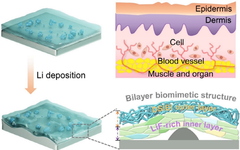
【Research Background】 Metallic lithium is considered an ideal anode material in battery chemistry due to its high theoretical capacity (3860 mAh g -1) and low reduction potential (3.04 V vs. SHE). However, metallic lithium anodes exhibit high chemical reactivity, spontaneously forming a brittle and uneven solid electrolyte interphase (SEI) layer upon contact with organic electrolytes. … Read more