With the continuous construction of campus information infrastructure, various intelligent sensing devices are becoming increasingly prevalent. The application of IoT technology has transitioned from pilot projects to large-scale implementation, becoming a significant driving force for the intelligent upgrade of campuses. The campus IoT builds a complete system of “comprehensive information perception, reliable data transmission, and intelligent decision-making” by deeply interconnecting various intelligent sensing devices within the campus with the internet, gradually turning the concept of “everything connected” into reality. On one hand, IoT technology significantly enhances campus operational efficiency and service accuracy by restructuring management processes. On the other hand, IoT technology plays a crucial role in key areas such as campus safety and energy management. The deep integration of these applications continuously promotes the intelligent level of smart campuses to a higher level.
1
Construction Principles
In recent years, Xi’an Jiaotong University has gradually formed a campus IoT construction model and plan that meets the daily management and usage needs of the school, relying on the construction of the Innovation Port campus. The overall design and construction adhere to the following principles:
Balancing Advancement and Maturity.Technology selection focuses on cutting-edge industry levels, ensuring that the chosen technologies and devices can support business development needs for the next 5 to 10 years, avoiding system reconstruction caused by short-term technology iterations; at the same time, mature solutions that have been long validated in the market and have stable operation cases are prioritized to reduce equipment failure risks and subsequent maintenance costs, ensuring the reliability of the system throughout its lifecycle.
Unifying Standardization and Openness.The design strictly follows national mandatory standards, industry technical specifications, and general protocols, ensuring seamless interoperability and compatibility between devices from different manufacturers and different system modules; at the same time, open interfaces and standardized protocol channels are reserved to support interconnection with existing campus management systems (such as dormitory management systems, public housing systems, and one-card systems) and future new systems, laying the foundation for subsequent expansion and upgrades.
Emphasizing Reliability and Security.Through redundant backup design and intelligent fault recovery mechanisms, it ensures that when a single device or link fails, the network can automatically switch to a backup channel, ensuring uninterrupted business; at the same time, a multi-layered security protection system is constructed, integrating access control, data transmission encryption, and terminal access control, to comprehensively resist malicious attacks, data theft, and illegal intrusions, safeguarding network and data security.
Adapting to Expandability and Flexibility.Using a modular and layered design approach, the network architecture supports on-demand expansion and can flexibly adapt to the scale growth of the campus from “partial IoT coverage” to “full-scenario interconnection”; at the same time, devices need to have flexible configuration capabilities and a unified management platform to support rapid adjustment of parameters and functions according to the needs of different application scenarios such as smart lighting, energy monitoring, and security early warning, achieving efficient adaptation to multiple business scenarios.
2
Campus IoT Architecture
The campus IoT architecture is divided into four parts: perception layer, network layer, platform layer, and application layer, forming a closed loop of data “collection, transmission, processing, and usage” from bottom to top. Each layer performs independent functions while supporting the implementation of intelligent campus scenarios through collaboration.
The perception layer collects various data from the physical space of the campus and converts physical signals into transmittable digital signals, while also receiving upper-layer instructions to drive actuator actions. It should adapt to the diverse scenarios on campus (classrooms, laboratories, distribution rooms, apartments, etc.), considering low power consumption, anti-interference, and ease of deployment.
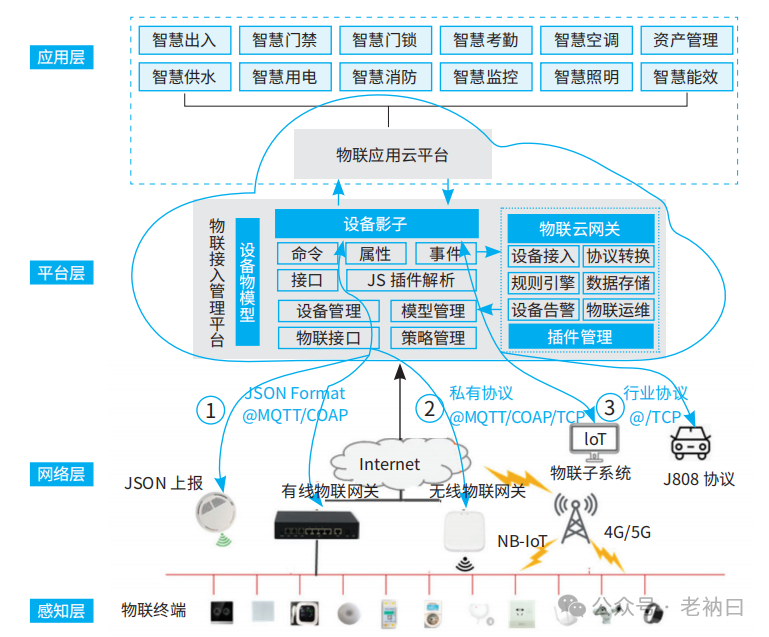
Figure 1 Campus IoT Architecture
The network layer securely, stably, and efficiently transmits data collected by the perception layer to the platform layer while issuing control instructions from the platform layer to the perception layer. It addresses the campus’s transmission needs for “multiple scenarios, multiple devices, and multiple protocols,” covering a wide range of indoor and outdoor areas (teaching buildings, playgrounds, underground garages) while adapting to different devices’ communication protocols and ensuring data transmission security.
The platform layer receives massive data transmitted from the network layer, cleans, stores, analyzes, and models it, while integrating hardware resources and software capabilities to provide standardized “data services” and “control interfaces” for upper-layer applications. It addresses the problem of “fragmented” campus data while possessing scalable and easy-to-manage characteristics.
The application layer develops vertical application systems based on the data and capabilities provided by the platform layer, directly addressing the needs of teachers and students and management pain points. It is closely aligned with the actual needs of the campus, focusing on usability and practicality.
Perception Layer.The perception layer can collect data through wired or wireless methods. Wired methods can use traditional RS485 or Ethernet for connection; wireless methods can use Bluetooth, ZigBee, NB-IoT, LORA, WIFI, and other modes for interconnection.
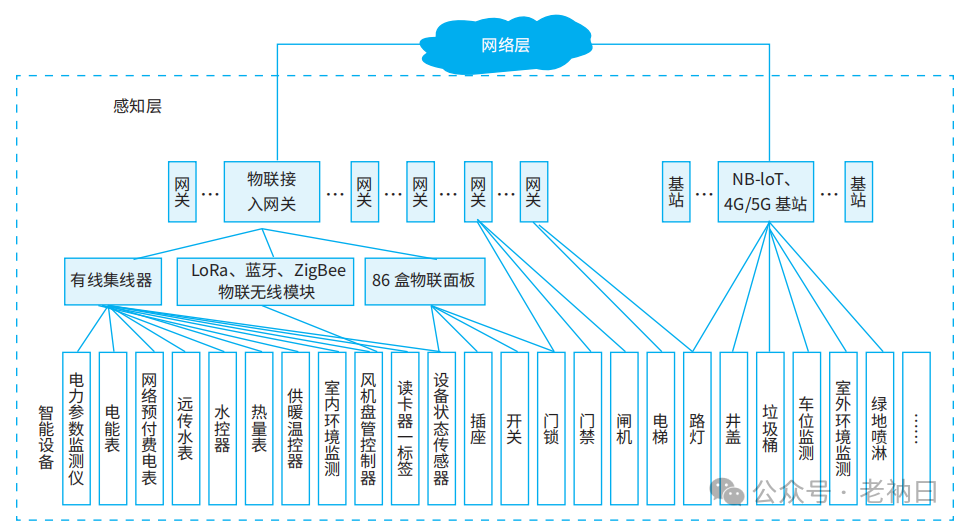
Figure 2 Perception Layer
Among them, Ethernet and WIFI integrate data collection and transmission, allowing direct access to the network layer without the need for a gateway for protocol conversion. Other collection methods can use IoT gateways for protocol conversion before accessing the network layer.
In the IoT construction of Xi’an Jiaotong University, the perception layer achieves the access of nearly 50,000 points, including electric meters, water meters, heating meters, turnstiles, access control, IoT locks, cameras, lighting controllers, temperature and humidity sensors, and water immersion transmitters through various methods such as Ethernet, RS485, NB-IoT, and WIFI.
Network Layer.The network of the Innovation Port campus was planned to utilize a set of network infrastructure to achieve access for various wired, wireless, and IoT networks on campus, integrating the originally independently deployed wired network, wireless network, and IoT network into a highly efficient collaborative basic physical network. Through SDN and VxLAN technologies, multiple logically independent virtual network channels are divided on this physical network, each carrying different types of services such as teaching and office, student internet access, and IoT device interaction.
Access layer devices or gateways in different locations can access the campus network nearby, achieving different types of private network access based on different scenarios. This model effectively addresses the practical issues faced in the construction of smart campuses, such as limited funding, shortage of maintenance personnel, and large-scale private network demands, significantly reducing long-term maintenance costs and minimizing repetitive labor for maintenance personnel, easily adapting to the expansion needs of various IoT services on campus.
Platform Layer.The platform layer is the “digital hub and interaction base” of the IoT, consisting of four core components: IoT perception access, data processing, security management, and rule engine. It serves as a business middleware centered on “data-driven” operations, supporting the operation of upper-layer business application systems through standardized data processing capabilities, and also acts as the underlying operating system that connects different “smart” campus applications, enabling cross-system data interaction and collaborative control, providing unified technical support for smart teaching, management, access, property, and other scenarios.
The platform layer completes the closed loop of “aggregation, processing, and encapsulation” of campus full-scenario perception data. On one hand, it solves the data interoperability problem of devices from different manufacturers through heterogeneous data format conversion; on the other hand, it triggers application business based on preset logic, constructing an automated process of “perception, decision-making, execution.” At the same time, the platform layer possesses full-dimensional capabilities such as protocol conversion, address mapping, data cleaning, information fusion, security authentication, IoT firewall, and rule engine driving, covering the entire link requirements from device access to data transmission, from security protection to business scheduling.
In terms of data access and transmission performance, it has strong multi-protocol compatibility and high concurrency processing capabilities, supporting the communication aggregation and fusion of mainstream protocols such as MQTT, CoAP, and HTTP, efficiently handling all communication traffic from cross-platform IoT devices.
In terms of deployment, the platform layer adopts a distributed deployment model, building an operating environment based on multiple high-performance servers. The servers must meet three major indicators: high reliability, high performance, and high throughput, and can elastically expand cluster services based on the scale of campus IoT construction (such as the number of device accesses and business complexity), ensuring that the platform remains stable during the continuous expansion of campus business.
Application Layer.The application layer builds a smart IoT support system based on IoT data, targeting departments such as logistics, property, security, and assets, focusing on core business areas such as energy, property, dining, and safety, optimizing service processes and improving support efficiency through data-driven approaches, providing more precise and efficient service support for campus teachers and students.
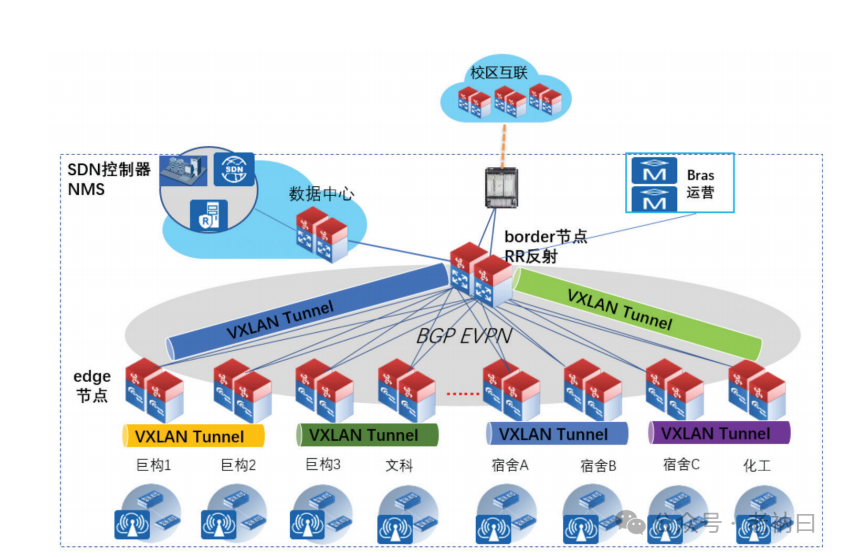
Figure 3 Application Layer
Smart Energy Services. Focusing on the goals of “efficient utilization, precise control, and safety assurance” of campus energy, IoT technology is integrated throughout the energy management process, achieving a transformation from “passive maintenance” to “proactive energy saving.” This includes the formulation and implementation of energy-saving strategies (such as optimizing air conditioning operation periods based on energy consumption data), real-time monitoring of energy system operations (such as monitoring the status of distribution room equipment), precise billing for water and electricity (such as separate metering for dormitories/merchants), and responsive maintenance for equipment failures (such as intelligent alerts and dispatch for water pipe leaks).
The service coverage includes comprehensive energy management (energy status, real-time monitoring of water/electricity in apartments and laboratories); pipeline balance control (leak detection in water supply pipelines, dynamic adjustment of water usage to avoid waste); safety assurance for power supply and distribution (monitoring current, voltage, and temperature of high and low voltage distribution room equipment, warning of short circuit and overload risks); optimization of heating and cooling efficiency (adjusting operating parameters of central air conditioning and heating pipelines), etc.
Smart Property Services. Relying on IoT technology to connect the “demand side, scheduling side, and execution side” of property services, improving service response speed and management precision, creating a “warm and efficient” campus property service system. It constructs a closed loop of the entire property service process, including user services (repair requests and consultation responses from teachers and students, such as submitting dormitory lighting repair requests via an app), management scheduling (work order allocation, such as dispatching work orders based on repair locations), and quality supervision (tracking service processes and satisfaction evaluation, such as automatically pushing evaluation questionnaires after repairs are completed).
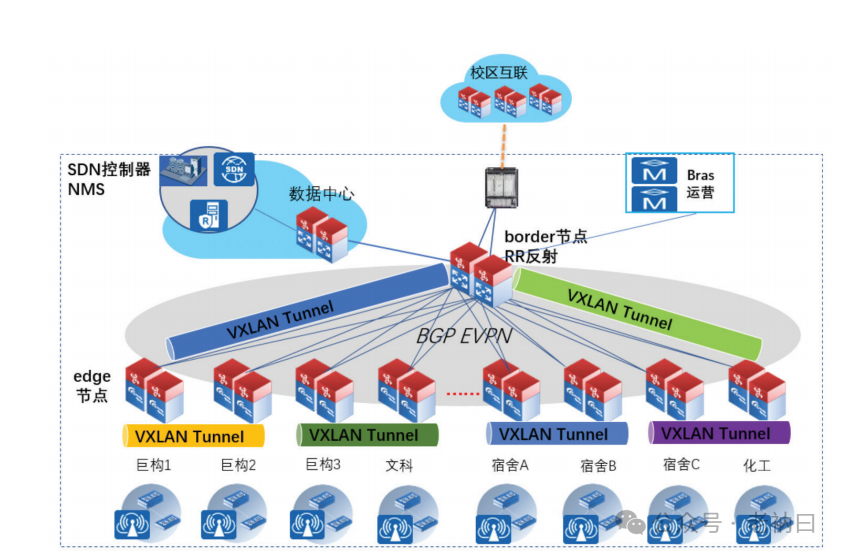
Figure 4 Network Layer
The service coverage includes building management (smart lighting control, access security, monitoring the status of fire protection facilities), apartment services (logistics inspections, maintenance responses, public area lighting), and maintenance of public facilities (smart control of campus streetlights), etc.
Logistics and Dining Services. Integrating IoT technology into the entire chain of campus dining “supply chain, operations, supervision,” achieving traceability of food safety, standardization of merchant management, and transparency of service supervision, ensuring food safety and experience for teachers and students. This includes optimizing the entire process of dining services, including commercial operations, operational control, and internal control management.
The service coverage encompasses all scenarios of campus dining services, specifically including intelligent warehouse procurement service systems, energy billing for cafeteria merchants, dining service supervision systems, AI + bright kitchen and stove, etc.
3
Conclusion
With the deepening of demands for “anytime, anywhere access” and “everything connected,” as well as the mature application of virtualization technologies such as SDN and VxLAN, smart campus networks are facing two key changes. On one hand, the scale of access for intelligent terminals and sensing terminals continues to expand, with device types and business needs becoming increasingly diverse; on the other hand, the traditional model of “independent construction and separate operation of wired networks, wireless networks, and IoT networks” is becoming inadequate to meet the needs for multi-network collaboration. Therefore, promoting the unified planning, construction, and management of IoT has become an important task in the construction of smart campus IoT, building a basic network system that can support ubiquitous connections.
Xi’an Jiaotong University has achieved comprehensive support for “campus-level” IoT applications and services, utilizing flexible access capabilities to adapt to the access needs of various IoT terminals in scenarios such as smart teaching, energy management, and property services. Whether it is thousands of temperature and humidity sensors in classrooms or tens of thousands of IoT locks and prepaid electric meters in dormitories, they can all efficiently access the network; leveraging dynamic scheduling capabilities, network resources can be adjusted according to business priorities to ensure real-time flow of critical data. At the same time, through multi-layered security protection and high-reliability transmission mechanisms, it can stably collect and securely transmit full-scenario perception data, providing high-quality and highly credible foundational data support for the campus IoT control management platform and various big data analysis platforms, becoming a solid foundation for the continuous upgrade of smart campuses.
Source: “China Education Network” September 2025 issue
Authors: Li Huqun, Zhang Zhe, Zhu Xiaomang, Wu Feilong, Xu Mo (Affiliation: Network Information Center, Xi’an Jiaotong University)
For submissions or collaborations, please contact: [email protected]
Previous Recommendations
Construction of Smart Classrooms Based on IoT
Core Principles and Transformation Prospects of IoT Construction in Universities
Follow Us for More ↓
More Exciting Video Recommendations


Welcome to Share, Like, and View
Active comments will also bring surprises and gifts~