01AI Agent Industry Chain Overview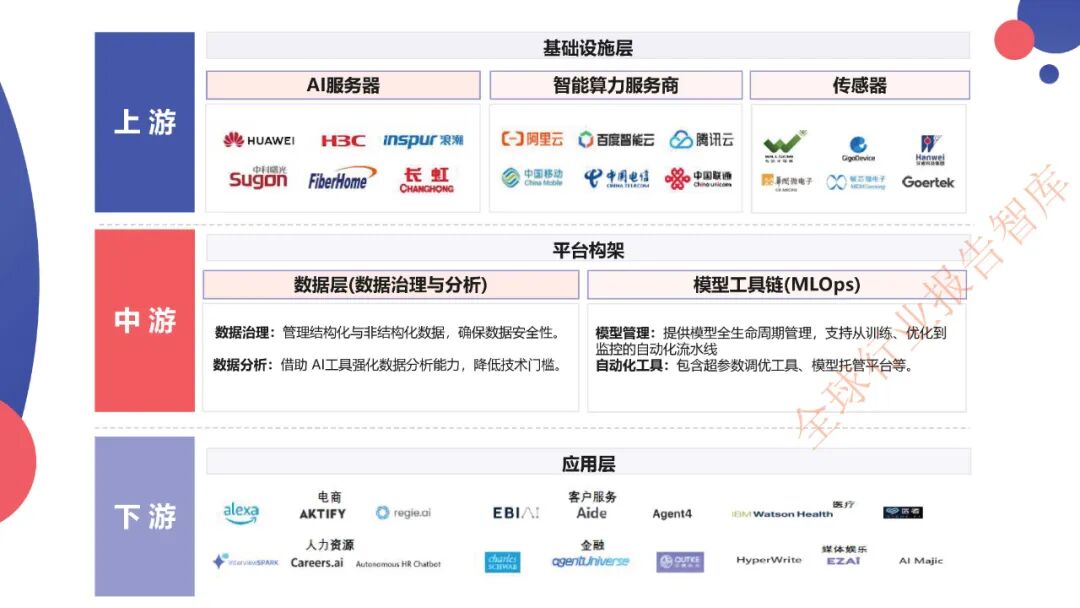 Source:Laimi Data, Northeast Securities02Introduction to the AI Agent Industry2.1 Introduction to the AI Agent Industry:AI Agent = Large Language Model (LLM) + Memory + Active Planning + Tool Use.1) Large Model: In LLM-based agents, the LLM acts as the brain of the agent.
2) Active Planning:Can decompose large tasks into subtasks and plan the execution process, while also reflecting on the task execution process to decide whether to continue executing the task or determine if the task is complete and terminate.
3) Memory: Short-term memory refers to the context during task execution, which is generated and temporarily stored during the execution of subtasks and cleared after the task is completed; long-term memory refers to information that can be retained for a long time, generally referring to external knowledge bases that can be stored or retrieved using vector databases.
4) Tool Use: Equipping agents with tool APIs, such as calculators/search tools/code executors/database query tools, to interact with the physical world and solve real problems.
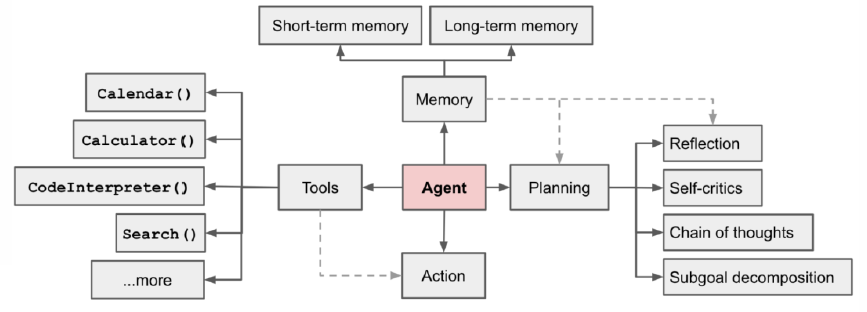 Agent Format2.2 AI Agent Levels:Based on the four core capabilities of agents: “Reasoning + Memory + Tool Use + Planning,” according to CBInsights research, agents with a certain level of autonomous decision-making ability can be divided into two levels.1) Basic Agent: AI models can automate tasks by replacing human roles with digital employees for repetitive tasks that require some flexibility.2) Advanced Agent: Agents are not just combinations of LLM calls but can autonomously and proactively plan and complete multi-step, long-duration tasks, making independent choices among multiple options without human instruction, achieving a high degree of autonomy.
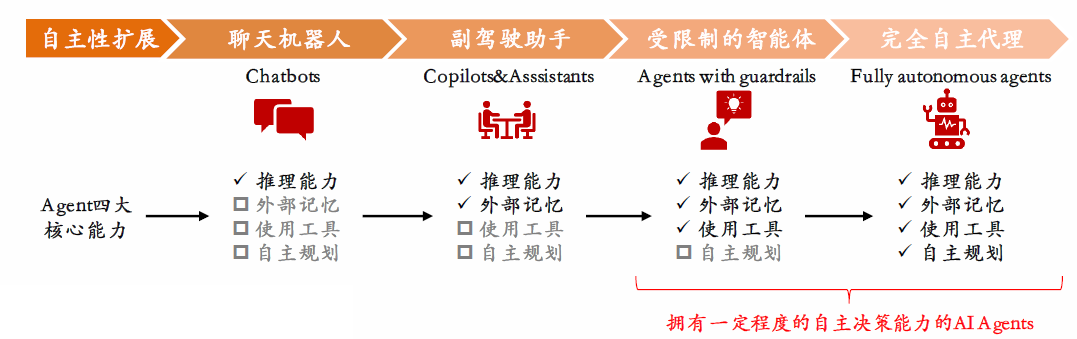 Classification of AI Agent Levels Based on Autonomy2.3 AI Agent Market Size:
The global autonomous agent market is expected to grow from $345 million in 2019 to $2.929 billion by 2024. In the future, a large number of agents will appear in the form of software assistants, while existing software assistant products will also be upgraded to autonomous agent products.
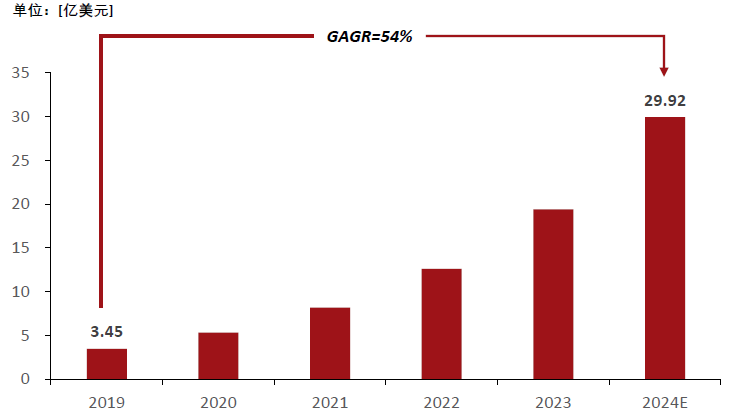
Global Autonomous Agent Market Size, 2019-2024E
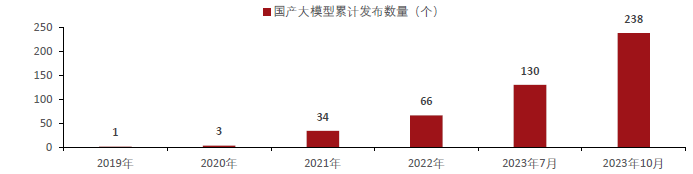
03Upstream Industry Chain of AI Agents3.1 AI Agent Infrastructure Development:The agent ecosystem is experiencing a wave-like development process, where each wave of innovative applications drives the iteration and upgrade of infrastructure. The advancement of underlying technologies further spurs the emergence of smarter applications, such as OpenAI’s GPT series (from GPT-1 to GPT-4) and the o series (from o1 to o3), Anthropic’s Claude model (from Sonnet-3 to 3.7), and Google’s Gemini model (from 1.5Pro to 2.5 Pro).The middle layer of agents has seen the emergence of tools like LangChain, Tool Calling, MCP, and A2A; the application layer has seen the emergence of Cursor, Claude Desktop, OpenAI Operator, etc. New applications pose more complex demands on infrastructure, and the advancement of infrastructure will feed back into new intelligent agent applications, shaping and evolving together, accelerating the commercialization of AI.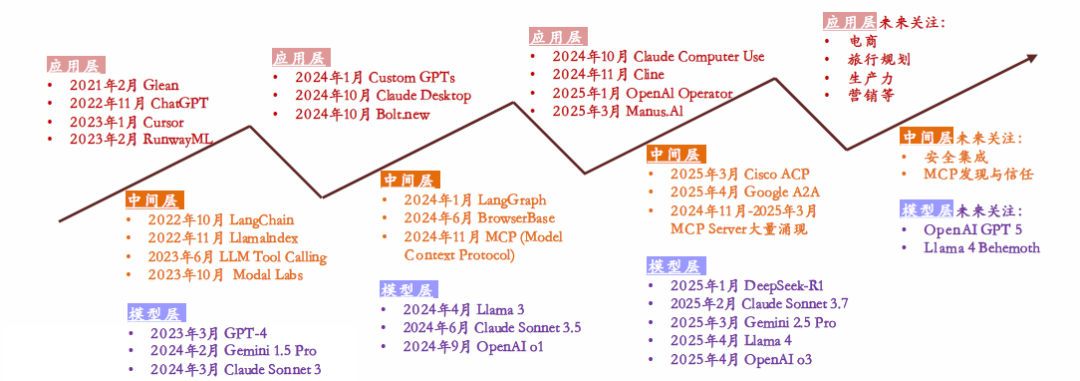 Co-evolution of Agent Infrastructure and Applications3.2 Large Models –Intensive Release of Domestic Large Model Products:As of October 2023, the cumulative number of domestic large models released has reached 238. Numerous domestic large model products have surged, with the release quantity growing exponentially.Many large models are on the edge of “riding the wave,” and leading domestic large model manufacturers will inevitably accelerate the iteration of AI Agent capabilities to differentiate themselves from the majority of domestic large models.
 Intensive Release of Domestic Large Model Products3.3 Computing Power –Total Scale Rapid Growth:In 2023, China’s total data output reached 8.1ZB, a year-on-year increase of 22.7%, accounting for 10.5% of the global total, ranking second in the world;
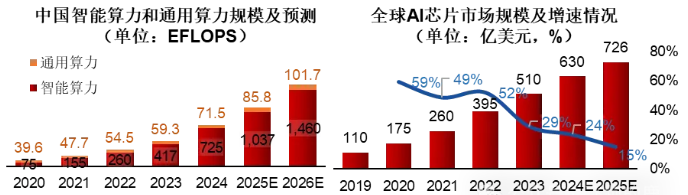 In 2023, China had over 8.1 million standard racks in use in data centers, with a total computing power of 230 EFLOPS. The steady growth of data output and total computing power in China provides a solid foundation for the realization of AI Agent capabilities.
 Rapid Growth of Data Volume and Total Computing Power3.3 Data –Fuel for Training Models:
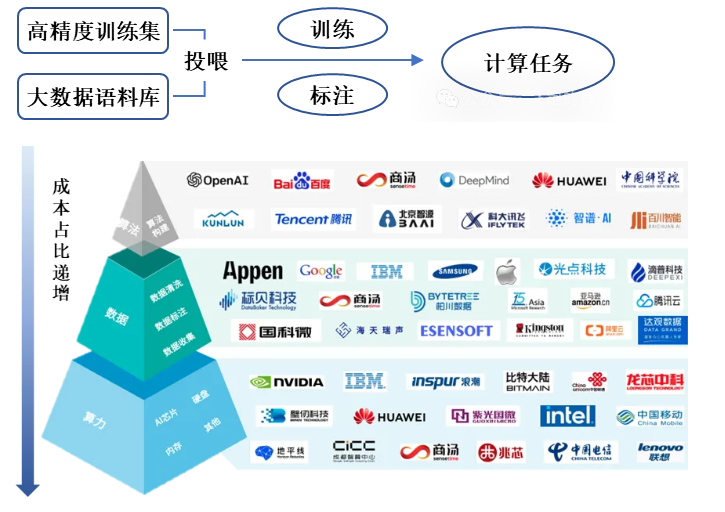
The quality of data directly determines the effectiveness of AI models – just as good ingredients are needed for cooking, if you input “garbage data,” the model output will also be “garbage.” Research shows that 90% of model performance issues stem from data rather than architecture.
 04Midstream Industry Chain of AI Agents
4.1 AI Agent Platform Architecture
1) Architecture Types:
Monolithic Architecture, Modular Architecture, Federated Architecture
2) Representative Solutions:
- Monolithic Architecture: DeepMind AlphaFold
- Modular Architecture: MIT CodeChain
- Federated Architecture: OpenMined PATE
3) Core Features:
- Monolithic Architecture: End-to-end optimization, high inference efficiency
- Modular Architecture: Hybrid neural-symbolic systems, hot-swappable modules
- Federated Architecture: Distributed privacy-preserving training
4) Limitations:
- Monolithic Architecture: Poor interpretability, difficult to update
- Modular Architecture: Challenges in interface standardization
- Federated Architecture: High communication overhead
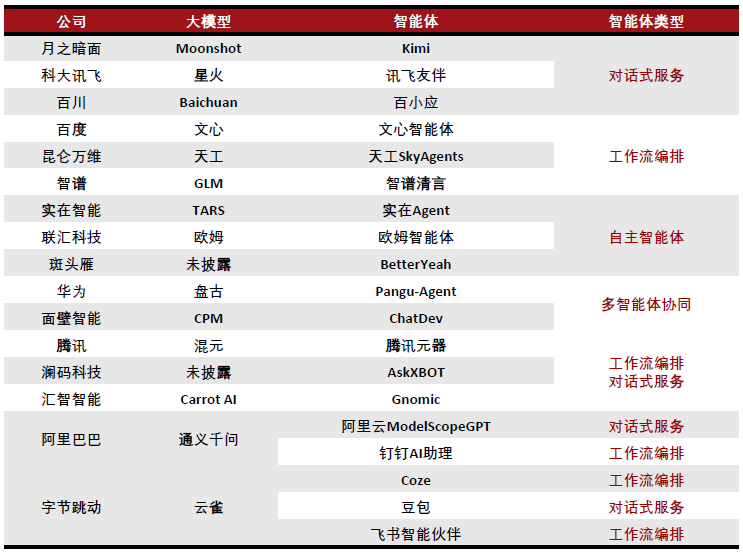
- 4.2 Classification of AI Agent Platform Framework Vendors and Their Product Types
The development of AI Agents in China is still in its early stages, with different types of companies, such as AIGC native manufacturers, internet giants, enterprise software/SaaS manufacturers, RPA manufacturers, low-code/no-code manufacturers, and 3C hardware manufacturers, entering the AI Agent market leveraging their unique advantages in their respective fields.
- 4.3 Business Models of AI Agent Platform Framework Vendors
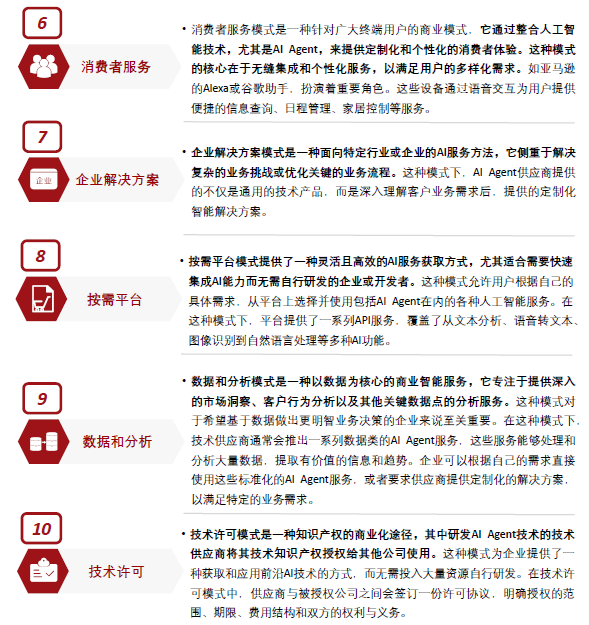
The business models of AI Agents include software and services, Agent as a Service, LLM as a Service, Agent Store, consumer services, enterprise solutions, on-demand platforms, data and analytics, technology licensing, etc.
- 4.3 AI Agent Market Size
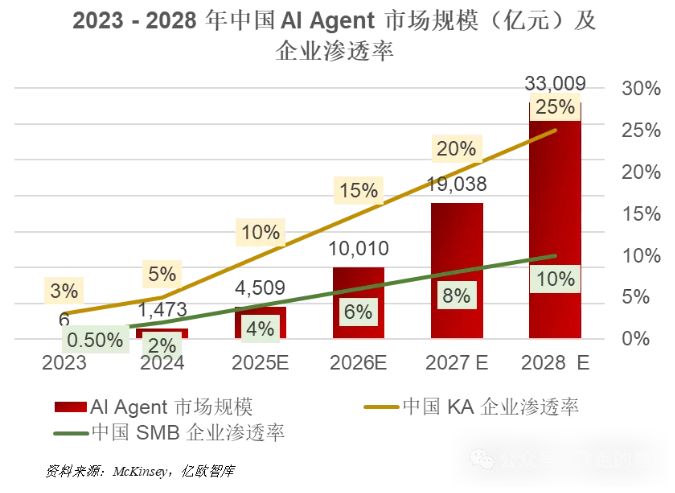
The AI Agent market in China is currently like a seed just sprouting, with a scale of 147.3 billion yuan in 2024, but less than 5 out of every 100 enterprises are using it (penetration rate below 5%). By 2028, the market size is expected to surge to 3.3 trillion yuan – equivalent to 1.5 times the entire GDP of Shanghai in 2023.
 05Downstream Industry Chain of AI Agents
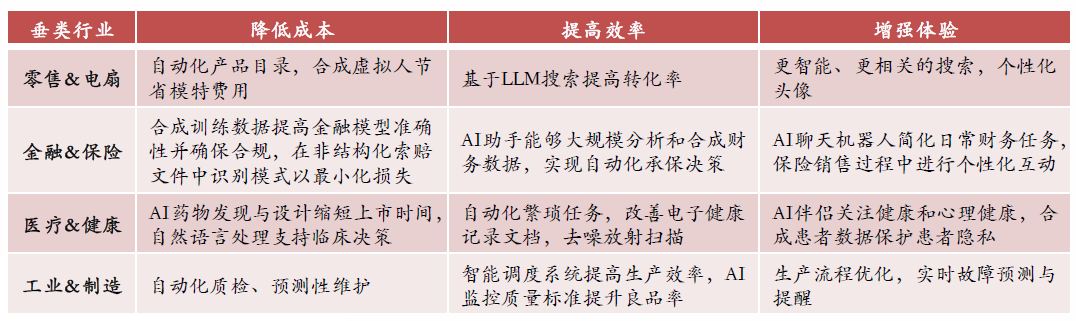
5.1 Advantages of AI Agent Application Scenarios: Vertical Industries
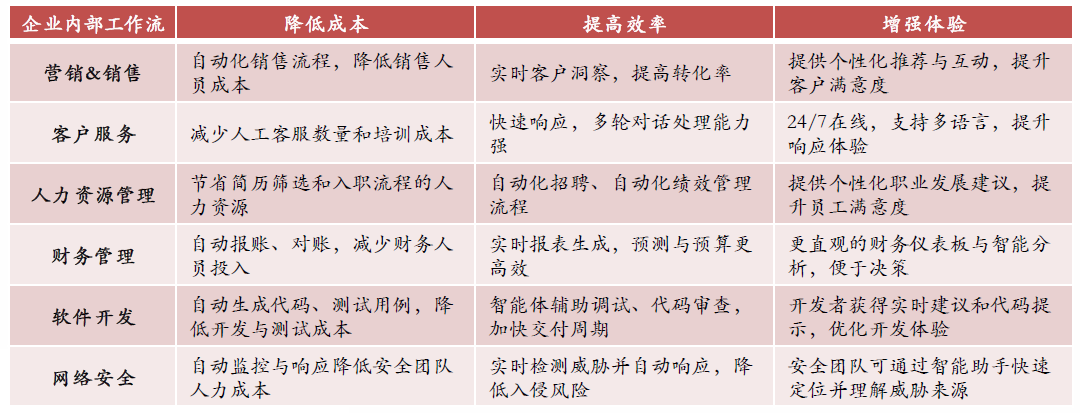
From the perspective of AI agents’ empowering role, the focus is mainly on“reducing costs + improving efficiency + enhancing experience” in three major directions. Among them, “reducing costs” can help enterprises improve profitability, “improving efficiency” is expected to enhance operational competitiveness, and “enhancing experience” will increase user retention and expand potential market size, thus building a closed-loop commercial value for agents.
5.1 Advantages of AI Agent Application Scenarios: Development Status in Vertical Industries
The application maturity, data accessibility, industry demand, and market potential of AI Agents in the financial industry are the highest. The application maturity and data accessibility of AI Agents in the government sector are not as high as in other mainstream application industries, mainly due to the sensitivity of government information, making it difficult to obtain.
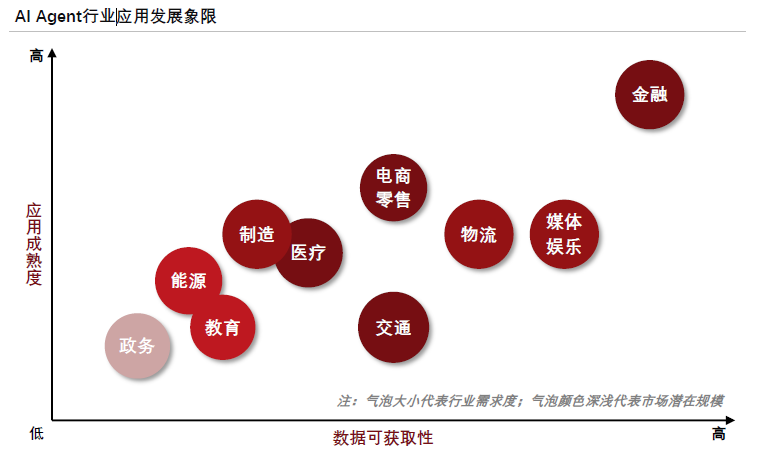
AI Agents have a wide and diverse range of vertical application scenarios, and they are accelerating penetration across various industries. Currently, AI Agent architectures and products are emerging in industries such as finance, e-commerce retail, education, healthcare, manufacturing, transportation, media entertainment, energy, logistics, and government. AI Agents can achieve intelligent risk control, intelligent customer service, intelligent marketing, etc., in the financial industry, providing real-time data in various scenarios, solving the timeliness issues in traditional large model methods. At the recent ArchSummit Global Architect Summit held in Shenzhen, Tianhong Fund shared its team’s development of an AI Agent based on large models in the financial industry.
5.2Advantages of AI Agent Application Scenarios: Internal Enterprise
For internal workflow scenarios in enterprises, the requirements are generally applicable to various positions and departments, featuring broad coverage, quick onboarding, and easy deployment, essentially aimed at creating office efficiency tools, or even forming an AI office operating system. In terms of cost reduction, agents automate routine tasks, reducing basic human resource input; in terms of efficiency improvement, they can compress the time spent on daily tasks; in terms of enhancing experience, they provide employees with a more efficient and smoother collaborative environment, making work rhythms lighter and work experiences smarter.
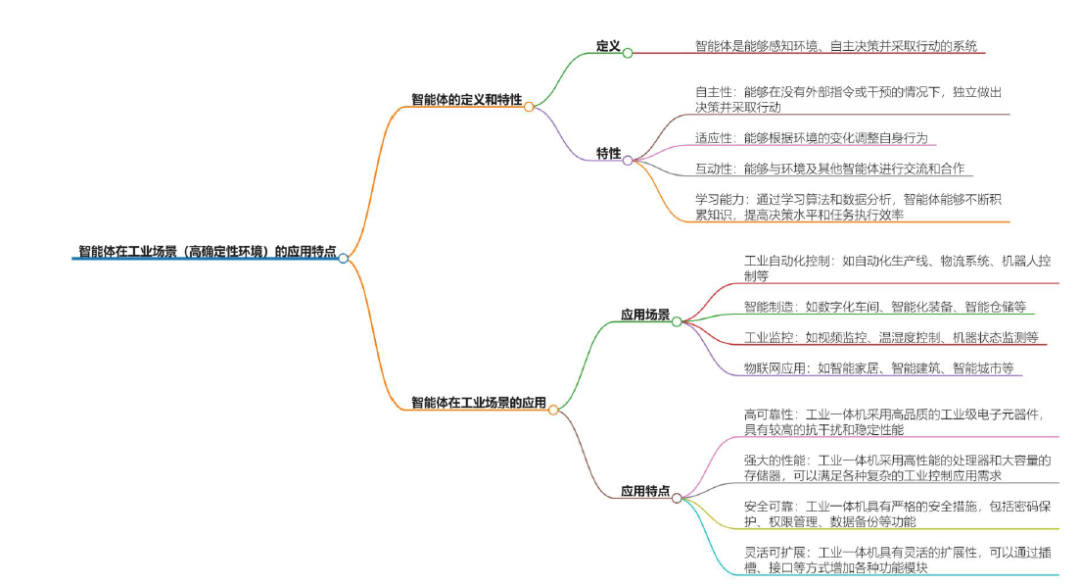
5.31 AI Agent Application Scenario Case 1: Industrial Applications
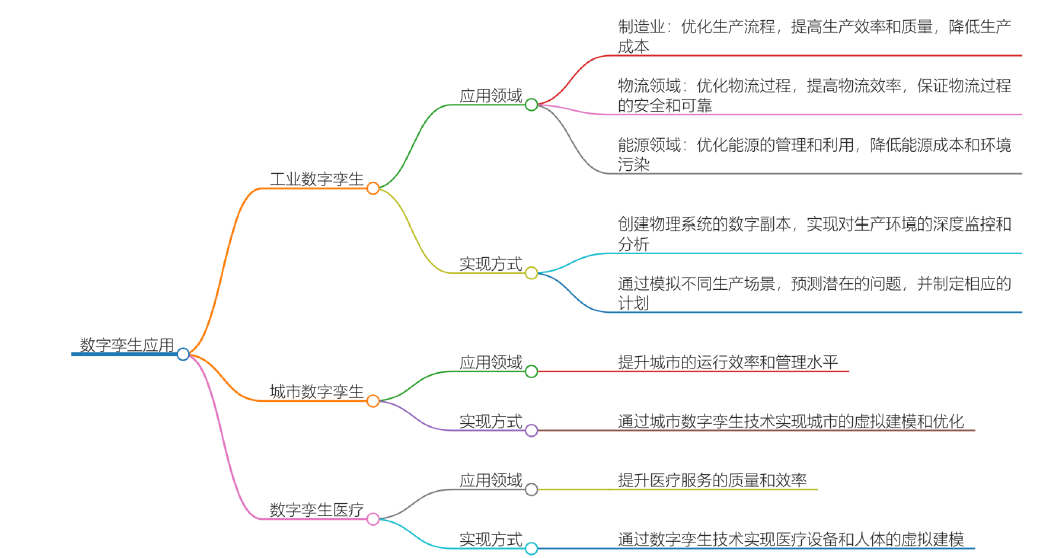
5.32 AI Agent Application Scenario Case 2: Metaverse
 07Development Trends of AI Agents
Overview of the AI Agent Industry – Development Trends
According to technical characteristics, the mainstream classification of AI Agents in academia includes Logic Agents, Task Agents, Job Agents, and Self-evolving Agents.
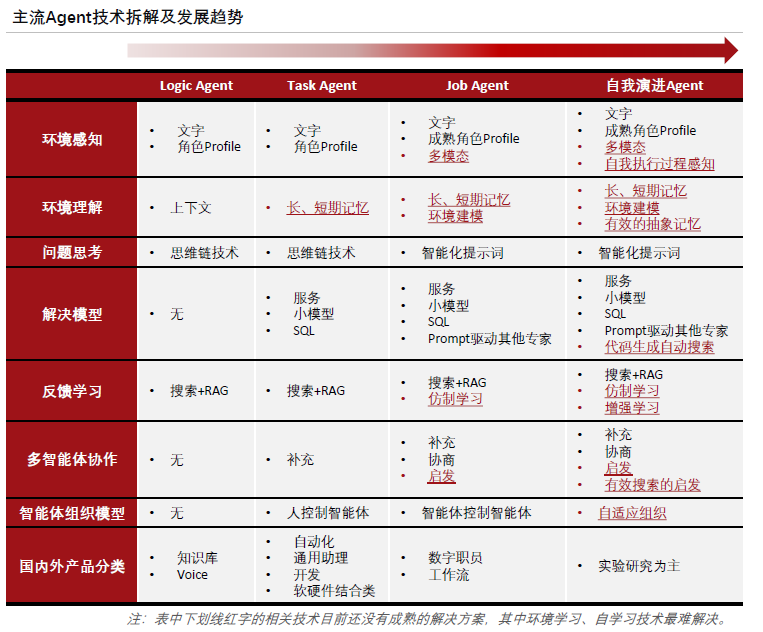
Currently, domestic and foreign products are mainly focused on Task Agents, and in the short term, Job Agents are expected to develop rapidly.
Source: Global Industry Report Think Tank