
 In the process of oral expression, Chinese people value “clear pronunciation and distinct tones” and “pearls falling on a jade plate”. Therefore, when Chinese people speak, it is as if they are counting beans, clearly dropping one bean at a time.English, on the other hand, requires highlighting certain key words in a sentence while weakening the non-key words. Especially in American English, it can even link two or more words together, making it feel as if the first word is not finished before the next one is already spoken, or it may omit a consonant from a word directly.For Chinese people who are used to speaking clearly one word at a time, many feel that English is “too vague”, which also leads to poor listening comprehension among many Chinese people.Conversely, if foreigners spoke English according to the Chinese way of “one word at a time”, there would be no issues with oral expression or poor listening comprehension.Therefore, as Chinese learners of English, it is essential to get closer to the English language habits. Of course, to master such “English-style” oral expression, the most fundamental thing is to pay attention to the linking and weakening in English.
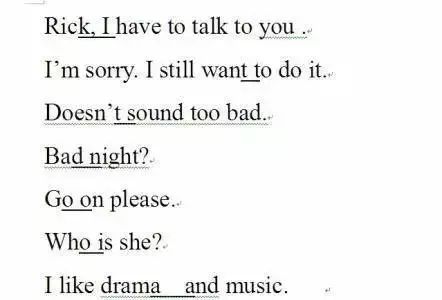
1 LinkingPronunciation Rule One: Consonant + VowelWhen two adjacent words in a sentence occur, if the first word ends with a consonant and the second word starts with a vowel, they are pronounced as “consonant + vowel”.Explanation: Do you remember some words in Chinese Pinyin like xi’an (西安), ku’ai (酷爱)? If you remove the separating sound, it becomes xian (先), kuai (快). In English, almost all sentences are pronounced from beginning to end. Simply put: linking means that if two words can be pronounced together, do so; if not, let them pass.For example: Take~it~easyPhrase Practice (Read aloud):1.far~away It’s not far~away from here.2.in~an~hour I should be there in~an~hour.3.put~it~on Here’s your sweater. Put~it~on.4.stand~up Stand~up and stretch for a while.5.take~care~of I’ll always take care~of you.Pronunciation Rule Two: Vowel + VowelWhen two adjacent words in a sentence occur, if the first word ends with a vowel and the second word starts with a vowel, a slight [j] or [w] sound is added between the two vowels, pronounced as “vowel + [j] or [w] + vowel”.[i:] or [eɪ] ending vowel + [j] + vowel1. see us → see [j] us Come and see~us again soon.2. be over → be [j] overIt will be~over soon.3. be able → be [j] ableWill you be~able to come tomorrow?4. say it → say [j] itCould you say~it again please?5. pay Ann → pay [j] Ann Please pay~Ann her salary.Vowel ending in [u:] or [əʊ] + [w] + vowel1. do it → do [w] itDon’t do~it again.2. go up → go [w] upLet’s go~upstairs and have dinner.3. show us → show [w] usCan you show~us something else.Note: The linking between vowels is a naturally glided sound. When your pronunciation approaches fluency, you will find that you can achieve effects without deliberately pronouncing [j] and [w], so just relax and practice; imitation is the first teacher.Pronunciation Rule Three: Omitting the [h] in LinkingIn linking rules, words beginning with the letter “h” have their [h] sound nearly omitted because the [h] pronunciation is very special—it is just a breath without friction, so it seems to be omitted when pronounced.1. Does~he know?2. What~happened?3. Please give~him a hand!English linking rules, explained in English throughout the lesson, real classroom teaching.
How do you link the sentence “What do you do for a living?”
Three-minute video to watch and practice.
2 WeakeningThe most obvious phonetic rule in English, besides linking, is weakening. When plosive sounds are adjacent, the first plosive sound only creates an obstruction but does not explode, which is called loss of explosion; when a plosive sound is adjacent to other consonants, that plosive sound does not fully explode. The phenomenon of loss of explosion and incomplete explosion in English phonetics is simply referred to as “weakening”. Mastering weakening is a key point in English phonetic learning and also a difficult point; mastering it means mastering the winning formula for authentic English pronunciation!Note: During weakening, it is not that the entire sound is discarded, but rather that the pronunciation is just touched upon, with a mouth shape but no sound or a slight sound.Important academic term—plosive sounds: [p] [b] [t] [d] [k] [g]1. Plosive + Plosive = Loss of ExplosionTips:When any two of the six plosive sounds meet, if one plosive sound is immediately followed by another plosive sound, the first sound is just touched upon, creating an obstruction but not exploding; the second sound completely explodes; if the second plosive sound is at the end of a word, it must be softened.When a plosive sound ends with the same plosive sound, only one sound is pronounced; the previous sound is prepared for pronunciation but not pronounced, directly pronouncing the second sound.Loss of explosion within words1.active=a(c)tive [k]+[t]Students are encouraged to be active in class.2.blackboard=blac(k)board [k]+[b]Our class has a large blackboard.3.dictation=di(k)tation [k]+[t]We’ll have dictation today.4.football=foo(t)ball [t]+[b]There is going to be a football match tonight. Shall we watch it together?5.goodbye=goo(d)bye [d]+[b]She waved me goodbye.Loss of explosion in sentencesThe loss of explosion and incomplete explosion phenomena listed above occur within words; in fact, in a sentence or phrase, the probability of adjacent words exhibiting loss of explosion and incomplete explosion is greater than that occurring within words.1.Stop talking!=Sto(p)-talking!2.I don’t care.=I don'(t) -care.3.I had a bad cold.=I had a ba(d)-cold.Plosive [t] and [d] + nasal consonants [m] and [n]When plosive sounds [t] and [d] are immediately followed by nasal consonants [m] and [n], [t] and [d] form an obstruction, and at the end of a word, they must explode through the nasal cavity; during pronunciation, the tip of the tongue is pressed against the upper gums, slightly released, and immediately pressed back, allowing the airflow to escape through the nasal cavity without changing tongue position from the plosive to the nasal sound. If it is in a word, it will be an incomplete explosion.[t] and [d] + [m] and [n] at the end of words1.Britain [tn]Britain is made up of England, Scotland, Wales, and Northern Ireland.2.certain [tn]They are certain to agree.3.frighten [tn]The high prices frighten off many customers.[t] and [d] + [m] and [n] within words1.admire=a(d)mire [d]=[m]I really admire your enthusiasm.2.admit=a(d)mit [d]+[m]She admits to being strict with her children.3.goodness=goo(d)ness [d]+[n]Thank goodness![t] and [d] + [m] and [n] in sentences1.Good morning!=Goo(d)-morning!2.Let me take a look.=Le(t)-me take a look.3.I don’t know what to say.=I don'(t)-know what to say.Plosive [t] and [d] + lateral sound [l]When plosive sounds [t] and [d] are immediately followed by lateral sounds [l], the two sides of the tongue must explode; this situation often occurs at the end of words. When plosive sounds [t] and [d] are immediately followed by clear lateral sounds [l], it results in incomplete explosion.[t] and [d] + [l] at the end of words1.battle [t]+[l]Any soldiers were killed in the battle.2.gentle [t]+[l]His soap is very gentle on the hands.3.little [t]+[l]I’m a little tired.4.settle [t]+[l]The company has agreed to settle out of court.5.title [t]+[l]Give your name and title.[t] and [d] + [l] within words1.heartless=hear(t)less [t]+[l]The decision does seem a little heartless.2.lately=la(te)ly [t]+[l] Have you seen him lately?3.badly=ba(d)ly [d]+[l]Things have been going badly.4.needless=nee(d)less [d]+[l]Banning smoking would save needless deaths.[t] and [d] + [l] in sentences1.Good luck!=Goo(d)-luck!2.I would like to have one.=I woul(d) like to have one.3.At last, we made it to his party.=A(t) last, we made it to his party.Plosive + Fricative/ Affricate = Loss of ExplosionWhen a plosive sound is immediately followed by a fricative sound or affricate sound, that plosive sound creates an obstruction but does not fully explode.Fricative sounds: [f][v][θ][ ð][s][ z][ ʃ][ ʒ ][h][r]Affricate sounds: [ts]-[dz],[tr]-[dr],[tʃ]-[dʒ]Loss of explosion within words1.advance=a(d)vance [d]+[v]We live in an age of rapid technological advance.2.bookshop=boo(k)shop [k]+[ ʃ]The bookshop opens at 7 o’clock in the morning.3.helpful=hel(p)ful [p]+[f]A: Sorry, I can’t be more helpful.B: Thank you. You’ve been very helpful.4.lecture=le(c)ture [k]+[tʃ] Mr. Li is giving a lecture to first-year students.5.object=o(b)ject [b]+[dʒ]The object is to educate people about road safety.Loss of explosion in sentences1.You look fantastic.=You loo(k)-fantastic.2.I’ll get there by ten.=I’ll ge(t) there by ten.3.Let’s have a good chat.=Let’s have a goo(d)-chat.4.I haven’t read the book.=I haven'(t)-read the book.5.Wish you a great success!=Wish you a grea(t)-success!6.Put the book on the desk.=Pu(t)-the book on the desk.7.She is one of my old friends.=She is one of my ol(d)-friends.8.I’d like a room with a good view.=I’d like a room with a goo(d) view.9.I am quite sure that you will win.=I am qui(te) sure that you will win.10.Don’t judge people only by appearance.=Don'(t) judge people only by appearance.3 PhrasingWhen a sentence is longer, it can be difficult for people to say it all in one breath. At this point, the sentence can be divided into several segments based on semantic and grammatical relationships, with each segment being a relatively independent meaning unit. In other words, a meaning unit is a segment that can form a relatively independent meaning and is a component of the sentence.There can be a pause between meaning units, which aligns with people’s cognitive processes. However, there should be no pause between the words within a meaning unit; the entire meaning unit should be read as if it is one long word. Remember: English is not spoken word by word.Example 1: Repeating after tapes is very important for beginners.Meaning unit: Repeating after tapes | is very important | for beginners.Repeating after tapes is very important for beginners.Example 2: Early to bed and early to rise makes a man healthy, happy, and wise.Meaning unit: Early to bed | and early to rise | makes a man | healthy, happy, and wise.Going to bed early and rising early makes one healthy, happy, and wise.Example 3: Liu Xiang, who’s a brilliant runner, represented China at the Olympic Games.Meaning unit: Liu Xiang, | who’s a brilliant runner, | represented China | at the Olympic Games. Liu Xiang, an excellent runner, represented China at the Olympic Games.Example 4: But the most important argument for a broad education is that in studying the accumulated wisdom of the ages, we improve our moral sense.Meaning unit: But | the most important argument | for a broad education | is that | in studying the accumulated wisdom of the ages, | we improve our moral sense. But the most important reason for broad education is that by studying the accumulated wisdom of our predecessors, we can improve our moral sense.The pauses between meaning units depend on the speaker’s situation and are not mandatory. However, if there is a pause, it must be between meaning units; pausing randomly disrupts the rhythm of the language. 4 Sentence StressThere is a joke about sentence stress in English: a man went to the post office to buy a stamp to send a letter, and he asked, “Must I stick it on myself?” Because he stressed the word “on” which should not have been stressed, the original meaning of “Do I stick it on (the envelope) myself?” turned into “Do I have to stick the stamp on myself?” resulting in an embarrassing situation. This shows that correctly handling sentence stress is absolutely crucial.The general rule of sentence stress is that not all words can be equally important in coherent speech; some words are more critical while others are relatively less significant. Generally, key words need to be stressed, which is what sentence stress is about, while other words do not need to be stressed. Alternatively, it can be said: content words are stressed, function words are not.Words that generally need to be stressed (content/ key words):Lexical verbs, nouns, adjectives, adverbs, numerals, interrogative words, and exclamatory words, etc.Words that generally do not need to be stressed (function/ non-key words):Auxiliary verbs, modal verbs, articles, prepositions, conjunctions, possessive pronouns, relative pronouns, and relative adverbs, etc.Additionally, personal pronouns, conjunctions, prepositions, and auxiliary verbs are generally not stressed, but in specific contexts, they may need to be stressed. For example, personal pronouns need to be stressed when they function as a compound subject or object, and prepositions at the beginning of a sentence also need to be stressed; demonstrative pronouns functioning as subjects or objects also need to be stressed.In listening exams, sentence stress can help candidates find key words and grasp the main idea, correctly understanding the content they hear. Generally, when there is no need to emphasize or contrast certain content, the sentence stress usually falls on the last content word that appears, for example:For instance: The course was more difficult than she had expected, but she got a lot out of it. Translation: This course was much more difficult than she had imagined, but she learned a lot from it.In this sentence, as long as you hear the stressed words or phrases, it is not difficult to understand the meaning correctly.(1) courage, more difficult, expected;(2) got, lot, out.Logical Stress of SentencesThe stress of a sentence always reflects the speaker’s thoughts and the key points of the meaning they are conveying; sometimes to emphasize, almost any word in the sentence can have stress, including some words that usually do not carry stress; this type of stress, which depends on the speaker’s intention, is called logical stress.For example:Did you tell my wife?Emphasizing “wife”, are you telling my wife?Emphasizing “my”, are you telling my wife?Emphasizing “you”, are you telling my wife?English sentence stress practice video5. IntonationIntonation is an important way to express various thoughts and feelings. The basic types of English intonation are falling intonation, rising intonation, and level intonation.Falling intonation indicates that the speaker’s attitude is affirmative, the meaning is complete, and the grammatical structure is independent; rising intonation indicates that the speaker’s attitude is uncertain, the meaning is incomplete, and the grammatical structure is not independent; level intonation is generally used after direct speech to express what was said, with no change in pitch. In sentences or meaning units that are more complex in meaning, all three basic intonations are often combined to form rising-falling or falling-rising intonation, making the intonation more complex.American English is more down-to-earth than British English, and its intonation tends to be more natural, with less deliberate modulation; British English intonation has greater fluctuations. Different intonations can convey different attitudes and implied meanings from the speaker. Using different intonations for the same sentence in English can produce entirely different semantic concepts.For example: “yes”, if pronounced with falling intonation, indicates that the speaker is very certain about the answer to the question; if pronounced with rising intonation, it indicates that there is a question about the issue. Intonation has a strong emotional color, making language more expressive.Falling Intonation1. Used in declarative sentences:For example: I have already seen that movie. ↘Translation: I have already seen that movie.2. Used in special interrogative sentences:For example: What has happened to him?↘Translation: What happened to him?Note: Special interrogative sentences sometimes use rising intonation to ask someone to repeat what they just said.For example:A: I graduated from Lanzhou University and majored in mechanical engineering.↘Translation: I graduated from Lanzhou University with a major in mechanical engineering.B: What was your major?↗Translation: What was your major?3. Used in imperative sentences:For example: Go back to your seat! Now!↘Translation: Go back to your seat! Now!4. Used in exclamatory sentences:For example: What a small world!↘Translation: What a small world!5. Used in the part after “or” in choice interrogative sentences:For example: Do you want to drive↗ or walk?↘Translation: Do you want to drive or walk?Rising Intonation1. Used in general interrogative sentences:For example: Do you mind if I sit here?↗Translation: Do you mind if I sit here?Note: General interrogative sentences can also use falling intonation, indicating impatience or a commanding tone.For example: Are you satisfied?↘Translation: Are you satisfied now?2. Used when listing items:For example: For each incomplete sentence, there are four choices marked A↗, B↗, C↗, and D↘.Translation: For each incomplete sentence, there are four choices, A, B, C, and D.3. Used in declarative sentences to indicate translation, suspicion, uncertainty, or expectation.For example: You really want to do it?↗Translation: Do you really want to do this?4. Used in introductory phrases and adverbial clauses at the beginning of sentences:For example: After dinner↗, I read a magazine and made telephone calls.Translation: After dinner, I read a magazine and made some phone calls.5. Used in the first participle of compound sentences, indicating that the sentence is not finished:For example: My fever is gone↗, but I still have a cough.Translation: My fever is gone, but I still have a cough.6. Used in polite imperative sentences:For example: Excuse me, sir↗. Can you help me↗?Translation: Excuse me, sir. Can you help me?7. Used in address terms:For example: Mrs. Smith↗, this is Tom Jones↘.Translation: Mrs. Smith, this is Tom Jones.Level IntonationUsed after direct speech to indicate the specific content of what was said.For example: “We are going to Florida,” she said brightly.Translation: She said cheerfully, “We are going to Florida.”
— END —
❤️ Recommended Reading
★ Illustrated version of New Concept Grammar Notes! Essential for middle school students! (Download included)
★ Word list for grades 7 to 9, dictation version (Download included)
☆ 10 high-scoring English movies about family (Watch online)