Industrial robots play a key role in various industries, enhancing production efficiency, reducing costs, improving product quality, and even transforming the production methods of entire industries. So, what components make up a complete industrial robot? This article will detail the various components of industrial robots and their functions to help you better understand this critical technology.
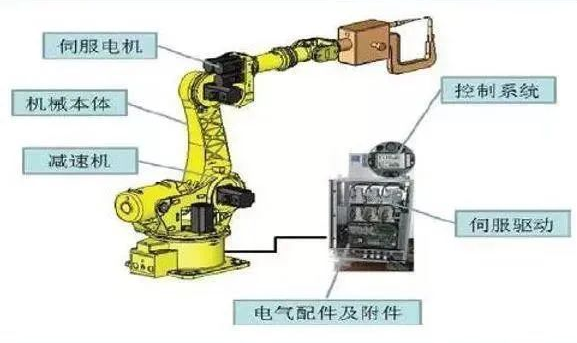
 1. Mechanical StructureThe basic structure of an industrial robot includes the body, arm, wrist, and fingers. These components together form the robot’s motion system, allowing it to achieve precise positioning and movement in three-dimensional space.– Body: The body is the main part of the robot, usually made of high-strength steel, used to support other components and provide internal space to accommodate various sensors, controllers, and other equipment.– Arm: The arm is the main part of the robot that executes tasks, usually driven by joints to achieve multi-degree-of-freedom movement. Depending on the application scenario, the arm can be designed with fixed axes or extendable axes.– Wrist: The wrist is the part where the robot’s end effector contacts the workpiece, usually composed of a series of joints and links to achieve flexible gripping, placing, and operating functions.– Fingers: The fingers are part of the robot’s end effector, usually including various tools and fixtures for performing specific operational tasks.
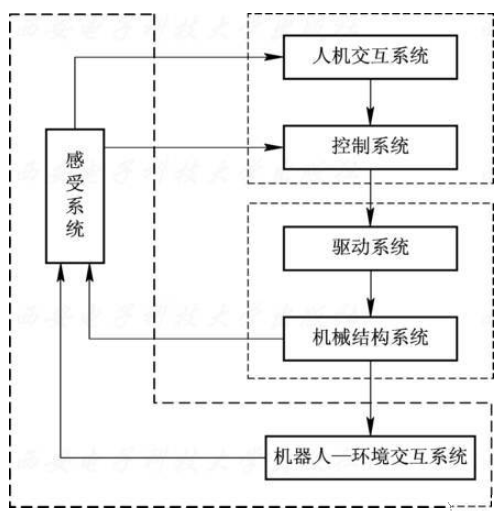
2. Control SystemThe control system of an industrial robot is its core part, responsible for receiving information from sensors, processing this information, and sending control commands to drive the robot’s movement. The control system typically includes the following components:– Controller: The controller is the brain of the industrial robot, responsible for processing signals from various sensors and generating corresponding control commands. Common types of controllers include PLC (Programmable Logic Controller), DCS (Distributed Control System), and IPC (Intelligent Control System).– Driver: The driver is the interface between the controller and the motor, responsible for converting the control commands issued by the controller into actual motor movements. Depending on application requirements, drivers can be categorized as stepper motor drivers, servo motor drivers, and linear motor drivers.– Programming Interface: The programming interface is the tool for users to interact with the robot system, typically including computer software, touch screens, or dedicated control panels. Through the programming interface, users can set the robot’s motion parameters, monitor its operating status, and diagnose and handle faults.3. SensorsIndustrial robots rely on various sensors to obtain information about their surrounding environment to perform correct positioning, navigation, and obstacle avoidance tasks. Common types of sensors include:– Vision Sensors: Vision sensors are used to capture images or video data of target objects, such as cameras and LiDAR. By analyzing this data, robots can achieve object recognition, positioning, and tracking functions.– Force/Torque Sensors: Force/torque sensors are used to measure the external forces and torques acting on the robot, such as pressure sensors and torque sensors. This data is crucial for the robot’s motion control and load monitoring.– Proximity/Distance Sensors: Proximity/distance sensors are used to measure the distance between the robot and surrounding objects to ensure a safe range of movement. Common proximity/distance sensors include ultrasonic sensors and infrared sensors.– Encoders: Encoders are sensors used to measure rotational angles and position information, such as photoelectric encoders and magnetic encoders. By processing this data, robots can achieve precise position control and trajectory planning.4. Communication InterfacesTo achieve collaborative work and information sharing with other devices, industrial robots typically need to have certain communication capabilities. Communication interfaces can connect the robot with other devices (such as other robots on the production line, material handling equipment, etc.) and upper management systems (such as ERP, MES, etc.), enabling data exchange and remote control functions. Common types of communication interfaces include:– Ethernet Interface: The Ethernet interface is a general-purpose network interface based on IP protocol, widely used in the field of industrial automation. Through the Ethernet interface, robots can achieve high-speed data transmission and real-time monitoring with other devices.– PROFIBUS Interface: PROFIBUS is an internationally standardized fieldbus protocol widely used in industrial automation. The PROFIBUS interface enables fast and reliable data exchange and collaborative control between different devices.– USB Interface: The USB interface is a universal serial communication interface that can be used to connect input devices like keyboards and mice, as well as output devices like printers and storage devices. Through the USB interface, robots can achieve interactive operations and information transmission with users.In summary, a complete industrial robot consists of multiple parts, including mechanical structure, control system, sensors, and communication interfaces. These components work together to enable the robot to perform various high-precision and high-speed tasks in complex industrial production environments. With the continuous development of technology and the expanding application demands, industrial robots will continue to play a vital role in modern manufacturing.
☞Source:Mechanical Engineering Review ☞Editor: You Xiaoxiu☞Reviewer: Wang Ying
☞Advertising Cooperation: Sun Ha 13811718902
Statement: If any videos, images, or texts used in this article involve copyright issues, please notify us immediately, and we will confirm the copyright based on the proof you provide and pay remuneration according to national standards or delete the content immediately!
Statement: If any videos, images, or texts used in this article involve copyright issues, please notify us immediately, and we will confirm the copyright based on the proof you provide and pay remuneration according to national standards or delete the content immediately!