The rapid development of the field of robotics and the continuous emergence of new research areas have led me to recommend this set of “Robot Handbook, 2nd Edition” consists of three volumes, covering the basics of robotics, robotics technology, and robotics applications.This book gathers the collective wisdom of numerous active scientists and researchers, fully reflecting the unique comprehensive reference material of both foundational and cutting-edge developments in the discipline. Since its publication, the handbook has been very successful and has received widespread acclaim in the industry. New researchers are continually attracted to robotics technology, contributing beneficially to the further development of this interdisciplinary field.The entire handbook consists of a total of 7 parts and 80 chapters, written by 229 authors, spanning over 2300 pages, including 1375 illustrations and 9411 references. It has consistently been a bestseller among all engineering books published by Springer, ranking first in chapter download rates (nearly 40,000 annually). In 2011, it ranked fourth among all Springer book downloads. In February 2009, the handbook was awarded the PROSE Award for Outstanding Physical Science and Mathematics by the Association of American Publishers (AAP), as well as the Engineering & Technology Award.Volume 1: Basics of Robotics
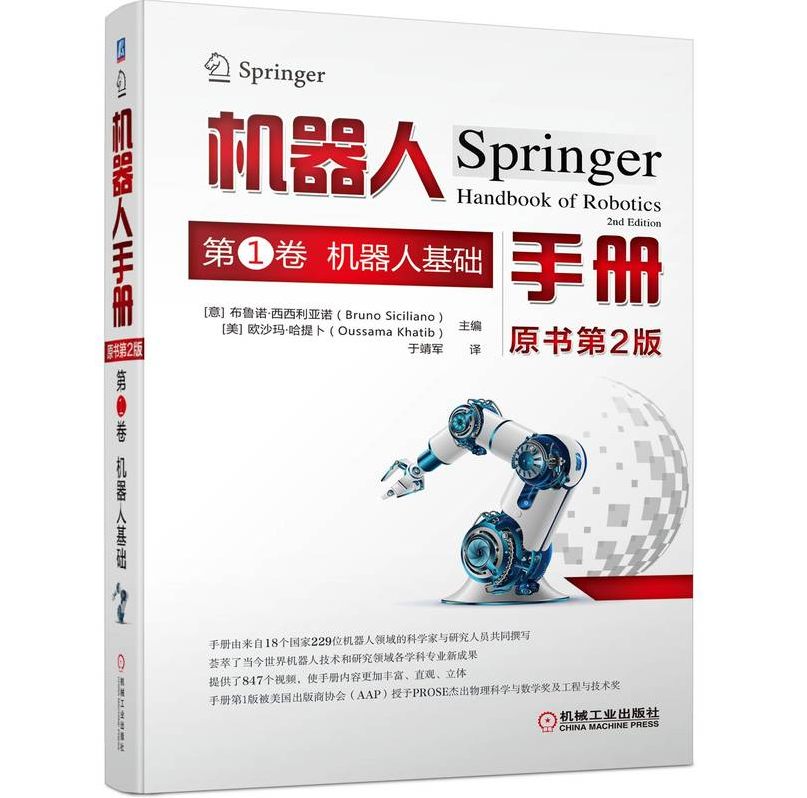
Click the image to purchase
Volume 1 of the “Robot Handbook” (2nd Edition) is divided into two parts::Basics of Robotics and Robotics Design.Part 1 The Basics of Robotics primarily introduces the fundamental principles and methods used for the modeling, design, and control of robotic systems, including topics such as kinematics, dynamics, mechanisms and drives, sensing and estimation, model identification, motion planning, motion control, force control, redundant robots, robots with flexible elements, robotic architectures and programming, behavior-based systems, artificial intelligence reasoning methods for robots, and robot learning. These topics form the foundation for subsequent chapters and are expanded upon and applied to specific robotic systems.Part 2 Robotics Design mainly discusses topics related to the design and modeling of actual physical models of robots, elaborating on both robot design and performance evaluation, and introducing various issues related to the design, modeling, motion planning, and control of physical implementations, including limb systems, parallel mechanisms, robotic hands, snake-like robots, continuum robots, soft robots, modular robots, bionic robots, wheeled robots, underwater robots, flying robots, and micro-nano robots. The themes covered in this part are not only essential for constructing actual physical models of robots but are also crucial for generating and controlling robotic actions, as well as for operating in the intended manner.

Volume 2: Robotics Technology
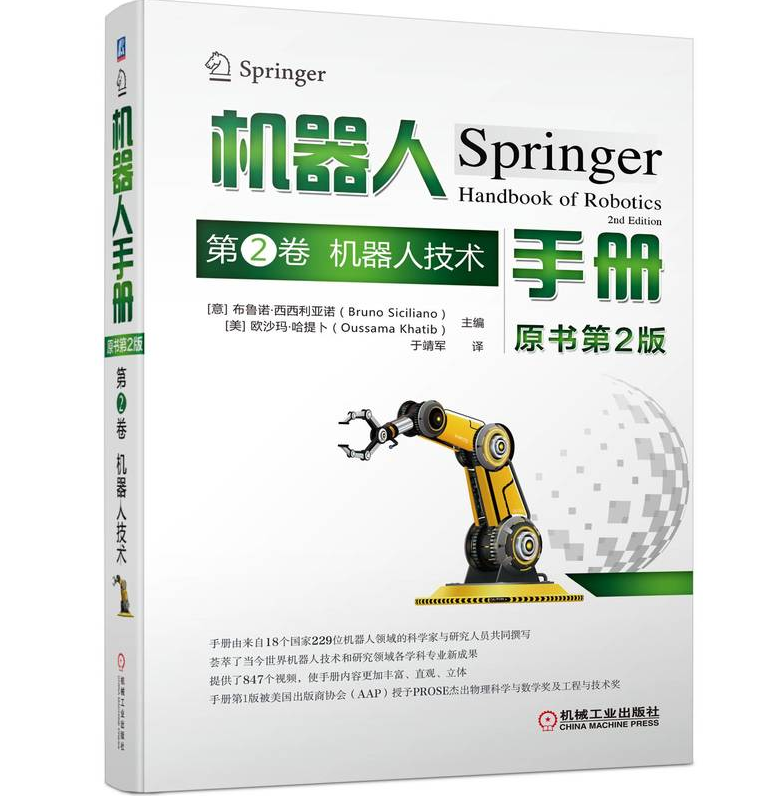
Click the image to purchase
Volume 2 of the “Robot Handbook” (2nd Edition) is divided into three parts::Sensing and Perception, Manipulation and Interaction, Mobility and Environment..
Part 3 Sensing and Perception details the various forms of robot perception and cross-temporal and spatial sensor data fusion techniques, primarily used for generating robot models and external environments, covering commonly used robot sensors such as force and tactile sensors, inertial sensors, GPS and odometers, sonar sensors, distance sensors, etc., as well as 3D visual navigation and grasping, visual object class recognition, visual servoing, and multi-sensor data fusion.
Part 4 Manipulation and Interaction explains technologies related to robot manipulation and interaction, where robotic manipulation technology mainly involves motion for task-oriented operations, contact modeling and manipulation, grasping, cooperative manipulation arms, mobile manipulation, and active perception for manipulation; robotic interaction technology focuses on tactile technology, teleoperated robots, and networked robots.
Part 5 Mobility and Environment introduces environmental modeling, simultaneous localization and mapping, motion planning and obstacle avoidance, and robots in different operational environments, including legged robots, wheeled robots, robots in rugged terrain, underwater robots, and flying robots, along with their modeling and control, as well as multi-mobile robot systems.
Volume 3: Robotics Applications
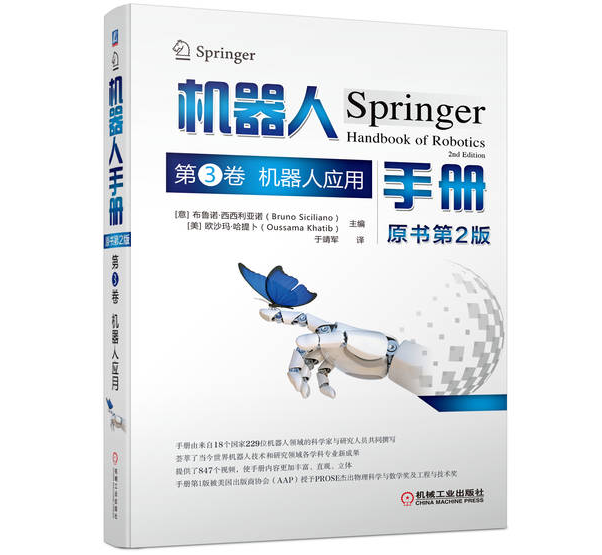
Click the image to purchase
Volume 3 of the “Robot Handbook” (2nd Edition) is divided into two parts:Task-oriented Robots and Robots and Humans.
Part 6 Task-oriented Robots primarily introduces robots that work in specific environments, including industrial robots, space robots, agricultural robots, construction robots, hazardous environment robots, mining robots, rescue robots, surveillance and security robots, intelligent vehicles, medical robots and computer-integrated surgery, rehabilitation and healthcare robots, domestic robots, and competition robots, covering hardware design, control perception, and user interfaces, as well as the economic/social factors driving the development of these applications.
Part 7 Robots and Humans mainly introduces some new findings related to human-robot interaction, including humanoid robots, human motion reconstruction, physical interaction between humans and robots, human-robot enhancement, cognitive human-robot interaction, social robots, socially assistive robots, learning from humans, bionic robots, evolutionary robots, neural robots, and perceptual robots, as well as educational robots and robotics ethics, all of which are crucial for creating robots that operate in human-centered environments.
-End-
☞Source: Jinfeng Mall, Reprint Platform: WeChat Public Account ☞Editor: Ma Hongjia,Reviewer: Han Jingchun ☞Media Cooperation: 010-88379798 ext. 520 ☞Metal Processing Magazine’s only submission website:http://tougao.mw1950.cn/