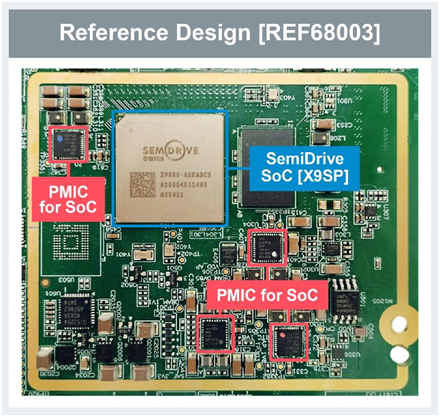
Global semiconductor manufacturer ROHM (headquartered in Kyoto, Japan) announced a collaboration with leading automotive chip company, Sintronic Technology, to jointly develop the reference design “REF68003” aimed at smart cockpits. This reference design primarily covers Sintronic Technology’s smart cockpit SoC*1 “X9SP” product, which is equipped with ROHM’s PMIC*2 products and was showcased at the 2025 Shanghai Auto Show at Sintronic Technology’s booth.
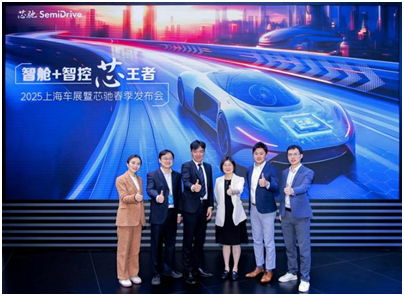
Photo from the 2025 Shanghai Auto Show at Sintronic Technology’s booth. Right three: Sintronic Technology Founder Qiu Yujing; Left two: Sintronic Technology Founder CTO Sun Mingle; Left three: ROHM Semiconductor (Shanghai) Co., Ltd. Chairman Yonezawa Hideo.
Sintronic Technology’s X9 series products comprehensively cover various cockpit application scenarios from entry-level to flagship, including instrument clusters, IVI, cockpit domain control, and cabin integration, with over a million units shipped and rich mass production experience, resulting in a mature ecosystem. According to the latest data from the GaiShi Automotive Research Institute (domestic passenger car insurance volume), from January to March 2025, among models priced over 100,000 yuan, Sintronic Technology’s X9 series cockpit chips (including instrument clusters, central control, and domain control) ranked first in domestic installations, covering over 50 mainstream models from automakers such as SAIC, Chery, Changan, FAW, GAC, BAIC, Dongfeng Nissan, and Dongfeng Honda, as well as many models exported overseas.
Sintronic Technology and ROHM began technical exchanges in 2019 and have been committed to the collaborative development of smart cockpit applications. In 2022, the two parties signed an advanced technology development cooperation agreement in the automotive field. To date, they have jointly developed reference designs for smart cockpits by combining Sintronic Technology’s automotive SoCs “X9H”, “X9M”, and “X9E” with ROHM’s PMIC, SerDes IC*3, and LED driver ICs.
In 2025, targeting mid-to-high-end smart cockpits, Sintronic Technology and ROHM jointly developed a new reference design “REF68003” based on the automotive SoC “X9SP”. ROHM provides PMICs for SoCs, including “BD96811F44-C”, “BD96806Q04-C”, “BD96806Q05-C”, and “BD96806Q06-C”, which comply with ISO 26262 and ASIL-B*4, aiding in the realization of various high-performance automotive applications. Moving forward, ROHM will continue to develop products suitable for automotive infotainment systems, contributing to the enhancement of vehicle convenience and safety.
Sintronic Technology CTO Sun Mingle stated: “With the rapid development of automotive intelligence, the requirements for automotive electronics and components are also increasing. The X9SP is the core flagship product of Sintronic’s X9 series high-performance cockpit SoCs, designed for smart cockpits and cross-domain integration scenarios, featuring high performance and reliability, particularly suitable for integrated cabin solutions. The newly developed reference design combines ROHM’s PMIC with the X9SP to enhance the overall system’s stability and energy efficiency. We look forward to continuing our collaboration with ROHM to provide various innovative in-vehicle solutions in the future.”
ROHM Director and Senior Executive Officer Tetsuo Tateishi expressed: “We are very pleased to collaborate with the leading company in the automotive SoC field, Sintronic Technology, to develop new reference designs. The smart cockpit, which integrates various functions such as infotainment and ADAS function monitoring, is accelerating in popularity, especially in the next generation of electric vehicles, where the role of PMICs and other automotive analog semiconductor products is becoming increasingly important. The PMICs provided by ROHM for SoCs are power ICs that can be flexibly applied to next-generation automotive power supplies while meeting functional safety requirements. In the future, by deepening our communication and collaboration with Sintronic Technology, ROHM will accelerate the development of products that support the multifunctional development of next-generation smart cockpits, contributing to the further advancement of the automotive industry.”
Background
In recent years, the smart cockpit, which is becoming more widespread, not only integrates various functions such as instrument clusters and infotainment systems but also accelerates the adoption of large displays. At the same time, the processing power required by automotive SoCs is also increasing, necessitating that power ICs such as PMICs, which serve as core components for power supply, support high current and operate efficiently.
ROHM provides PMICs for SoCs that not only offer high stability and efficiency but also allow for arbitrary output voltage settings and sequencing control through internal memory (OTP). With minimal circuit changes, power systems can be constructed for various vehicle models, contributing to reducing development time for automotive manufacturers.
About the Reference Design “REF68003” Equipped with “X9SP” and ROHM Products
“REF68003” is equipped with Sintronic Technology’s smart cockpit SoC “X9SP” and ROHM’s PMIC for SoCs. Currently, this reference design has been validated by Sintronic Technology. Utilizing this reference design, a smart cockpit achieving safety level ASIL-B can be realized. Additionally, the PMIC for SoCs provided by ROHM can use internal memory (OTP) for arbitrary output voltage settings and timing control, allowing for efficient and flexible power supply according to specific circuit requirements.
This reference design utilizes Sintronic Technology’s proprietary hardware virtualization support function, enabling multiple operating systems (OS) to run on a single SoC. At the same time, using a hardware security management module, commands from the OS can be transmitted to the SoC and GPU. Furthermore, by replacing it with other pin-compatible Sintronic Technology SoCs, specifications can be quickly changed without altering the circuit.
About Sintronic Technology
Sintronic Technology is a leader in all-scenario intelligent vehicle chips, focusing on providing high-performance, high-reliability automotive-grade chips that cover the smart cockpit and intelligent vehicle control fields, encompassing the most critical chip categories in future automotive electronic and electrical architectures. Sintronic’s entire series of chips are in mass production, with shipments exceeding 8 million units. Sintronic currently has over 200 fixed-point projects, serving more than 260 customers, covering over 90% of domestic OEMs and some international mainstream automakers, including SAIC, Chery, Changan, Dongfeng, FAW, Nissan, Honda, Volkswagen, and Li Auto.
About ROHM
ROHM is a semiconductor electronic component manufacturer established in 1958. Through a global development and sales network, it provides high-quality and high-reliability ICs, discrete semiconductors, and electronic component products for automotive and industrial equipment markets, as well as consumer electronics, communications, and many other markets. In the fields of power electronics and analog, where ROHM excels, its advantage lies in providing comprehensive optimization solutions for systems, including silicon carbide power devices and driver ICs that fully leverage their performance, as well as transistors, diodes, resistors, and other peripheral components.
Terminology Explanation
*1) SoC (System-On-a-Chip)
An integrated circuit that incorporates a CPU (central processing unit), memory, interfaces, etc. It is widely used in automotive, consumer, and industrial devices to achieve high processing power, power efficiency, and space reduction.
*2) PMIC (Power Management IC)
An IC that contains multiple power systems and integrates power management and timing control functions on a single chip. Compared to circuit structures composed of standalone DC-DC converter ICs, LDOs, and discrete components, it can significantly save space and shorten development cycles, making it a commonly used device in applications with multiple power systems in both automotive and consumer electronics.
*3) SerDes IC
A general term for two ICs used in pairs for high-speed data transmission and communication mode conversion. The serializer converts data into a format suitable for high-speed transmission (converting parallel data into serial data), while the deserializer converts the transmitted data back to its original format (converting serial data back into parallel data).
*4) ISO 26262, ASIL (Automotive Safety Integrity Level)
ISO 26262 is an international standard for functional safety related to automotive electronic and electrical systems, officially issued in November 2011. It is a standardized development process aimed at achieving “functional safety”. It requires calculating the fault risk in automotive electronic controls and embedding mechanisms to reduce that risk as one of the functions in the system. This standard covers the entire lifecycle of vehicle development, from the vehicle concept phase to system, ECU, embedded software, device development, production, maintenance, and disposal phases. ASIL is a risk classification system defined in ISO 26262, divided into four levels, with higher risk levels requiring higher functional safety standards.