Click the blue text
Follow us
In November 2018, the Shanghai Stock Exchange established the Science and Technology Innovation Board (STAR Market); in July 2019, the STAR Market officially opened, with the first 25 companies ringing the bell for listing. At the inception of the STAR Market, it coincided with a time of geopolitical turbulence, and the state endowed the STAR Market with significant political missions. The series of institutional documents for the STAR Market also express its positioning at a high level: facing the world’s technological frontier, the main economic battlefield, and major national needs. As of now, nearly 600 companies have been listed on the STAR Market. Among these nearly 600 enterprises, we will systematically review the semiconductor listed companies. Today, we will look at this company: Ankai Microelectronics (688620).
1. Who is Ankai Micro?
Currently, Internet of Things (IoT) technology is thriving, especially the intelligent IoT (AIoT) formed by deep integration with artificial intelligence (AI), which is penetrating various aspects of the social economy at an unprecedented speed, creating a huge demand for various core chips, especially system-on-chip (SoC) solutions.
Guangzhou Ankai Microelectronics Co., Ltd. (hereinafter referred to as “Ankai Micro”), as a chip design company listed on the STAR Market, is an active participant in this wave. Ankai Micro focuses on the design of core chips for IoT smart hardware, dedicated to providing high-performance, low-power SoC chip solutions for the rapidly growing IoT market. On June 13, 2023, Ankai Micro successfully listed on the STAR Market of the Shanghai Stock Exchange (stock code: 688620.SH), opening a new chapter in the development supported by the capital market.
2. Development History of Ankai Micro
The development of Ankai Micro can be roughly divided into three main stages: early exploration and technological accumulation, strategic focus and market breakthroughs, and the new development stage after listing on the STAR Market.
1. Early Exploration and Technological Accumulation (2001-2009)
The company was established in 2001 (formerly known as Ankai Limited) and until 2009, mainly engaged in the design of application processor chips. This period was a key stage for Ankai Micro’s technological accumulation, with a long 9 years of technological foundation laying a solid technical basis and talent reserve for the company’s subsequent successful transformation into the IoT SoC field.
2. Strategic Focus and Market Breakthrough (2010-2022)
Since 2010, in response to the rise of the IoT market, Ankai Micro keenly adjusted its strategic direction, shifting its business focus to the IoT smart hardware SoC chip field. During this stage, the company successfully commercialized its products and expanded its market. During this period, Ankai Micro successively launched and continuously iterated high-level chip products such as IoT camera chips and IoT application processor chips, meeting market demands for intelligence, high definition, and low power consumption. At the same time, it gradually entered the supply chain systems of well-known domestic and foreign customers, including China Mobile, TP-LINK, Hangzhou Tuya Smart, Entropy Technology, and Anjubao, achieving leading market shares in niche markets such as home cameras and intercom systems.
3. Listing on the STAR Market (2023-Present)
In June 2023, Ankai Micro successfully listed on the STAR Market, marking a new milestone in the company’s development, raising approximately 925 million RMB in net funds, mainly directed towards “chip R&D upgrades and industrialization projects in the IoT field”; in terms of technological iteration, the company has begun research and development of advanced 12nm FinFET processes.
3. Ankai Micro’s Business and Products
1. Main Business and Technical Principles
Ankai Micro’s main business is the R&D, design, final testing, and sales of core SoC chips for IoT smart hardware. SoC (System-on-Chip) technology integrates microprocessors (CPU), memory, and various interfaces and functional modules (such as image signal processors (ISP), video codecs, audio processors, network interfaces, human-computer interaction interfaces, etc.) into a single chip. This highly integrated design allows SoC chips to run complete operating systems and provide powerful computing, control, and connectivity capabilities for terminal devices, serving as the “brain” for IoT devices.
The core SoC chips designed by the company are widely used in smart home, smart security, smart office, and industrial IoT fields. In addition to commonly used IPs, they also integrate multiple functional IPs such as ISP, NPU, video codecs, audio codecs, encryption modules, and storage modules, serving as the main control chip for IoT smart terminals, responsible for data computation and control and management of peripheral components. For example, the internal integration schematic of the IoT camera chip AK39Av100 series is as follows:
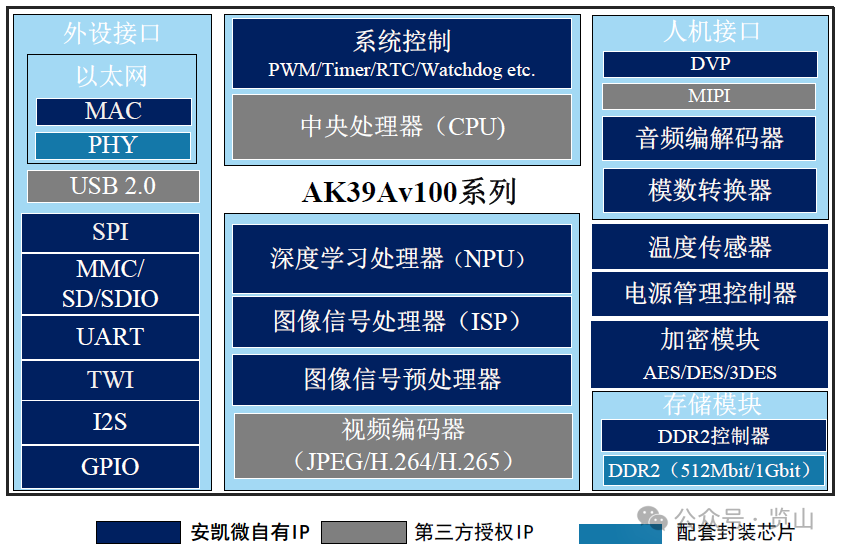
The company’s main product lines include two categories: IoT camera chips and IoT application processor chips. These SoC chips integrate CPU, image signal processing (ISP), audio and video encoding and decoding, storage control, various peripheral interfaces, and artificial intelligence acceleration units, providing core processing capabilities for various terminal devices in smart homes, smart security, smart offices, and industrial IoT.
2. Core Product Matrix and Featured Products
(1) IoT Camera Chips: Mainly used in smart home (such as home network cameras, smart doorbells), smart security (such as surveillance cameras), etc. Featured products include the AK39Av100 series chips, which use advanced 22nm process technology, integrate the company’s self-developed image signal processing (ISP) technology, possess 0.5 TOPS of intelligent computing power, support video resolutions up to 6 million pixels, while maintaining a low typical power consumption (approximately 300mW).
(2) IoT Application Processor Chips: Mainly used in smart office (such as human-computer interaction interfaces for smart conference systems), industrial IoT, smart buildings (such as intercom systems), etc.
3. Application Fields and Major Clients
Ankai Micro’s chip products are widely used in smart home, smart security, smart office, and industrial IoT fields, which are rapidly growing AIoT niche markets. With reliable product performance and high-quality technical services, the company has accumulated a batch of high-quality customer resources: (1) its IoT camera chips have entered the supply chain systems of well-known domestic and foreign enterprises or their ODM/OEM manufacturers, such as China Mobile, TP-LINK, Hangzhou Tuya Smart, Motorola Home, and Guangzhou Jiua. (2) Its IoT application processor chips are widely used in products of well-known terminal brands such as Entropy Technology, Anjubao, Xiamen Lilin, Ningbo Deli, and Fuzhou Guanlin.
4. How Strong is Ankai Micro’s Listing on the STAR Market?
1. Market Position and Competitive Landscape
In the field of IoT SoC chips, especially in the mid-to-low-end market, domestic chips have gained certain competitiveness. Ankai Micro, as one of them, is an important participant and contributor in the domestic substitution process, especially in the cost-sensitive and high-demand consumer IoT device market.
In 2021, Ankai Micro’s market share in the global security camera chip field was 2.33%. Although the overall share is not high, it performs outstandingly in niche markets: its IoT camera chips hold a leading position in the home camera market (25.57% shipment share in 2021) and its IoT application processor chips have over 50% market share in the intercom field in 2021.
2. Core Technologies
After years of accumulation, Ankai Micro has built a core technology system that includes SoC chip design technology, self-developed ISP (image signal processing) technology, video encoding and decoding technology, audio processing technology, wireless communication technology, low-power system technology, and machine learning technology. Among them, the company’s self-developed ISP technology has been iterated to the fifth generation, which is key to improving the image quality of camera products.
5. Conclusion and Outlook
As a member of China’s semiconductor industry focusing on IoT SoC chips, Ankai Micro has occupied a place in the wave of domestic substitution with over twenty years of technological accumulation and deep cultivation in niche markets. Listing on the STAR Market has brought new development opportunities, as well as higher market expectations and more severe challenges. In the future, whether Ankai Micro can seize the huge opportunities of AIoT industry development, continue technological innovation, effectively mitigate operational risks, and achieve a leap from a niche market leader to an important industry participant is worth continuous market attention and expectation.
THE
END

Image materials are sourced from the internet, copyright belongs to the original creator.
If there is any infringement, please contact for deletion.
For more exciting content, please follow the “Lanshan” public account.