1️⃣ Introduction: Understanding CodeBERT in One Sentence
Translating “The injection molding machine is broken” into “First replace the thermocouple, then set the PID” using an AI large model.
| Dimension | 2025 Industrial Practice |
| Parameter Count | 125 M (LoRA fine-tuning is sufficient) |
| Corpus | +500,000 enterprise work orders |
| Typical ROI | Halved downtime |
2️⃣ Functional Architecture:
2-1 Functional Matrix
| Function Domain | Input Example | Output Example | Applicable Position |
| Maintenance Script Generation | Work order text | Python function | Equipment Maintenance |
| Process Parameter Generation | Verbal description | JSON parameters | Process Engineer |
| Defect Report Generation | Defect image + text | Markdown report | Quality Department |
| Ladder Diagram Generation | Natural language | LD ladder diagram | Electrical Engineer |
2-2 Scenario-Capability Correspondence Table
| Industrial Scenario | Required Capability | CodeBERT Output Form | Next Action |
| Injection Molding Machine | NL→Python script | Maintenance script.py | Copy to Jetson for execution |
| Laser Cutting | NL→G-code | cut_120mm.gcode | Paste into laser machine |
| PLC Interlock | NL→LD | ladder.ld | Download to PLC |
3️⃣ Technical Architecture: One Diagram + Layer-by-Layer Breakdown
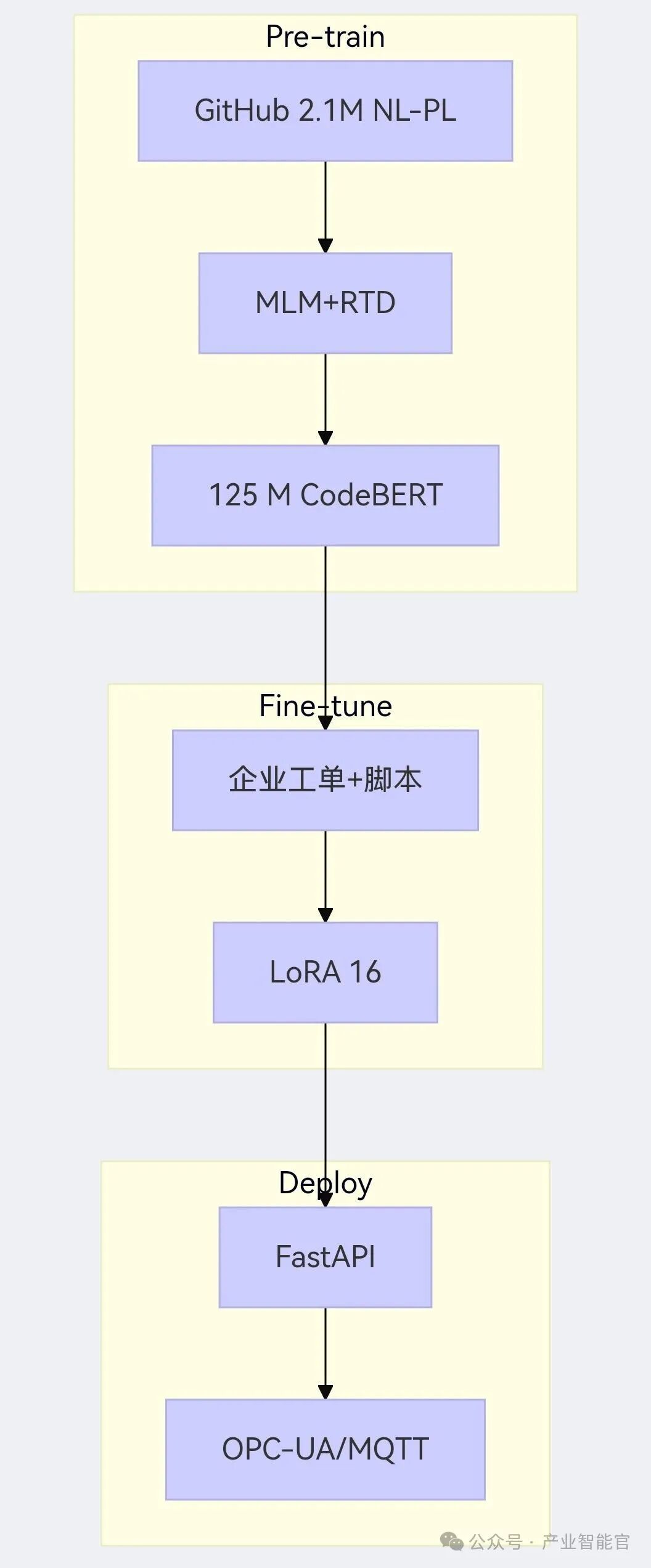
| Layer | Chinese Name | English Name | Function in One Sentence | Example Code |
| Input Layer | Natural Language + Code | NL & PL Tokens | Tokenizing “The injection molding machine is broken” | `tokenizer(“注塑机坏了”)` |
| Embedding Layer | Word Vector | Embedding | Transforming tokens into 768-dimensional vectors | `nn.Embedding(vocab, 768)` |
| Attention Layer | Multi-Head Attention | Multi-Head Attention | Identifying the relationship between “injection molding machine” and “thermocouple” | `nn.MultiheadAttention(768, 12)` |
| Feed Forward Layer | Fully Connected | Feed Forward | Non-linear transformation | `nn.Linear(768, 3072)` |
| Task Head | Three Task Heads | MLM+RTD+CPT | Simultaneously learning “fill in the blanks” and “true or false” tasks | `CrossEntropyLoss()` |
4️⃣ Data Architecture: From GitHub to PLC
4-1 Data Flow Diagram

4-2 Data Table
| Data Type | Source | Cleaning Rules | Storage | Lifecycle |
| Open Source Code | GitHub | Fork filtering + License whitelist | S3 Glacier | Permanent |
| Enterprise Work Orders | MES Logs | Desensitization + AST parsing | Delta Lake | 3 years |
| Sensor Logs | OPC-UA | Time series alignment + Denoising | TimescaleDB | 1 year |
5️⃣ Application Architecture: 10 Implementation Templates
| Template ID | Scenario Name | Input Example | Output Example | Deployment Method | Next Action |
| APP-01 | Injection Molding Maintenance | “Nozzle temperature abnormal” | repair.py | FastAPI + Docker | `python repair.py` |
| APP-02 | Laser Cutting | “Right side crack 120 mm” | cut_120mm.gcode | OPC-UA Dispatch | Paste into laser machine |
| APP-03 | PLC Ladder Diagram | “Temperature > 90℃ start fan” | ladder.ld | Codesys IDE | Download to PLC |
| APP-04 | MES SQL | “Yesterday’s output” | daily.sql | Grafana Query | Paste to BI dashboard |
| APP-05 | Predictive Model | “Future 1 h failure probability” | predict_model.pt | PyTorch Inference | `torch.load()` |
| APP-06 | Predictive Maintenance | “Bearing wear” | maintenance_schedule.json | MQTT → SCADA | Automatic scheduling |
| APP-07 | Equipment Inspection | “Inspection of machine 2” | checklist.md | WeChat Mini Program | Scan to confirm |
| APP-08 | Quality Traceability | “Batch number 20240801” | trace.json | Blockchain Write | Scan to verify |
| APP-09 | Energy Consumption Optimization | “Night shift energy-saving mode” | energy_plan.json | REST → EMS | Automatic scheduling |
| APP-10 | New Employee Training | “Injection molding novice” | onboarding.ipynb | JupyterHub | Online learning |
6️⃣ Risks and Future
| Risk | Countermeasure |
| Hallucination Steps | Confidence threshold + Manual review |
| Data Privacy | Local deployment + Federated learning |
| Liability Attribution | Blockchain logs + Insurance coverage |
7️⃣ One-Page Quick Reference (Printable)
| What do you want to do | Copy and paste commands |
| Install Environment | `pip install transformers peft torch` |
| Download Model | `from transformers import AutoTokenizer, AutoModel; tok=AutoTokenizer.from_pretrained(‘microsoft/codebert-base’)` |
| Fine-tune | `LoraConfig(task_type=”CAUSAL_LM”, r=16)` |
| Deploy | `uvicorn app:app –host 0.0.0.0` |
8️⃣ Conclusion
CodeBERT has been widely implemented in industrial automation, covering the entire chain of maintenance, quality inspection, processes, traceability, and energy consumption, and is edge-friendly with high ROI.
Let your equipment understand human language.
Six Core Advantages of CodeBERT in the Field of Industrial Automation
1️⃣ Bilingual Understanding Advantage: Locate faults with just one sentence
Technical Point: CodeBERT understands both natural language descriptions and source code/logs, mapping “Injection molding machine nozzle temperature abnormal 320℃” to the corresponding function check_thermocouple().
Case Study: Baosteel thick plate used 500,000 defect images + log text → scrap rate 3% → 0.5%, annual revenue increase of 50 million
Replicable Checklist:
prompt = “Injection molding machine nozzle temperature abnormal 320℃ cannot decrease”
script = codebert.generate(prompt, max_length=128)
# Output: check_thermocouple(); replace_ssr(); calibrate_pid();
2️⃣ Low Compute Power Friendly: Edge devices can also run
Technical Point: 125 M parameters, after LoRA fine-tuning, a single Jetson Orin Nano < 100 ms latency.
Case Study: Leading home appliance manufacturer 200 injection molding machines, on-site edge box + CodeBERT → downtime 15 min → 3 min
Replicable Checklist:
docker run -p 8000:8000 nvcr.io/nvidia/l4t-pytorch:py3
pip install transformers peft
3️⃣ Output Diversity: One line of code generates multiple industrial instructions
| Output Form | Example | Downstream Device | Usage Method |
| Python Script | `check_thermocouple()` | Edge PC | `python repair.py` |
| G-code | `G01 X1200 F2000` | Laser Cutter | Paste into control panel |
| SQL Query | `SELECT * FROM temp_log WHERE ts>` | MES | Paste into BI dashboard |
| LD Ladder Diagram | `LD X0 OUT Y0` | PLC | Import into Codesys |
4️⃣ Zero-shot/Few-shot: Usable even with little data
Technical Point: 50 enterprise work orders are sufficient for LoRA fine-tuning, BLEU-42 can go live.
Case Study: A chemical park with 20,000 work orders → Fault warning 30 min in advance, 0 accidents
5️⃣ End-to-End Closed Loop: From diagnosis to execution in one step
Architecture: CodeBERT → Python → OPC-UA → PLC → Machine Action
Case Study: Wind turbine blade quality inspection → Traceability time 2 days → 10 min
6️⃣ Edge-Cloud Hybrid Deployment: Lightweight + Scalable
| Deployment Scenario | Hardware | Latency | Concurrency | Remarks |
| Single Device | Jetson Orin Nano | < 100 ms | 50 req/s | Local offline |
| Workshop Level | 4×RTX 4090 | < 10 ms | 200 req/s | Private cloud |
| Factory Level | 8×A100 | < 5 ms | 1000 req/s | Hybrid cloud |
📊 One-Page Quick Reference
| Advantages | Technical Implementation | Applicable Conditions | ROI Example |
| Bilingual Understanding | Natural language + code dual stream | Any scenario with text + code | Halved downtime |
| Low Compute Power | 125 M parameters + LoRA | Edge box is sufficient | Hardware cost 20,000 |
| Multiple Outputs | Script/G-code/SQL | PLC/Laser machine/BI can all use | One person can handle multiple roles |
| Few-shot | Fine-tuning with 50 data points | Factories with little data | Go live in 3 weeks |
| Closed Loop | Python→OPC-UA→PLC | Fully automated | Accident rate 0 |
✅ Conclusion:
In industrial automation scenarios, CodeBERT, with its five advantages of bilingual understanding, low compute power, multiple outputs, few-shot learning, and closed-loop deployment, has become one of the most economical, fastest, and versatile AI intelligent engines under the three-tier architecture of edge-workshop-factory.

Leading the Industry + Physical AI
Industry Intelligence OfficerAI–CPS
Join the Knowledge SphereIndustry Intelligence Research Institute: Industry OT technology(Automation + Machinery + Craft + Precision Benefits) and new generation IT technology(Cloud Computing + IoT + Blockchain + Big Data + AI) deeply integrated, building a “State Awareness – Real-time Cognition – Autonomous Decision-making – Precise Execution – Learning Enhancement” Physical AI; realizing industrial transformation and upgrading, driving business value innovation and creating an interconnected ecosystem.
Physical AI as the core driving force of the fourth industrial revolution, will further unleash the enormous potential accumulated by previous technological revolutions and industrial changes, creating a new powerful engine; reconstructing design, production, logistics, and service economic activities at all levels, forming intelligent new demands across various fields from macro to micro, triggering new technologies, new products, new industries, new business models; driving significant changes in economic structures, profoundly altering human production and lifestyle, and realizing a comprehensive leap in social productivity.
In today’s world where industrial intelligence technology is applied, practitioners must understand how to fully integrate Physical AI into the entire company, products, and business scenarios, leveraging Physical AI to form digitalization, networking, and intelligence, achieving a new layout for industries, a new construction for enterprises, and a refreshing rebirth.

Copyright Statement::Industry Intelligence Officer (ID: AI-CPS) recommends this article, unless it is impossible to verify, we will always credit the author and source; for copyright issues, please contact us for resolution, contact, and submission email: [email protected].