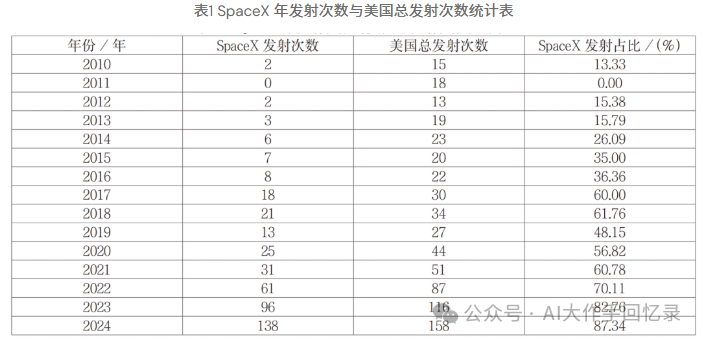
First, let’s briefly outline the logic of the commercial space industry: grand and far-reaching.1. Orbital resources are non-renewable and limited: Earth’s low Earth orbit is expected to accommodate about 60,000 satellites (CCID).2. The principle of first-come, first-served creates urgency in the arms race: The International Telecommunication Union (ITU) stipulates that the acquisition of orbital and frequency resources follows the “first-come, first-served” principle, and early-launching countries have significant advantages.3. The main competition globally is between China and the United States, with the U.S. primarily represented by SpaceX, while China is currently lagging behind.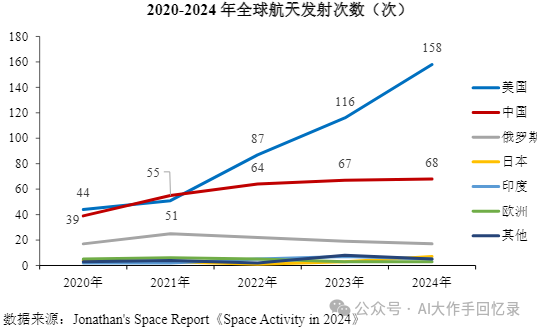
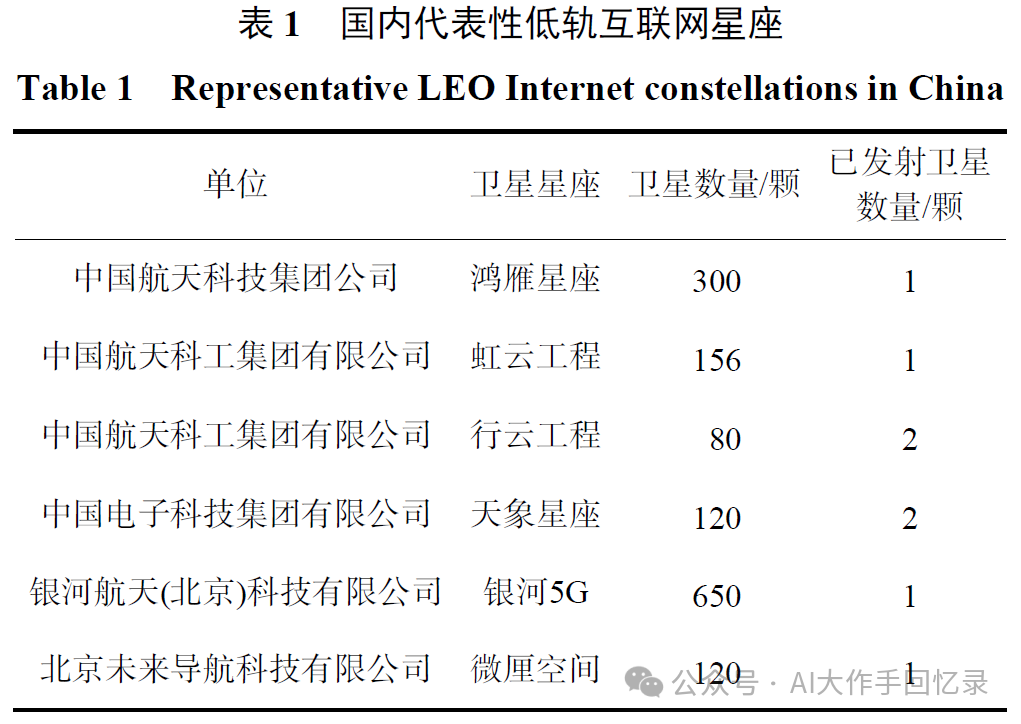
 4. China plans to launch over 20,000 satellites, but has only launched around 1,000 so far, creating market space for satellites. Previous plans such as Hongyan and Hongyun did not meet expectations in actual launch situations (data source: Journal of Beijing University of Aeronautics and Astronautics 2024.01).
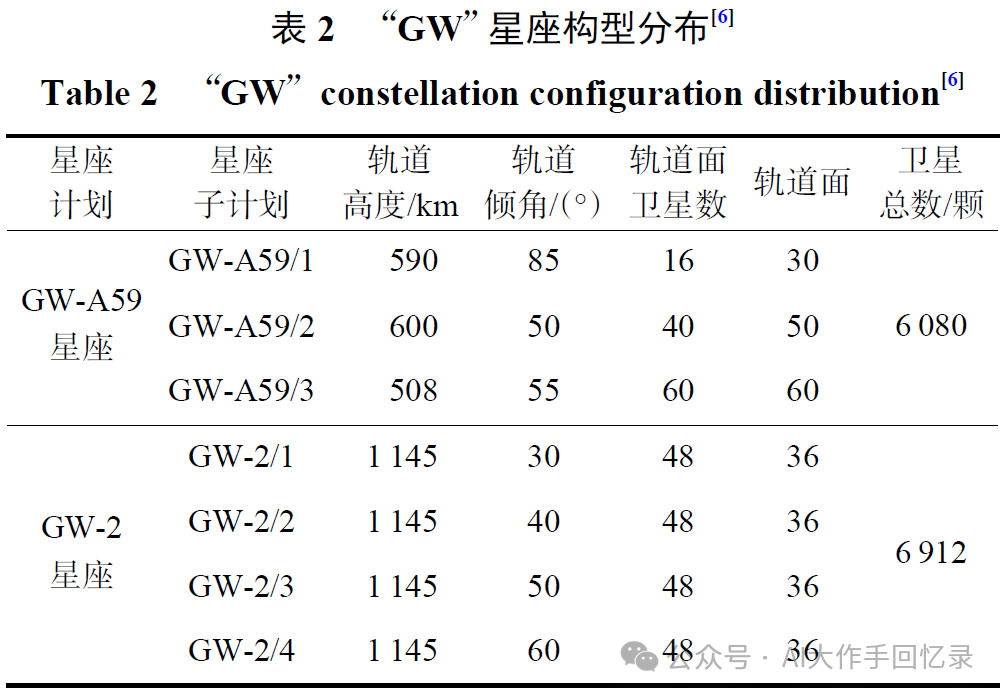
 Currently, the main projects are GW and G60, which together have plans for over 20,000 launches, but less than 1% have been completed so far. GW has applied to the ITU for two constellations totaling 12,992 satellites (as of March 25, 2019, 32 have been launched), and G60 has plans for around 15,000 satellites (as of March 25, 2019, 94 have been launched).
 5. The industry trend is to reduce rocket launch costs —-> “one rocket, multiple satellites” (enhancing rocket capacity), “rocket recovery“ Currently, SpaceX has reduced the cost of low Earth orbit to about 10,000 yuan/kg, while China’s Long March series is still in the range of 40,000–90,000 yuan/kg, and commercial rockets are mostly above 100,000 yuan/kg. After reducing launch costs, China’s satellite launches are expected to enter the “low-cost, high-frequency scaling” stage.“Rocket recovery technology maturity is an important milestone for the industry, and by the end of the year, we will enter a phase of intensive launches, potentially accelerating the development of the domestic satellite industry chain. Zhuque-3 (the first, significant): Reports indicate a planned first flight in mid to late November (next week). Prior to this, no reusable rocket in China has completed a launch mission. Zhuque-3 is expected to become China’s first operational reusable launch vehicle. Zhuque-3 is the world’s first all-stainless steel liquid oxygen-methane rocket, with the “stainless steel + methane” combination focusing more on reuse lifespan and future scalability. In terms of launch costs, Zhuque-3 aims to match Falcon 9, targeting a cost of less than 20,000 yuan per kilogram, which is roughly equivalent to Falcon 9 (about 3,000 USD/kg).
| Planned Time (Window) | Rocket Model | R&D Unit | Propellant/Diameter | LEO/SSO Capacity | Recovery Plan and Reuse Target | First Flight Recovery and Mission Attributes |
| August 2025 (window has passed/choose timing) | Zhi Shen Xing-1 | Xinghe Power | Liquid oxygen-kerosene; core stage vertical recovery plan | LEO 8t | Designed for 50 reuses (company plan) | Planned first flight at the end of August 2025 |
| September 2025 (window has passed/choose timing) | Li Jian Er Hao | CAS Space | Liquid oxygen-kerosene; core stage recoverable plan | LEO 12t/SSO 8t | First batch of missions disposable; target recovery in 2028 | Planned first flight in September 2025, including space station cargo ship mission |
| Second half of 2025 (choose timing) | Xing Yun Yi Hao | Deep Blue Aerospace | Liquid oxygen-methane | LEO 2t | “Orbit + Recovery” dual verification | Announced for first flight in mid/late 2025 |
| Mid to late November 2025 | Zhuque-3 | Landspace | Liquid oxygen-methane; rocket diameter 4.5m (stainless steel) | Disposable LEO 21.3t; recovery in flight 18.3t/return recovery 12.5t (different diameters) | Target cost ≤ 20,000 yuan/kg; one sub-stage reusable 10–20 times; land recovery plan | Announced “first flight in mid to late November”, with three missions planned for the year + first stage recovery test |
| December 2025 | Shuangquxian San Hao | Interstellar Glory | Liquid oxygen-methane | LEO 14t | Designed for ≥ 20 reuses of the first stage; first flight sea recovery route | Planned for December 2025 “orbit + sea recovery” first flight test |
| Q4 2025 (end of year) | Tianlong San Hao | Tianbing Technology | Liquid oxygen-kerosene; rocket diameter 3.8m; fairing diameter 4.2m (full carbon fiber) | LEO 17–22t; SSO 10–17t | Benchmarking Falcon 9; subsequent recovery verification, first flight not recovered | Announced first flight by the end of the year; completed full process verification for “one rocket 36 satellites” separation on the ground |
| End of 2025 capable of first flight | Yinli Er Hao | Oriental Space | Liquid oxygen-kerosene; rocket diameter 4.2m; core stage recovery reuse plan | LEO 21.5–22t; SSO 15–20t (different diameters) | Mainly focused on core stage recovery, high cost-performance ratio, and high orbit missions | Expected to be capable of first flight by the end of 2025 |
| End of 2025 | Long March 12A/B (reusable verification type) | China Aerospace Science and Technology Corporation, Eighth Academy | Liquid oxygen-methane; 4m/5m level reusable type spectrum | Not disclosed (verification type) | Completed 10km level VTVL and 75km level tests; transitioning to first launch preparation | Expected first launch (verification type) by the end of 2025 |
| 2026 | Long March 10A (new generation crewed) | China Aerospace Science and Technology Corporation, First Academy | Liquid/first stage reusable configuration | LEO 70t; can send 27t into lunar orbit | For crewed and deep space scenarios; reuse enhances efficiency and reduces costs | Expected first flight in 2026 |
| 2026 | Xing Yun Er Hao | Deep Blue Aerospace | Liquid oxygen-kerosene (company plan) | LEO 25t; SSO 18t (company plan) | Aimed at scaling commercial launches and enhancing recovery reuse capabilities | Expected first flight in 2026 |
| 2025 (choose timing) | Yuan Xing Zhe Yi Hao | Arrow Yuan Technology | Liquid oxygen-methane + stainless steel; successful sea soft landing recovery verification | LEO 7t | First flight and recovery (sea splashdown route) | Planned to be capable of first flight and recovery in 2025 |
Personal phased learning notes, for reference only.