According to reports, the Loongson 9A1000 graphics card has been under development since 2023, and the development work has now been completed, with tape-out scheduled for the third quarter of this year.
The 9A1000 is Loongson’s first graphics card, marking an important milestone for this Chinese manufacturer, which has previously focused primarily on processors (CPUs). The company positions the 9A1000 as an entry-level graphics card that supports AI acceleration. Therefore, it does not compete in the same market segment as another Chinese graphics card, the Lishan G100, which is said to rival the Nvidia GeForce RTX 4060.
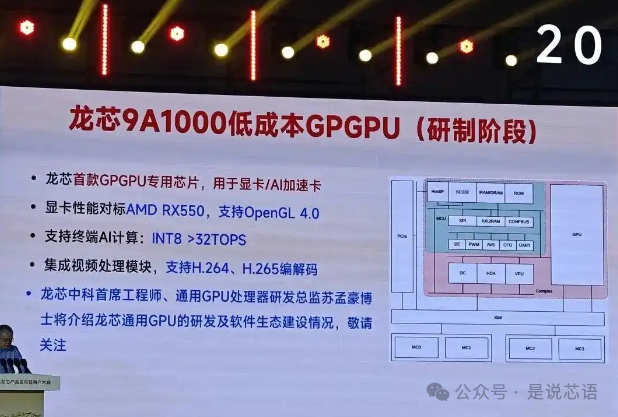
Loongson has kept details under wraps, only hinting that its performance is similar to that of the Radeon RX 550 released eight years ago.
Recent news about the 9A1000 indicates that Loongson has reduced the area of each GPU’s basic computing unit by 20%. The manufacturer also claims to have increased the operating frequency of the 9A1000 by 25% while achieving a 70% optimization in power consumption under light load scenarios. In terms of functionality, the 9A1000 is compatible with OpenGL 4.0 and OpenCL ES 3.2 APIs.
According to Loongson, the performance of the 9A1000 can be up to four times faster than the integrated graphics of the 2K3000 processor, LG200. It also offers a maximum of 40 TOPS of AI computing power, slightly lower than the 50 TOPS of the XDNA 2 NPU in the AMD Ryzen AI Max+ (codenamed Strix Halo) chip.
The 9A1000 is not Loongson’s only graphics card project. In addition to the 9A1000, Loongson also disclosed the 9A2000, an independent graphics card chip aimed at the mid-to-high-end market, which integrates four 9A1000 chips, upgrades the graphics API to OpenGL 4.6, and adds support for virtualization. In addition to supporting INT8 and INT4, the tensor units also increase support for floating-point data types such as BF16 and FP8. In terms of computing power, the single-precision floating-point performance reaches 5 TFLOPS, and the INT8 AI computing power reaches 160 TOPS, with a memory bandwidth of 256 GB/s. Furthermore, the 9A2000 supports dual-chip interconnection, allowing for an overall performance increase of up to double, reaching an internationally advanced level under the same process. This chip is expected to be released in 2027.
The company is also developing the 9A2000, which is said to be up to ten times faster than the 9A1000 and can reach the level of the GeForce RTX 2080. Loongson also plans to launch the 9A3000 as a successor to the 9A2000, but currently, there is no specification information available.
Loongson Chairman Hu Weiwu also revealed that the upcoming 9A3000 will be a higher-performance GPGPU, which could bring a 3-5 times performance improvement if advanced Xnm technology is adopted.
Currently, many Chinese companies and startups have entered the graphics card industry. However, many of these companies ultimately fail and exit the market. Therefore, the news we hear often comes from a few more representative manufacturers, such as Birun, Moer Thread, and in recent years, Loongson and Lishan Technology.
Source: Daily IC
Join the “China IC Unicorn Alliance,” please click to enter
Reprinted by Shuo Xin Yu, welcome to follow and share