C/C++ Fundamentals: In-Depth Analysis from Source Code to Hardware and the Art of System-Level Programming
Overview
In today’s era of numerous high-level programming languages, C/C++ still maintains its status as the king of system-level programming languages. The fundamental reason for their enduring popularity lies in their ability to provide absolute control over computer systems. This article will delve into how C/C++ maps step by step from source code to hardware execution, revealing its underlying principles and helping developers achieve a deeper understanding of the “why” behind the “what”.
Terminology Explanation:
Core Concept Analysis
|
Term |
In-Depth Explanation |
|
Compiler |
A complex system that translates high-level language code into machine code, including multiple stages such as lexical analysis, syntax analysis, semantic analysis, optimization, and code generation. |
|
Pointer |
A variable type that stores memory addresses, serving as the “key” for direct memory manipulation in C/C++, reflecting the underlying philosophy of “memory as address”. |
|
Stack and Heap |
Two core memory areas: the stack is used for automatically managed local variables, while the heap is used for manually managed dynamic memory, reflecting different lifecycle management strategies. |
|
Virtual Function Table |
The underlying implementation of C++’s polymorphism mechanism, achieving runtime dynamic binding through an array of function pointers, exemplifying a balance between object-oriented design and performance. |
|
System Call |
A bridge between user programs and the operating system kernel, enabling privilege level switching and kernel service calls through specific interrupts or instructions. |
C/C++ Development History and Technological Evolution
Historical Context
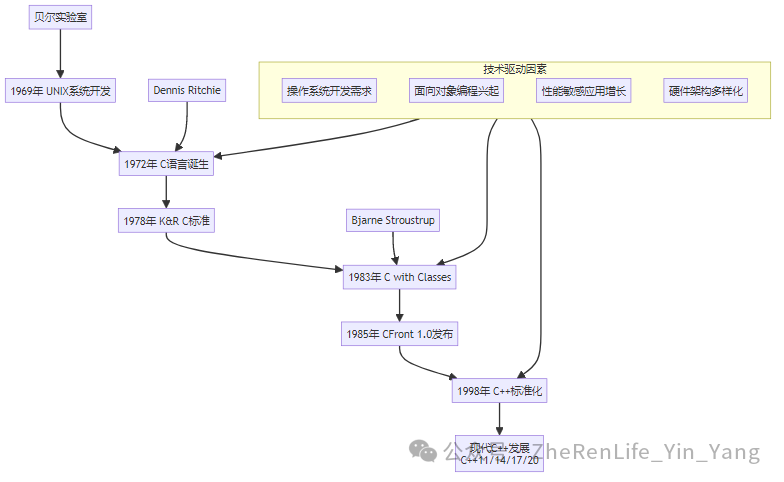
Milestone Events
-
1972: Dennis Ritchie developed the C language at Bell Labs for rewriting the UNIX operating system.
-
1983: Bjarne Stroustrup added classes, inheritance, and other features to C, creating “C with Classes”.
-
1998: The first international standard for C++, ISO/IEC 14882:1998, was released, marking the maturity of the language.
-
2011: The C++11 standard was released, introducing modern features such as automatic type deduction and lambda expressions.
-
2020: The C++20 standard was released, introducing concepts, coroutines, and other advanced abstraction mechanisms.
Compilation Process: From Source Code to Machine Instructions
Complete Compilation Chain Analysis

Technical Details of Each Stage
Preprocessing Stage
-
Processing #include directives: Recursively includes header file contents.
-
Processing #define directives: Performs macro replacement and conditional compilation.
-
Generates clean C/C++ source code, removing all preprocessing directives.
Compilation Stage
-
Lexical Analysis: Decomposes source code into a stream of tokens.
-
Syntax Analysis: Constructs an abstract syntax tree.
-
Semantic Analysis: Type checking, symbol table construction.
-
Intermediate Code Generation: Generates platform-independent intermediate representation.
-
Code Optimization: Performs various levels of optimization.
Assembly Stage
-
Converts assembly mnemonics into machine instruction encoding.
-
Generates object files containing relocation information.
-
Establishes a symbol table recording function and variable information.
Linking Stage
-
Symbol Resolution: Resolves function and variable references across files.
-
Address Relocation: Allocates final memory addresses for all symbols.
-
Library Linking: Links static and dynamic libraries.
Memory Management: The Cornerstone of Program Execution
Memory Lifecycle State Machine
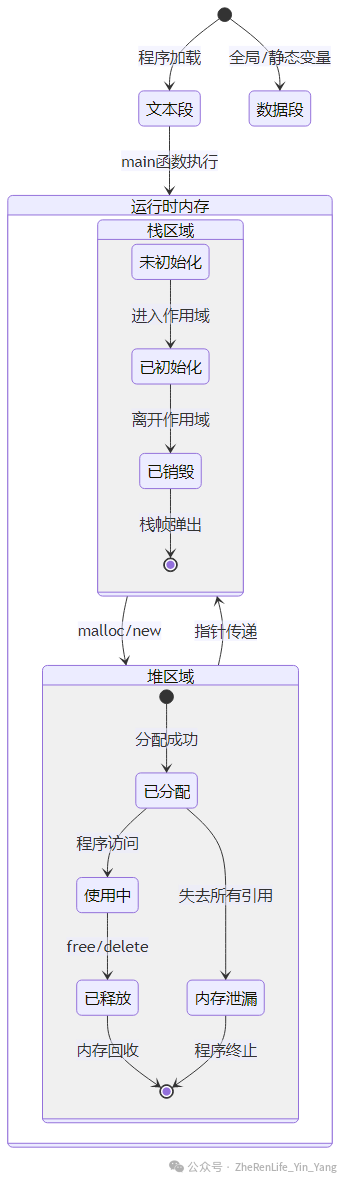
In-Depth Analysis of Memory Areas
Text Segment
-
Stores executable instructions and has read-only attributes.
-
Mapped into memory by the operating system during program loading.
-
Contains the main logic code of the program.
Data Segment
-
.data Segment: Stores initialized global and static variables.
-
.bss Segment: Stores uninitialized global and static variables, zeroed out upon loading.
Stack Memory
-
Automatically managed, following the LIFO principle.
-
Stores local variables, function parameters, and return addresses.
-
Each thread has its own independent stack space.
Heap Memory
-
Manually managed, with allocation and deallocation controlled by the programmer.
-
Lifecycle spans across function calls.
-
Needs to prevent memory leaks and fragmentation.
System Calls and Hardware Interaction Mechanisms
Complete Execution Chain Analysis
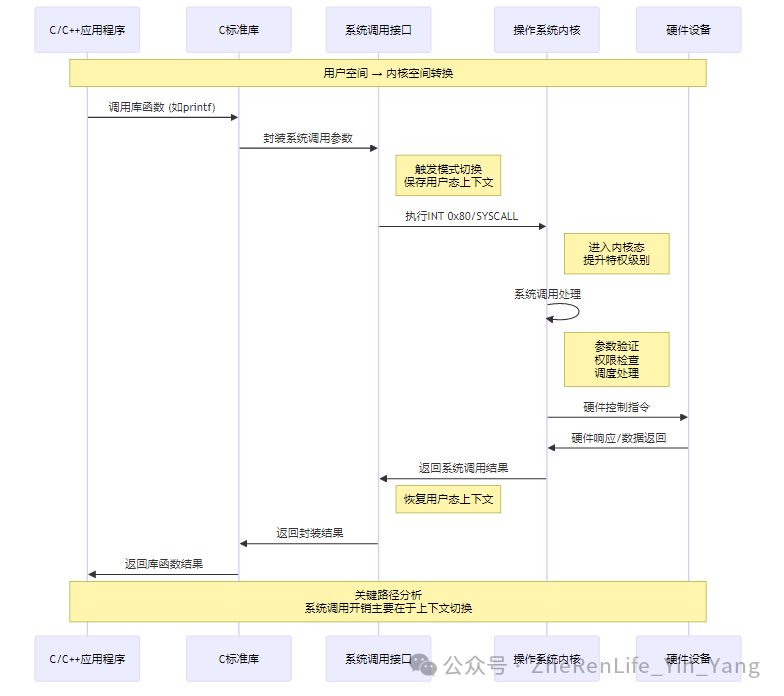
Key Technologies for Hardware Interaction
Context Switching Overhead
-
Register saving and restoring.
-
Cache invalidation and TLB flushing.
-
CPU cycle consumption during mode switching.
Optimization Strategies
-
Batch system calls to reduce switching frequency.
-
Memory-mapped files to avoid data copying.
-
Asynchronous I/O to overlap computation with I/O operations.
Authoritative References and Literature
Classic Works
-
“The C Programming Language” – Brian W. Kernighan, Dennis M. Ritchie
The bible of C language, written by the language designers themselves.
-
“The Design and Evolution of C++” – Bjarne Stroustrup
In-depth understanding of C++ design philosophy and evolution.
-
“Computer Systems: A Programmer’s Perspective” – Randal E. Bryant
Deep understanding of computer systems from a programmer’s perspective.
Technical Standards
-
ISO/IEC 9899:2018 – C18 Language Standard
-
ISO/IEC 14882:2020 – C++20 Language Standard
-
System V ABI – System-level binary interface specification
Online Resources
-
C++ Reference – The most authoritative online reference for C++.
-
GCC Documentation – Internal mechanisms of the compiler.
-
Linux man pages – Documentation for system calls.
Systematic Cognition and Mnemonics
| Core Knowledge System |
Mnemonic:
-
Four stages of compilation, preprocessing first.
-
Memory divided into four areas: stack, heap, data, and code.
-
Pointer is an address; operations must be cautious.
-
System calls interact with the kernel; hardware interaction is deep.
-
C++ objects are modeled; virtual tables implement polymorphism.
-
Performance optimization seeks control down to the bit level.
| Understanding the “why” behind the “what”. |
Understanding at the Compilation Level
-
Not only knowing how to use the compiler but also understanding the products of each stage.
-
Mastering the analysis methods for debugging symbol tables and map files.
-
Understanding the impact of optimization options on generated code.
Understanding at the Memory Level
-
Being able to view memory layout through a debugger.
-
Understanding cache-friendly data structure design.
-
Mastering debugging techniques for memory leaks and out-of-bounds access.
Understanding at the System Level
-
Understanding the boundary between applications and the operating system.
-
Mastering the use of system performance analysis tools.
-
Being able to perform cross-platform system-level programming.
Conclusion
The underlying principles of C/C++ reflect the fundamental philosophy of computer science: the balance between abstraction and control. Through layers of abstraction, they provide both the expressiveness of high-level languages and the control to directly manipulate hardware. This design philosophy makes C/C++ irreplaceable in performance-sensitive, resource-constrained scenarios that require direct hardware interaction..